













If your overseas forex trading results in a net loss for the year, you are not required to file a tax return.However,if you have other miscellaneous income, such as from cryptocurrency or affiliate marketing, it is advisable to declare your losses and offset them against your other income to reduce your tax burden.
This article explains the tax system for losses incurred in overseas forex trading, how to offset gains and losses, and how to fill out a tax return, using the latest rules that reflect the 2025 tax reform (basic deduction of approximately $3,625)
Conclusion | Key Points Regarding Losses from Overseas Forex Trading and Tax Filing
- Years with only losses do not require filing a tax return: There is no obligation to file because no taxable income is generated. Losses cannot be carried forward to the following year.
- If you have other miscellaneous income, filing a tax return is advantageous: You can offset losses from overseas forex trading against profits from cryptocurrencies, etc. (not against domestic forex trading).
- The declaration documents are the "Tax Return Form" (Pages 1 and 2): Overseas FX trading should be recorded in the "Miscellaneous Income (Other)" section. The calculation statement for futures trading should not be used.
For a complete overview of tax rates, calculation methods, and filing procedures, please refer to " How Much Tax Do You Have to Pay on Overseas Forex Trading? Tax Rates, Calculation Methods, and How to File Your Tax Return," supervised by a certified tax accountant
*This article is created and updated by the MoneyCharger editorial team in accordance with their content creation policy . Tax information such as tax rates and deductions is based on publicly available materials from the National Tax Agency , and points to note regarding the use of overseas FX brokers are also based on publicly available information from the Financial Services Agency . Tax laws are subject to change, and tax treatment may vary depending on individual circumstances, so please consult with the tax office or a tax accountant before filing your return.
Tax system and mechanisms for overseas forex trading

Profits from overseas forex trading are treated as miscellaneous income andcomprehensive taxationpurposes. First, let's explain the tax system you should be aware of in the year you incurred a loss.
Losses from overseas forex trading are not required to be declared
If you incur only losses from overseas forex trading throughout the year,you are not obligated to file a tax return for those losses. This is because income tax is calculated based on taxable income, so if you only incur losses in a given year, you will not be liable for income tax and therefore do not need to file a return.
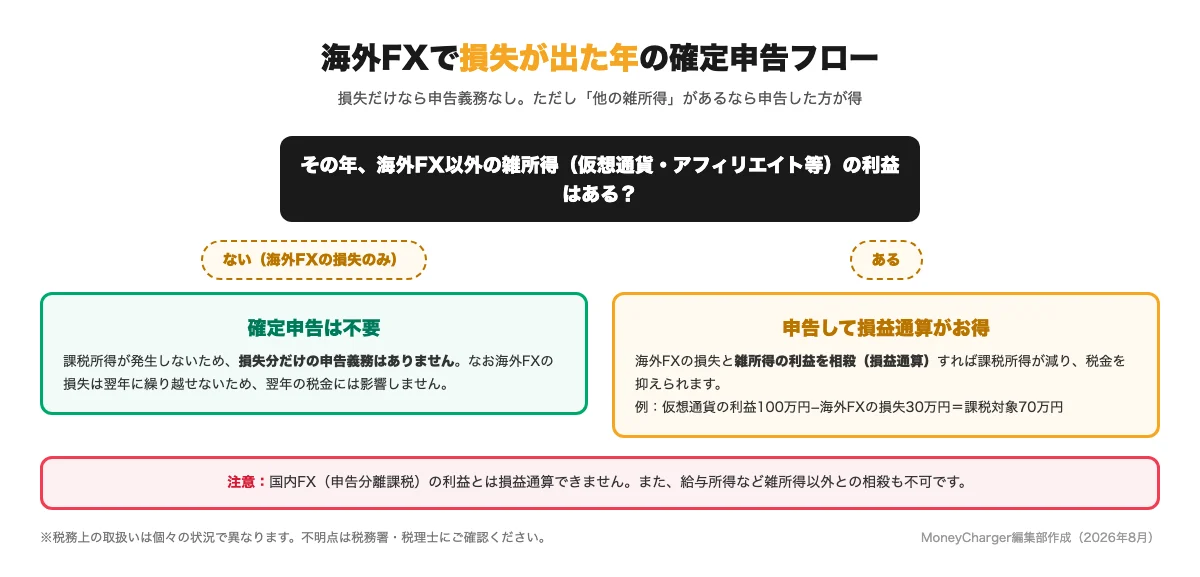
If you have any miscellaneous income that is generating a profit, you should also declare any losses on your tax return
If you have other miscellaneous income in addition to overseas forex trading, you should also include your overseas forex losses in your tax return.because offsetting profits and losses in the same year reduces your taxable income and thus the amount of income tax you pay.
| Example of offsetting gains and losses: Loss from overseas forex trading is approximately $1,875, and profit from cryptocurrency is approximately $6,250. → Calculate income tax on the remaining taxable income of approximately $4,375 after offsetting. |
However, losses cannot be offset against gains from domestic FX brokers
Because overseas forex trading and domestic forex trading are categorized differently in terms of income tax,profits and losses from both cannot be offset against each other. Overseas forex trading is subject to "comprehensive taxation," while domestic forex trading is subject to "separate taxation," and income tax is calculated separately for each category.
| Overseas FX | Domestic FX | |
|---|---|---|
| Tax classification | Comprehensive taxation | Separate taxation upon declaration |
| tax rate | 5%〜45% | 20.315% |
| Loss carryforward | Not possible | Possible (for 3 years) |
| Offsetting profits and losses | Possible with miscellaneous income | Possible in futures trading, etc |
For example, even if you have a loss of approximately $1,875 from overseas forex trading and a profit of approximately $6,250 from domestic forex trading, you cannot offset them, and taxes will be calculated on the domestic forex profit of approximately $6,250
Also, be aware that losses cannot be carried forward
Losses incurred in overseas forex tradingcannot be carried forward to subsequent years. Losses can only be offset against gains within the same year.
| If you incur losses in overseas forex trading, in the first year: a loss of approximately $1,875, and in the second year: a profit of approximately $6,250. Since losses cannot be carried forward, income tax will be calculated on approximately $6,250 in the second year. |
| If you incur losses in domestic FX trading, in the first year you will have a loss of approximately $1,875, and in the second year you will have a profit of approximately $6,250. Since you can carry forward losses for three years, in the second year you will calculate income tax on approximately $4,375, which is approximately $6,250 minus approximately $1,875. |
Furthermore, if you trade through a corporate account, you can carry forward losses . If you are looking to make large profits, please also refer to " Timing and Method of Incorporating for Overseas Forex Trading ."
You are required to file a tax return if your income exceeds approximately $1,250 for salaried employees and approximately $3,625 for non-salaried employees
If your profits from overseas forex trading exceed a certain amount, you will need to file a tax return. The threshold is as follows:
| Salaried employees(company employees, part-time workers, etc.) | If your annual income other than salary exceeds approximately $1,250 |
| Non-salaried individuals(self-employed individuals, housewives, students, etc.) | If your total annual income, including overseas forex trading, exceeds approximately $3,625 (basic deduction amount for 2025 and beyond) |
When determining whether you need to file a tax return, you should include miscellaneous income other than overseas forex trading (such as cryptocurrency and affiliate marketing). If you have other sources of income, be sure to combine them before checking
In some cases, those with low salary income may not need to file a tax return
Individuals with low annual salary income, such as those working part-time or on a casual basis, may not need to file a tax return even if they make profits from overseas forex trading. The 2025 tax reform increased the minimum guaranteed salary income deduction to approximately $4,063 and the basic deduction to a maximum of approximately $5,938, thusexpanding the tax-free range.
| Example of part-time income of approximately $3,750 (for 2025 and beyond): Salary income approximately $3,750 - Salary income deduction approximately $4,063 = Salary income approximately $0.00. If profits from overseas forex trading are within the basic deduction of approximately $5,938 (if total income is approximately $8,250 or less), then taxable income is approximately $0.00 → No tax return is required. |
Additionally, pensioners are exempt from filing a tax return. If your total income from public pensions, etc., is approximately $25,000 or less (all subject to withholding tax) and your other income is approximately $1,250 or less, you are not required to file a tax return for that year
Tax-saving tips! Declaring expenses will lower your taxes
In overseas forex trading, you can deduct expenses incurred to generate profits from your earnings.The more expenses you claim, the lower your taxable income will be, and the more income tax you can reduce. The main examples of expenses that qualify are as follows:
- Purchase costs of computers and smartphones used for trading (percentage of which was used for trading)
- Communication costs and VPS contract fees for automated trading
- FX-related book costs and seminar participation fees (including transportation and accommodation expenses)
- Transaction fees and costs for equipment such as desks and chairs
Expenses unrelated to overseas forex trading, such as personal consumables, are not deductible. Whether an expense is actually recognized is at the discretion of the relevant tax office, so exclude any expenses for which you cannot provide a valid explanation when inquired. For more details, please see " List of Deductible Expenses for Overseas Forex Trading ."
It is also recommended to use various income deductions such as the spousal deduction
Utilizing various income deductions is an effective way to reduce income tax. The requirements for the main deductions changed as follows in the 2025 tax reform
| Spousal deduction | If your spouse's total income is approximately $3,625 or less (or approximately $7,688 or less if it's solely from salary), you can deduct up to approximately $2,375 from your income |
| Special spousal deduction | If your spouse's combined income is between approximately $3,625 and approximately $8,313, you can receive a certain amount of deduction depending on your income |
| Basic deduction | Approximately $3,625 (up to approximately $5,938 for 2025 and 2026, depending on income) |
In addition, medical expense deductions, social insurance premium deductions, life insurance premium deductions, and hometown tax donations (donation deductions) can also be deducted from taxable income. * Please note that the special deduction for blue-form tax returns (maximum approximately $4,063) applies to business income, etc., and does not apply to profits from overseas forex trading (miscellaneous income) itself
The overall picture of tax-saving strategies is explained in detail in " 7 Tax-Saving Strategies for Overseas Forex Trading ."
Filing tax returns for profits and losses from overseas forex trading: Required documents and how to fill them out

From here, we will explain the procedures and how to fill out the necessary documents for filing a tax return for profits and losses from overseas forex trading
Tax returns are generally filed from February 16th to March 15th
In principle, income tax returns for overseas forex trading are filed between February 16th and March 15th of the following year, and income tax is paid at that time. There are three methods of submission:
- File your tax return via e-Tax (you can complete the process on your smartphone if you have a My Number Card)
- Send it to the tax office by mail or courier service
- Take it to the tax office and submit it
The required documents are the first and second pages of the "Tax Return Form" plus supporting documents
The following documents are required for filing your tax return for overseas forex trading. Please note that the previous distinction between "Tax Return Form A" and "Tax Return Form B" has been abolished for tax returns filed from 2023 onwards, and has been consolidated into a single "Tax Return Form."
- Tax return form (Form 1 and Form 2): The main part where you record your income, earnings, deductions, and tax amount.
- Identity verification documents: My Number Card, etc.
- Withholding tax slip(for those with salary income): Use the information on the slip for transcription (attachment is not required).
- Annual trading report: Output from MT4/MT5. Attachment is not required, but please keep it for calculation purposes.
- Expense receipts and various deduction certificates: Even those that do not require attachment must be kept for 5 years.
A common mistake: The "Calculation Statement for Miscellaneous Income, etc., Related to Futures Trading" is a document specifically for separate taxation (domestic FX and futures trading, etc.). It is not used for overseas FX, which is subject to comprehensive taxation. Please be careful, as using it incorrectly will result in an incorrect tax classification in your declaration
Profits and losses from overseas forex trading should be recorded in the "Miscellaneous Income (Other)" column
Profits and losses from overseas forex trading should be recorded in the "Miscellaneous Income (Other)" section of your tax return . Here are some key points on how to fill it out:
| Table 2: "Breakdown of Income" | For each overseas forex broker, list the broker name (where the income is generated) and the amount of income. For salary income, transcribe the information from your withholding tax statement |
| Table 1, "Miscellaneous (Other)" column | This section lists the income from overseas forex trading and the net income after deducting expenses. If you have multiple overseas forex brokers or other miscellaneous income, please include the total amount |
| Table 2: "Matters concerning resident tax" | If you don't want your company to find out about your side job, choose "Pay yourself (ordinary collection)" |
If you offset losses against other miscellaneous income in the year of the loss,the net amountshould be recorded as miscellaneous income. Note that miscellaneous income cannot be offset against other income categories (such as salary income), so if the total miscellaneous income is negative, it will be treated as approximately $0.00.
If you're unsure, the "Tax Return Preparation Corner" is the safest option
Rather than searching for the correct fields on the form yourself, using the National Tax Agency's tax return preparation corner will automatically fill in the correct fields as you follow the on-screen instructions. Instructions with screenshots are explained in the tax return section of the "Overseas Forex Tax Guide," so please refer to that as well.
Q&A regarding losses from overseas forex trading and tax filing

Here are five frequently asked questions regarding losses from overseas forex trading and filing tax returns
Q. When do taxes on overseas forex trading begin?
The total profit or loss realized after closing a position is subject to taxation. Unrealized gains and losses that are not yet settled are not subject to taxation. Swap points are subject to taxation when they are settled and reflected in the account
Please note that you will need to file a tax return if, for salaried employees, your annual income from sources other than salary exceeds approximately $1,250, and if, for non-salaried employees, your total annual income exceeds approximately $3,625 (for the year 2025 and beyond)
Q. When will my company find out about my income from overseas forex trading?
The two main reasons are that "resident tax becomes unusually high compared to your main job income" and "the information might spread to your colleagues.""self-payment (ordinary collection)"as the method of collecting resident tax when filing your tax return, you can reduce the risk of your company finding out about the change in your resident tax. However, not all municipalities offer this option, so be sure to check with your local city hall before filing.
Q. Which has higher taxes, overseas forex trading or domestic forex trading?
Looking at marginal tax rates, the tax rate for overseas forex trading (comprehensive taxation) exceeds 20.315% for domestic forex trading once taxable income exceeds approximately $20,625. For income solely from overseas forex trading, the tax-paying break-even point is approximately $30,000. (Calculations for 2025 and beyond, applying only the basic deduction of approximately $3,625 (resident tax approximately $2,688), including the special reconstruction income tax.)
| annual income | Overseas FX (income tax + resident tax 10%) | Domestic FX (income tax + resident tax 5%) |
|---|---|---|
| approx. $9,375 | Approximately $962.50 | Approximately $1,215 |
| approx. $20,625 | Approximately $2,908 | Approximately $3,501 |
| approx. $31,250 | Approximately $5,769 | Approximately $5,659 |
| approx. $56,250 | Approximately $13,656 | Approximately $10,738 |
| approx. $112,500 | Approximately $37,863 | Approximately $22,165 |
For a detailed comparison, please see " Differences between Overseas Forex and Domestic Forex ."
Q. Are there any loopholes in the tax system?
No, there isn't. Japanese tax authorities can track income earned overseas through overseas remittance reports and the CRS (Common Reporting Standard). If non-filing is discovered, a 15-20% penalty tax will be imposed, and a heavy penalty tax of 35-40% will be levied for serious negligence such as concealing income. For ways to legally reduce your tax burden, please see " 7 Tax-Saving Strategies for Overseas Forex Trading ."
Q. How do I file my tax return for a dollar-denominated account?
If you make a profit in a dollar-denominated account, you need to convert it to yen and file your tax return. As a general rule, the conversion is done using the mid-rate (TTM: the midpoint rate between the telegraphic selling rate and the telegraphic buying rate) for each trading day ( National Tax Agency | Conversion of Foreign Currency Transactions ).
Converting between daily transactions is quite time-consuming for individuals, so those unfamiliar with dollar-denominated transactions are advised to use yen-denominated accounts. If you have any questions, consult a tax accountant or other professional
Summary: You don't need to file a tax return if you only have losses. However, it's advantageous to file a return in years when you can offset gains and losses
Finally, let's review the key points regarding filing your tax return for a year in which you incurred losses from overseas forex trading
- There is no obligation to declare losses from overseas forex trading in a given year (losses cannot be carried forward to the following year)
- If you have other miscellaneous income (such as from cryptocurrency or affiliate marketing), it is more advantageous to declare it in order to offset losses against gains
- Domestic FX (separate taxation) cannot be used for offsetting gains and losses
- Tax filing thresholds: For salaried employees, annual income exceeding approximately $1,250; for non-salaried employees, annual income exceeding approximately $3,625 (for the year 2025 and beyond)
- The required documents for filing are the first and second pages of the "Tax Return Form." Overseas forex trading should be listed in the "Miscellaneous Income (Other)" section, and the calculation statement for futures trading should not be used
Years with losses are precisely the time to review your trading costs.By using a cashback site,you can effectively lower your trading costs because a portion of the spread is returned to you in cash every time you trade, regardless of whether you win or lose.
\ Win or lose, get cash back with every trade! /