













While there are no "loopholes" in overseas forex taxation, there are seven legal tax-saving strategies to reduce your tax burden.Since profits from overseas forex are subject to comprehensive taxation (with a maximum tax rate of 45%),the amount of tax you pay will vary significantly depending on whether you utilize expense deductions, loss offsetting, and various other deductions.
For those who feel that "Overseas Forex taxes are too high...", this article explains everything from the basics of overseas Forex taxes to 7 tax-saving strategies (tax strategies) that salaried employees and sole proprietors can use, and how to avoid getting caught by your company, all based on the latest rules that are in line with the 2025 tax reform (raising the basic deduction to approximately $3,625)
Conclusion | Key Points for Tax Savings in Overseas Forex Trading
- There are no loopholes for tax evasion: Tax authorities can track overseas income through overseas remittance reports and CRS (Common Reporting Standard). Penalties for non-declaration can reach up to 40%.
- There are seven legitimate ways to reduce taxes: expense accounting, offsetting losses against miscellaneous income, various income deductions, hometown tax donations, profit adjustments, settlement timing, and incorporation.
- The tax break point between domestic and overseas FX: Based on the marginal tax rate, a taxable income of approximately $20,625 is a rough guideline (if only income from overseas FX is earned, the tax amount is approximately $30,000).
The tax rates, calculation methods, and overall process of filing your tax return are explained in detail in " How Much Tax Do You Have to Pay on Overseas Forex Trading? Tax Rates, Calculation Methods, and How to File Your Tax Return," supervised by a certified tax accountant
*This article was created and updated by the MoneyCharger editorial team in accordance with their content creation policy . Tax information such as tax rates and deductions was confirmed using publicly available materials from the National Tax Agency , and points to note regarding the use of overseas FX brokers were also confirmed using publicly available information from the Financial Services Agency . Since tax treatment varies depending on individual circumstances, please check with the tax office or a tax accountant before taking any action.
Before you start tax-saving strategies with overseas forex trading! Essential tax knowledge you should know

Before considering tax-saving strategies, let's first understand the tax system for overseas forex trading.The effectiveness of each strategy depends on this foundation.
Taxes are levied on profits
Taxes on overseas forex trading are calculated based on profits realized between January 1st and December 31st of that year. Those who have made a profit are generally required to file a tax return between February 16th and March 15th of the following year
Profits from overseas forex trading aretreated as miscellaneous income and aresubject to "comprehensive taxation," meaning they are combined with other income such as salary income to calculate the tax amount. On the other hand, domestic forex trading is subject to separate taxation (a flat rate of 20.315%), so the tax system is completely different.
You will need to file a tax return for profits from overseas forex trading in the following cases:
| Salaried employees | If your annual income other than salary exceeds approximately $1,250 |
| Non-salaried workers | If your total annual income, including overseas forex trading, exceeds approximately $3,625 (basic deduction amount for 2025 and beyond) |
The annual income required for filing your tax return includes miscellaneous income other than overseas forex trading (such as cryptocurrency and affiliate marketing). If you have other sources of income, be sure to combine them for your calculation
Overseas forex trading is subject to a "progressive tax system" where the tax rate increases the more you earn
Income tax on overseas forex trading is subject to a progressive tax system , where the tax rate increases as taxable income increases. There are seven tax brackets depending on taxable income
| Taxable income | tax rate | Deduction amount |
|---|---|---|
| approx. $6.25 ~ approx. $12,181 | 5% | approx. $0.00 |
| approx. $12,188 ~ approx. $20,619 | 10% | approx. $609.38 |
| approx. $20,625 ~ approx. $43,431 | 20% | approx. $2,672 |
| approx. $43,438 ~ approx. $56,244 | 23% | approx. $3,975 |
| approx. $56,250 ~ approx. $112,494 | 33% | approx. $9,600 |
| approx. $112,500 ~ approx. $249,994 | 40% | approx. $17,475 |
| Approximately $250,000 or more | 45% | approx. $29,975 |
On the other hand, the tax rate on domestic FX is uniform regardless of the amount of income (income tax 15% + local inhabitant tax 5% + reconstruction special income tax 0.315% =20.315%)。
The break-even point for taxes on overseas and domestic forex trading
Looking at marginal tax rates, ifyour taxable income exceeds approximately $20,625, the tax rate on overseas forex trading (20% income tax + 10% local tax) clearly exceeds the 20.315% rate for domestic forex trading. For those with salary income and who use the basic deduction on their salary side, this "approximately $20,625" is a practical guideline.
On the other hand, if the income is solely from overseas forex trading,the tax-paying thresholdis approximately $30,000 due to the effects of basic and quick calculation deductions. Below is a comparison of tax amounts by annual income. (For 2025 and later; income from overseas or domestic forex trading only; only the basic deduction of approximately $3,625 (local tax is approximately $2,688) is applied; includes reconstruction special income tax; flat-rate tax and other deductions are omitted.)
| annual income | Overseas FX (income tax + resident tax 10%) | Domestic FX (income tax + resident tax 5%) |
|---|---|---|
| approx. $9,375 | Approximately $962.50 | Approximately $1,215 |
| approx. $20,625 | Approximately $2,908 | Approximately $3,501 |
| approx. $31,250 | Approximately $5,769 | Approximately $5,659 |
| approx. $43,438 | Approximately $9,477 | Approximately $8,135 |
| approx. $56,250 | Approximately $13,656 | Approximately $10,738 |
| approx. $112,500 | Approximately $37,863 | Approximately $22,165 |
As mentioned above, if your income consists solely of overseas forex trading, your tax burden will be lower with domestic forex trading once your annual income reaches approximately $31,250. However, the actual break-even point will vary depending on how you utilize the various deductions and expenses discussed later, so please consider this only as a guideline
For a comprehensive overview of taxes, including how to calculate income tax and resident tax, please see " How much tax do I have to pay on overseas forex trading? Tax rates, calculation methods, and how to file your tax return ."
Unrealized gains and losses are not subject to taxation
Only realized gains and losses aresubject to taxation; unrealized gains and losses are not taxable. Realized gains and losses refer to profits and losses that have been confirmed by closing out held positions.
Please note that swap points, which are received from the interest rate difference between the currencies being bought and sold, will be subject to taxation when the transaction is settled and reflected in your account
However, cashback is subject to taxation
Cashback received from overseas forex brokers and cashback sites for opening an account or trading is also subject to taxation.As it is income earned continuously in connection with trading, itis generally subject to comprehensive taxation as "miscellaneous income" and is combined with the profits and losses from overseas forex trading in the same category.
Details on taxes and tax filing for cashback are explained in " Do I need to file a tax return for cashback from overseas forex trading? "
Please note that losses cannot be carried forward
Losses incurred in overseas forex trading cannot be carried forward to subsequent years to offset future profits
| If you incur losses in overseas forex trading, in the first year: a loss of approximately $1,875, and in the second year: a profit of approximately $6,250 . Since losses cannot be carried forward, taxes will be calculated on approximately $6,250 in the second year. |
| If you incur a loss in domestic FX trading, in the first year you will have a loss of approximately $1,875, and in the second year you will have a profit of approximately $6,250. Since you can carry forward losses for three years, in the second year you will calculate taxes on approximately $4,375, which is approximately $6,250 minus approximately $1,875. |
However, within the same year, it is possible to offset gains and losses between multiple overseas forex brokers and with other miscellaneous income (see Tax Saving Measures ② for details). For information on filing a tax return in a year in which losses were incurred, please see " Do I need to file a tax return for losses from overseas forex trading? "
7 Tax-Saving Strategies for Overseas Forex Trading
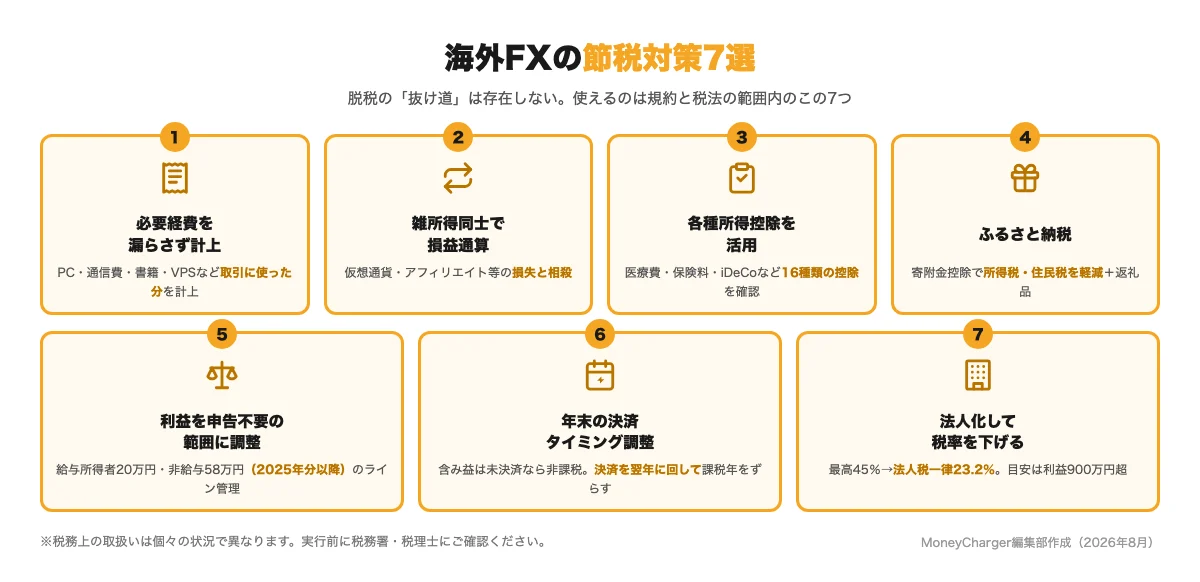
There are seven ways to legally reduce taxes on overseas forex trading.All of these are legitimate methods that can be used within the bounds of the terms and conditions and tax laws, and the more you combine them, the more effective they become.
① Record all necessary expenses without fail
Since profits from overseas forex trading are calculated as "income - necessary expenses,"simply by accurately recording all expenses, you can directly reduce your taxable income. The main examples of expenses are as follows:
- Purchase costs of computers and smartphones used for trading (percentage of which was used for trading)
- Communication fees and VPS contract fees
- FX-related book expenses and seminar participation fees (including transportation costs)
- Transaction fees and costs for equipment such as desks and chairs
For items such as computers, rent, and communication fees, only the portion used for overseas forex trading is eligible , not the full amount . Keep records of usage time. Also, expensive equipment costing approximately $625.00 or more should be expensed over several years (depreciation).
| Cost of purchasing a smartphone or computer | Distribution method |
|---|---|
| Approximately less than $625.00 | Lump-sum accounting |
| Approximately $625.00 or more, and less than approximately $1,250 | Accounted over three years |
| Approximately $1,250 or more | Accounted over four years |
Details on what can and cannot be deducted as expenses are explained in " List of expenses that can be deducted in overseas forex trading ."
② Offset losses against other miscellaneous income
If you have other miscellaneous income gains or losses besides those from overseas forex trading,offset those gains and losses against each other. This will reduce your taxable income.
| Example of offsetting gains and losses: If you have a profit of approximately $9,375 from overseas forex trading and a loss of approximately $6,250 from cryptocurrency trading , you can calculate income tax on the remaining taxable income of approximately $3,125. |
If you use multiple overseas forex brokers, you can offset profits and losses across accounts. However, please note that you cannot offset profits and losses with domestic forex (which is subject to separate taxation) as it falls under a different income category
③ Utilize various income deductions
There are 16 types of income deductions , including medical expense deductions, social insurance premium deductions, life insurance premium deductions, and iDeCo (small business mutual aid contribution deduction) . The more deductions you can apply, the lower your taxable income will be, and the more you can reduce both income tax and resident tax.
The 2025 tax reform increased the basic deduction from approximately $3,000 to approximately $3,625 (up to approximately $5,938 depending on income) , making the deduction more effective than before. For a list and details of deductions, please see the tax saving section of the " Overseas Forex Tax Guide "
④ Utilize the Furusato Nozei (hometown tax donation) system
In years when you make a profit from overseas forex trading,the maximum amount you can donate through the Furusato Nozei (hometown tax donation deduction) program also increases. This is a classic strategy to reduce your income tax and resident tax while receiving return gifts for a net cost of approximately $12.50.
Please note that the one-stop special exemption system cannot be used in years when you have profits from overseas forex trading. Therefore, please apply for the donation deduction by filing a tax return together with your forex income
⑤ Adjust profits to be within the dependent allowance limit or to an amount that does not require reporting
By keeping your profits within the range that does not require filing a tax return and within the range for dependents, you can avoid paying taxes altogether.The thresholds for 2025 and beyondare as follows:
| No tax return is required (for salaried employees) | Keep your annual income other than salary to approximately $1,250 or less |
| No tax return required (for non-salaried employees) | Keep your total annual income to approximately $3,625 or less |
| To receive a spousal deduction | Keep your spouse's total income to approximately $3,625 or less (equivalent to approximately $7,688 if it's salary income) |
| Receiving a special spousal deduction | Keep your spouse's total income between approximately $3,625 and approximately $8,313 |
However, in many cases, earning more is more advantageous in terms of net income than suppressing profits for tax purposes. If you're unsure right before making a decision, compare the net income figures
⑥ Adjust the timing of year-end settlements
Since tax is levied on "profits and losses that have been settled and realized,"if you postpone the settlement of positions with large unrealized gains at the end of the year until the following year,you can postpone taxation by one year. If you already have large profits this year, this has the effect of shifting those profits to a year with a lower tax rate.
Conversely, if you close and realize a position with unrealized losses before the end of the year, you can offset it against your profits for that year. However, distorting your market judgment solely for tax purposes would be counterproductive, so consider this only as one option
⑦ Incorporate to lower your tax rate
Once your profits start to grow, incorporating your business becomes the most effective tax-saving strategy.While the top individual tax rate is 45%, the corporate tax rate is a flat 23.2%. Furthermore, you'll have more expense categories, such as executive compensation, and you'll be able to carry forward losses.
On the other hand, there are fixed costs such as registration fees and tax accountant fees, and executive compensation is bound by rules such as regular fixed salaries, making it difficult to freely withdraw money. The break-even point is approximately $56,250 in annual profit . For more details, please see " Timing and Method of Incorporating an Overseas Forex Business ."
Will my company find out about my overseas forex trading? Or will they not?

In conclusion,if you don't take precautions, there's a high probability your company will find out. Companies track employees' tax amounts through year-end tax adjustments, and if your resident tax increases while your salary remains the same, they'll suspect you have a side job (like overseas forex trading).This increase in resident tax is the most likely reason your company will find out.
In addition, large profits can change one's sense of money, which can be noticed by colleagues
Measures to prevent your company from finding out about your overseas forex trading
- To choose "ordinary collection (self-payment)" as the method of collecting resident tax: Select this when filing your tax return. If it's deducted from your salary (special collection), your company will be notified.
- Don't suddenly raise your standard of living: This is the biggest factor that will make people around you notice.
- By claiming expenses and keeping your income below approximately $1,250, you may not even need to file a tax return.
- I don't tell my colleagues about my side job
Even if you select "pay yourself," your taxes may be mistakenly processed as special collection, so it's best to confirm with your local city hall after filing your tax return. Detailed instructions, including screenshots, are provided in the tax return section of the " Overseas Forex Tax Guide ."
Q&A regarding tax savings in overseas forex trading

Here are four frequently asked questions regarding tax savings in overseas forex trading
Q. Are there any loopholes in paying taxes?
There are no loopholes when it comes to paying taxes.Japanese tax authorities can track income earned overseas through systems such as overseas remittance reports and the CRS (Common Reporting Standard).
Report on Overseas Remittances, etc.: A system that allows tax authorities to track remittances from overseas to domestic accounts.
CRS: An international information exchange system to prevent tax evasion and avoidance using foreign financial institutions.
If it is discovered that youhave not filed a tax return, in addition to the original tax amount, a penalty tax of 15-20%for failure to file, late payment penalties will be imposed for late payments, and a heavypenalty tax of 35-40%will be imposed if there is serious negligence such as concealing income. Always file a tax return if you have made a profit, and use the seven legitimate methods outlined in this article to minimize your taxes.
Q. Do I need to file a tax return for losses?
If your overseas forex trading results in a net loss for the year, you are not obligated to declare that loss on your tax return. However,if you have other miscellaneous income, itis advantageous to declare it to offset the loss. For example, if you offset a loss of approximately $1,875 from overseas forex trading with a profit of approximately $6,250 from cryptocurrency trading, you can reduce your taxable income to approximately $4,375.
Q. How will I pay my resident tax?
Profits from overseas forex trading are subject to local inhabitant tax (income-based tax, tax rate 10%). If you file an income tax return, you do not need to file a local inhabitant tax returnHowever, even if you do not file an income tax return, youare required to file a local inhabitant tax return with your municipality if your profit is even approximately $0.01. In addition, local inhabitant tax also includes a flat-rate portion (usually around $31.25) regardless of income.
Q. Are computers and smartphones considered business expenses?
Computers and smartphones used for overseas forex trading can be claimed as business expenses. If used exclusively for forex, the full amount is deductible; if used for both personal and business purposes,only the proportion of usageis deductible. Similarly, communication expenses should be prorated based on records of usage time, etc. Note that items costing approximately $625.00 or more are subject to depreciation (accounted for over multiple years).
Tax calculations and simulations for salaried employees based on annual income are explained in detail in our article on taxes for overseas FX trading for salaried workers
Summary: Tax saving should be done using the straightforward method of "expenses x deductions x loss offsetting". Don't forget to double-dip on cashback
There are no loopholes when it comes to taxes on overseas forex trading, butby combining expense deductions, loss offsetting, and various other deductions, you can legally significantly reduce your tax liability. Let's summarize the key points one last time.
- Overseas forex trading is subject to comprehensive taxation (progressive taxation). The dividing line between overseas forex and domestic forex is a taxable income of approximately $20,625
- The basics of tax saving are "recording all expenses without fail," "offsetting gains and losses from miscellaneous income," and "16 types of income deductions."
- The threshold for not needing to file a tax return: Approximately $1,250 per year for salaried employees and approximately $3,625 per year for non-salaried employees (for the year 2025 and beyond)
- Losses cannot be carried forward. The tax year can be controlled at the time of settlement at the end of the year
- If annual profits reach approximately $56,250, we will consider incorporating the business
Furthermore, just as effective as "reducing" taxes is "recovering" transaction costs.By using a cashback site, a portion of the spread is returned to you in cash with every trade. Maximize the money you have left over by taking advantage of both tax savings and cashback.
\ Reduce your actual costs in conjunction with tax savings, and get cash back with every transaction! /