













Overseas forex trading offers the potential for large profits through high leverage. However, overseas forex trading is subject to a "comprehensive taxation" category, meaning that taxes tend to increase as income increases
This articleprovides a detailed explanation of taxes and tax filing methods related to overseas forex trading.
This article explains how to calculate taxes and the differences in taxes between overseas and domestic FX trading, so please refer to it if you have any questions about taxes on overseas FX trading
This article should answer all your questions regarding taxes on overseas forex trading. Please read it to the end
Supervisor of this article

Tax accountant
Hirakawa Fumina (Nekokoro)
While a student at Kyoto University, I began studying for the Certified Public Tax Accountant (CPA) exam. In December 2018, I passed all three tax law subjects (corporate, consumption, and national tax collection) simultaneously,my CPA qualificationofficial gazette recognition. From September 2018, I worked for two years at KPMG Tax Corporation, one of the Big Four CPA firms, where I was one of the few young and female employees, engaging in a wide range of tasks including tax due diligence and advisory services. In September 2020, I moved to Boston Consulting Group, a foreign-owned strategic consulting firm, where I engaged in a wide range of tasks from strategy formulation to implementation support. In December 2024, I became a freelance consultant, engaging in consulting and writing services.
Conclusion | Key Points Regarding Taxes on Overseas Forex Trading
- Profits from overseas forex trading are classified as "miscellaneous income" subject to comprehensive taxation: 5-45% income tax (progressive) + 10% local inhabitant tax + special reconstruction income tax.
- Tax return thresholds: For salaried employees, income other than salary must exceed 200,000 yen per year; for non-salaried employees, income must exceed 580,000 yen per year (for the 2025 tax year and beyond).
- There are no loopholes: Tax authorities can track overseas income through overseas remittance reports and CRS (Common Reporting Standard). Penalties for non-declaration can reach up to 40%.
The 2025 tax reform increased the basic deduction from 480,000 yen to 580,000 yen (up to 950,000 yen depending on income) . This article explains the latest rules after the reform. For specific tax-saving measures, please also see " Summary of Tax-Saving Measures for Overseas Forex Trading ," and for details on the filing procedure, please see " How to File Your Tax Return ."
*This article was created by the MoneyCharger editorial team in accordance with our content creation policy and is published and updated under the supervision of a certified tax accountant. Tax information such as tax rates and deductions was confirmed using publicly available materials from the National Tax Agency , and points to note regarding the use of overseas FX brokers were also confirmed using publicly available information from the Financial Services Agency . Since tax laws can be amended, please check the latest information from the National Tax Agency website, tax office, or certified tax accountant when filing your tax return.
Taxes are incurred on profits made in overseas forex trading
In overseas forex trading, taxes are incurredat the time of profit.
Furthermore, there are no tax loopholes even if you make a profit from overseas forex trading. If you try to evade taxes, the tax authorities will find out, so anyone who makes a profit above a certain amount must file a tax return
Below, we will explain the reasons why tax evasion is discovered and what happens if you fail to pay your taxes
- Are there any loopholes in the taxes on overseas forex trading? Why tax evasion gets discovered
- What happens if you don't pay taxes on your overseas forex trading?
Are there any loopholes in the taxes on overseas forex trading? Why tax evasion gets discovered
In conclusion,there are no loopholes when it comes to taxes on overseas forex trading.
Even if you use an overseas forex broker with a base abroad, if you make a profit above a certain amount and fail to pay taxes, the tax authorities will inevitably find out that you are evading taxes
This is becauseJapanese tax authorities can track income generated overseas through overseas remittance reports and the CRS (Common Reporting Standard).
Report on Overseas Remittances, etc.: A notification to the tax office when profits earned from overseas forex trading are deposited into a domestic account for use in Japan.
CRS: A system to prevent tax evasion and tax avoidance using foreign financial institutions, etc.
Furthermore, individual tax audits are not conducted immediately, but rather every 5 to 10 years. This is because the longer the period of tax evasion, the easier it becomes to collect more taxes
In other words, "no tax audit" does not mean that your tax evasion hasn't been discovered. If you make a profit above a certain amount, you must file a tax return
What happens if you don't pay taxes on your overseas forex trading?
you are required tofile a tax return but fail to do so, it may be considered tax evasion, andyou could face severe penalties.
- Failure to declare income will result
in a penalty tax of 15% to 20%. - If you file or pay taxes after the deadline,
a late payment penalty of 2.4% to 14.6% will - In cases of serious negligence such as concealing income, a heavy
penalty tax of 35% to 40% will be imposed. - If the filing deadline is missed, or if there are missing documents or concealment,
the approval for blue return filing may be revoked or special deductions may be reduced.
If you have other miscellaneous income besides overseas forex trading (such as cryptocurrency trading or affiliate income), you should combine it with your overseas forex profits and file your tax return accordingly
Taxes, tax rates, and calculation methods for overseas forex trading
Below, we will explain the taxes, tax rates, and calculation methods related to overseas forex trading
- Taxes and tax rates on overseas forex trading
- How to calculate taxes on a 10 million yen profit from overseas forex trading
Taxes and tax rates on overseas forex trading
The taxes on overseas forex trading consist of two types: "income tax" and "resident tax."
Below, we will introduce the details and tax rates for each tax
① Income tax
Income tax is a tax levied on an individual's income. The tax amount is calculated by applying a tax rate to the taxable income, which is the remaining income after deducting income deductions from all income earned during the year.
(Source:National Tax Agency | Income Tax System)
Income is classified into eight categories, and profits from overseas forex trading fall under "miscellaneous income."
- Interest income
- Dividend income
- Real estate income
- business income
- Salary income
- Capital gains
- temporary income
- Miscellaneous income
overseas forex tradingcomprehensive taxation, if you have other income in addition to your overseas forex profits, you will need to combine them to calculate your income tax.
Comprehensive taxation is a system where the tax rate increases with higher income. Details are as shown in the quick reference table below
| Taxable income | tax rate | Deduction amount |
|---|---|---|
| From 1,000 yen to 1,949,000 yen | 5% | 0 yen |
| From 1,950,000 yen to 3,299,000 yen | 10% | 97,500 yen |
| From 3,300,000 yen to 6,949,000 yen | 20% | 427,500 yen |
| From 6,950,000 yen to 8,999,000 yen | 23% | 636,000 yen |
| From 9,000,000 yen to 17,999,000 yen | 33% | 1,536,000 yen |
| From 18,000,000 yen to 39,999,000 yen | 40% | 2,796,000 yen |
| Over 40,000,000 yen | 45% | 4,796,000 yen |
Furthermore, with the 2025 tax reform (Reiwa 7 reform), the basic deduction was raised from 480,000 yen to 580,000 yen (for those with a total income of 23.5 million yen or less) . If your annual income is 580,000 yen or less, you will not be subject to income tax . In addition, for the 2025 and 2026 tax years, there is a special provision that allows for an additional basic deduction of up to 950,000 yen depending on your income (see the basic deduction table below).
②Resident tax
Income tax is only levied if profits exceed a certain amount,local inhabitant tax must be paid even if profits are only 1 yen.
The local tax rate for overseas forex tradinga flat 10%.
If you file a tax return, you do not need to file a resident tax return. However, if you do not file a tax return and have made a profit of 1 yen or more from overseas forex trading, you will need to file a resident tax return with your local municipality
How to calculate taxes on a 10 million yen profit from overseas forex trading
The following is how to calculate taxes on an income of 10 million yen earned through overseas forex trading. (For the year 2025 and later; only the basic deduction applies; no necessary expenses. Resident tax is calculated using the basic deduction of 430,000 yen, and flat-rate taxes are omitted.)
| [Income Tax Calculation Formula] 10 million yen (profit) - 580,000 yen (basic deduction) = 9.42 million yen (taxable income) 9.42 million yen (taxable income) × 33% (tax rate) - 1,536,000 yen (quick calculation deduction) = 1,572,600 yen |
| [Calculation formula for local tax] 10 million yen (profit) - 430,000 yen (basic deduction for local tax) = 9.57 million yen (taxable income) 9.57 million yen (taxable income) × 10% (tax rate) = 957,000 yen |
| [Calculation formula for the special reconstruction income tax] 1,572,600 yen (income tax amount) × 2.1% (tax rate) = 33,024.6 yen |
| [Total Tax Amount] 1,572,600 yen (income tax) + 957,000 yen (resident tax) + 33,024.6 yen (special reconstruction income tax) = approximately 2,562,625 yen |
Differences in tax rates between overseas and domestic forex trading
Below, we will explain the differences in tax rates and break-even points between overseas and domestic forex trading
- Which is cheaper in terms of taxes: overseas forex trading or domestic forex trading?
- What is the tax break point between overseas and domestic forex trading?
- Differences in taxes between foreign exchange (FX) and cryptocurrency (Bitcoin) FX
Which is cheaper in terms of taxes: overseas forex trading or domestic forex trading?
First, the tax systems for overseas forex trading and domestic forex trading are significantly different
| Overseas FX | Domestic FX | |
|---|---|---|
| Tax classification | Comprehensive taxation | Separate taxation upon declaration |
| tax rate | 5%〜45% | 20.315% |
| Loss carryforward | Not possible | Possible |
| Offsetting profits and losses | Possible | Possible |
Forex trading, whether conducted overseas or domestically, is treated as "miscellaneous income" for tax purposes. However, domestic forex trading falls under the "special provisions for taxation of miscellaneous income, etc., related to futures trading," so the tax amount is calculated separately from other income. This is called " separate taxation ."
The tax rates for separate taxation are as follows, and are uniform regardless of the amount of income
| Separate taxation based on declaration: Income tax 15% + Local inhabitant tax 5% + Reconstruction special income tax 0.315% = Total20.315% |
On the other hand, overseas forex trading is subject to "comprehensive taxation," where it is combined with other income to calculate the amount of tax payable, and the tax rate increases according to the amount of income (progressive tax rate)
| Taxable income | tax rate | Deduction amount |
|---|---|---|
| From 1,000 yen to 1,949,000 yen | 5% | 0 yen |
| From 1,950,000 yen to 3,299,000 yen | 10% | 97,500 yen |
| From 3,300,000 yen to 6,949,000 yen | 20% | 427,500 yen |
| From 6,950,000 yen to 8,999,000 yen | 23% | 636,000 yen |
| From 9,000,000 yen to 17,999,000 yen | 33% | 1,536,000 yen |
| From 18,000,000 yen to 39,999,000 yen | 40% | 2,796,000 yen |
| Over 40,000,000 yen | 45% | 4,796,000 yen |
The highest tax rate is 45% for overseas forex trading, and the tax rate increases with income, so it can be said that domestic forex trading is tax-advantaged
What is the tax threshold between overseas and domestic forex trading? [The guideline is a taxable income of 3.3 million yen]
Looking at marginal tax rates,if your taxable income exceeds 3.3 million yen, the tax rate on overseas forex trading (20% income tax + 10% local tax) clearly surpasses the 20.315% rate for domestic forex trading. For those with salary income and who use the basic deduction on their salary side, this "3.3 million yen" is a practical guideline.
The table below shows estimated taxes on overseas and domestic forex trading based on annual income. (Foreign forex trading from 2025 onwards; only income from overseas or domestic forex trading is included; only the basic deduction of 580,000 yen (430,000 yen for local inhabitant tax) applies; includes reconstruction special income tax; flat-rate tax and other taxes are omitted.)
| annual income | Overseas FX (income tax + resident tax 10%) | Domestic FX (income tax + resident tax 5%) |
|---|---|---|
| 1.5 million yen | Approximately 154,000 yen | Approximately 194,400 yen |
| 3.3 million yen | Approximately 465,200 yen | Approximately 560,100 yen |
| 5 million yen | Approximately 923,100 yen | Approximately 905,400 yen |
| 6.95 million yen | Approximately 1,516,300 yen | Approximately 1,301,600 yen |
| 9 million yen | Approximately 2,184,900 yen | Approximately 1,718,000 yen |
| 18 million yen | Approximately 6,058,100 yen | Approximately 3,546,400 yen |
As mentioned above, if your income is solely from overseas forex trading, the tax burden becomes lower with domestic forex trading once your annual income reaches around 5 million yen
While overseas forex trading offers advantages such as high leverage and zero-cut systems that eliminate margin calls, if we focus solely on taxes, the general guideline is that domestic forex trading becomes more advantageous when profits exceed 3.3 million yen for those with salary income, and approximately 4.8 million yen for those whose income comes solely from overseas forex trading
When deciding whether to use overseas or domestic forex trading, consider factors such as tax implications and ease of use
Differences in taxes between foreign exchange (FX) and cryptocurrency (Bitcoin) FX
The differences in taxes between foreign exchange (FX) and cryptocurrency FX are as follows:
| Overseas FX | Domestic FX | Cryptocurrency FX | |
|---|---|---|---|
| Tax classification | Comprehensive taxation | Separate taxation upon declaration | Comprehensive taxation |
| tax rate | 5%〜45% | 20.315% | 5%〜45% |
| Loss carryforward | Not possible | Possible | Not possible |
| Offsetting profits and losses | Possible | Possible | Possible |
As you can see from the table above,cryptocurrency FX issubject to the same tax classifications and tax rates as overseas FX.
If you trade both overseas forex and cryptocurrency forex, you may be able to offset your gains and losses, potentially reducing your tax burden
How much profit from overseas forex trading is subject to taxation?
Even if you make a profit from overseas forex trading, you won't be taxed on income up to a certain amount
The amount at which income becomes taxable varies depending on whether you are a salaried employee or a self-employed individual. Below, we will explain in detail how much profit is required to be taxed
- Profits from overseas forex trading are not eligible for year-end tax adjustments
- Cases where filing a tax return is required
- Cases in which filing a tax return is not required
- Unrealized gains and losses are not subject to taxation
Profits from overseas forex trading are not eligible for year-end tax adjustments
Year-end tax adjustment: The procedure for settling the amount of withholding tax deducted from salary and bonuses to match the annual tax amount
The amount of withholding tax deducted from your salary and bonuses is an approximate calculation, and the correct annual tax amount is determined through year-end adjustments
Therefore, salaried employees, such as company employees, complete their income tax filing and payment through their company's year-end tax adjustment process
However, year-end tax adjustments cover company salaries and other income,and income other than salary, such as profits from FX trading, is not subject to year-end tax adjustments.
Therefore, remember that if you make a certain amount of profit from FX trading, you will need to file your own tax return
Cases where filing a tax return is required
Below, we will explain the cases in which filing a tax return is required, divided into "salaried employees" and "non-salaried employees."
Salaried employees and other wage earners | Annual profit of 200,000 yen or more
Salaried employees and others who receive a salary are required to pay taxes if their income from overseas forex trading or other side jobs exceeds 200,000 yen per year
The following are the individuals and conditions under which you are required to file a tax return if you have made a profit from overseas forex trading
| Target audience | - Individuals who receive a salary from their employer, such as company employees, part-time workers, or temporary workers. - Individuals who have income from public pensions, etc |
| conditions | If your annual income other than salary exceeds 200,000 yen |
If you have income from other sources besides overseas forex trading (such as cryptocurrency trading or affiliate marketing), these will be combined and calculated together
Self-employed individuals, full-time housewives, and other non-salaried individuals | Annual income exceeding 580,000 yen
Individuals who are not employed, such as self-employed individuals or full-time housewives, are required to file a tax return if their total annual income, including income from overseas forex trading, exceeds 580,000 yen (the basic deduction amount from 2025 onwards)
| Target audience | Self-employed individuals, housewives, students, unemployed people, and others who do not receive a salary |
| conditions | If your total annual income, including income from overseas forex trading, exceeds 580,000 yen (for the year 2025 and beyond) |
Furthermore, the basic deduction for income tax is 580,000 yen from 2025 onwards (for those with total income of 23.5 million yen or less), so if your annual income is 580,000 yen or less, your taxable income will be 0 yen and you will not need to file a tax return. In addition, for 2025 and 2026, the basic deduction will be increased up to a maximum of 950,000 yen depending on your income, so in reality, there will be a wider range of cases where filing a return is not required
| Total income of the taxpayer | Deduction amount |
|---|---|
| Under 1.32 million yen | 950,000 yen |
| Over 1.32 million yen and under 3.36 million yen | 880,000 yen* |
| Over 3.36 million yen and under 4.89 million yen | 680,000 yen* |
| Over 4.89 million yen and up to 6.55 million yen | 630,000 yen* |
| Over 6.55 million yen and up to 23.5 million yen | 580,000 yen |
| Over 23.5 million yen and up to 24 million yen | 480,000 yen |
| Over 24 million yen and up to 24.5 million yen | 320,000 yen |
| Over 24.5 million yen and up to 25 million yen | 160,000 yen |
| Over 25 million yen | 0 yen |
Basic deduction: One of the deductions that can be subtracted from your annual income when calculating your income tax amount during tax filing or year-end adjustments. This applies to individuals with an annual income of 25 million yen or less
Please note that miscellaneous income other than that from overseas forex trading is also subject to tax filing. If you have income other than overseas forex trading from a side job or other source, please be sure to remember to combine it and file your tax return
Cases in which filing a tax return is not required
The following are cases in which you do not need to file a tax return:
- Salaried employees: Annual income other than salary is 200,000 yen or less
- Non-salaried employees: Total annual income including profits from overseas forex trading is 580,000 yen or less (for the year 2025 onwards. In some cases, up to 950,000 yen may be exempt due to additional special provisions)
However,if you make even a single yen profit from overseas forex trading, you are required to declare it to your local municipality for local resident tax purposes.If you file an income tax return, you do not need to declare it to your local municipality, but if you do not file an income tax return, be sure to declare your local resident tax to your local municipality.
The deadline for filing your resident tax return is March 15th of the following year. Failure to file your resident tax return will result in severe penalties, so please be careful not to miss the deadline
- Penalty for failure to file tax return
- Late payment penalties
- Heavy penalty tax
- criminal punishment
In addition, there is a "tax return exemption system" for pensioners
This system exempts you from filing a tax return if your income from public pensions is 4 million yen or less and you meet certain conditions
The conditions for being eligible for the tax return exemption system are as follows:
- The total amount of income from public pensions, etc. is 4 million yen or less, and all of the public pensions, etc. are subject to withholding tax
- Income other than miscellaneous income from public pensions, etc. is 200,000 yen or less
You can determine if you are eligible by looking at your "Withholding Tax Statement for Public Pensions, etc."
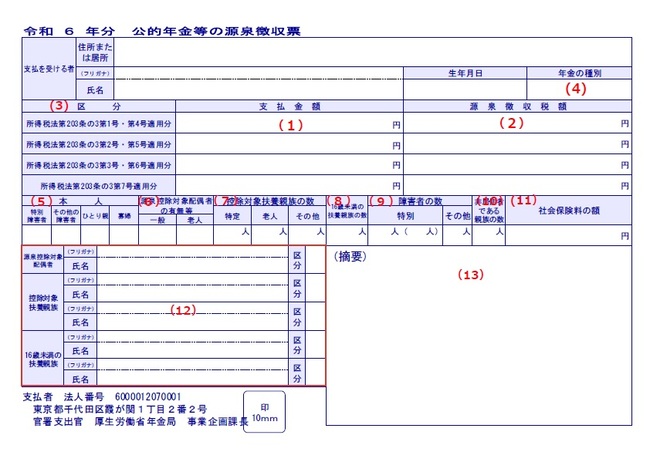
If the amount in (1) of your withholding tax statement is 4 million yen or less, and your income other than pensions for that year is 200,000 yen or less, you are not required to file a tax return
Unrealized gains and losses are not subject to taxation
Only realized gains and losses are subject to taxation; unrealized gains and losses are not.Realized gains and losses refer to the profits and losses that have been confirmed by closing out held positions.
Please note that swap points, which are received when adjusting for the interest rate difference between the currencies being bought and sold, are subject to taxation when they are received and reflected in your account
Please note that taxes are not levied at the time of withdrawal, but rather when the position is closed and the funds are reflected in the account
Will my company find out about my profits from overseas forex trading?
Many people don't want their company to find out they're trading with overseas forex brokers, but if you're making profits that require filing a tax return, there's a high chance your company will find out unless you take precautions
There are two ways to pay resident tax: "special collection," where it is deducted from your salary by your company, and "ordinary collection," where you pay it yourself
It's conceivable that the company's resident tax officer might find out if the amount of resident tax is significantly higher than the taxable income from your main job when they check your resident tax
How to prevent your company from finding out
There are two ways to keep your overseas forex trading profits a secret:
- I will pay the local tax on overseas forex trading through ordinary collection
- I don't tell my colleagues that I have a side job
When filing your tax return , check the box to "pay the local tax on overseas forex trading yourself." This means that the local tax on overseas forex trading will be collected through ordinary collection, and you will be responsible for paying it yourself

Even if you select "pay yourself," your tax return may be mistakenly processed as special collection, so be sure to check with your city hall after filing your tax return
Additionally, there's a risk of being reported to the company if you tell a colleague about your side job or if they see your phone notifications
Raising your standard of living, such as by wearing expensive items, increases the risk of being found out by those around you, so be careful not to raise your standard of living too much, even if you are making a certain amount of profit
How to file your tax return for overseas forex trading
Below, we will introduce the necessary documents and procedures for filing your tax return for overseas forex trading
Preparation of necessary documents
The following documents are required when filing your tax return:
- My Number Card
- Withholding tax statement (for those with salary income)
- Annual Transaction Report
- Expense receipts
- Various deduction certificates (social insurance premiums, medical expenses, etc.)
When checking your trading history with overseas forex brokers,an "annual trading report." If you are using MT4 or MT5, which are adopted by most overseas forex brokers, you can easily obtain an annual trading report.
The method for obtaining the annual transaction report is as follows:
- Launch MetaTrader 4 or MetaTrader 5 and log in to your account
- Select "Account History" at the bottom of the screen
- Right-click in the window and select "Specify period"
- Specify the report period
- Right-click in the window and select "Report"
- Specify the save format as "Open XML" or "HTML"
Also, be sure to declare all applicable deductions to minimize your taxes. Depending on the type of deduction, you may need supporting documents, so checking with the tax office beforehand will help ensure a smooth tax filing process
Tax return filing process
Below, we will explain the tax return filing procedure in detail
While you can obtain a tax return form from the tax office and fill it out by hand, this time we will explain the procedure using "e-Tax," which allows you to omit the submission of necessary documents
① Access the National Tax Agency's tax return preparation page
I will prepare the necessary documents for filing your tax return
Access the tax return preparation section and click "Start Preparation"
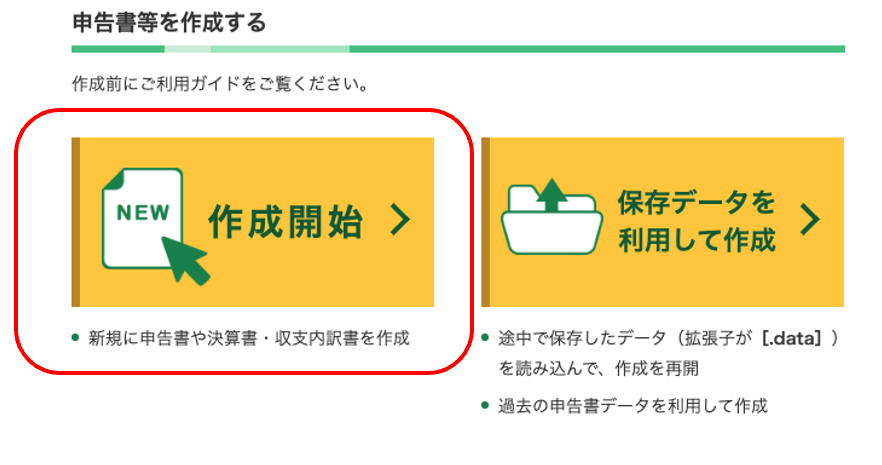
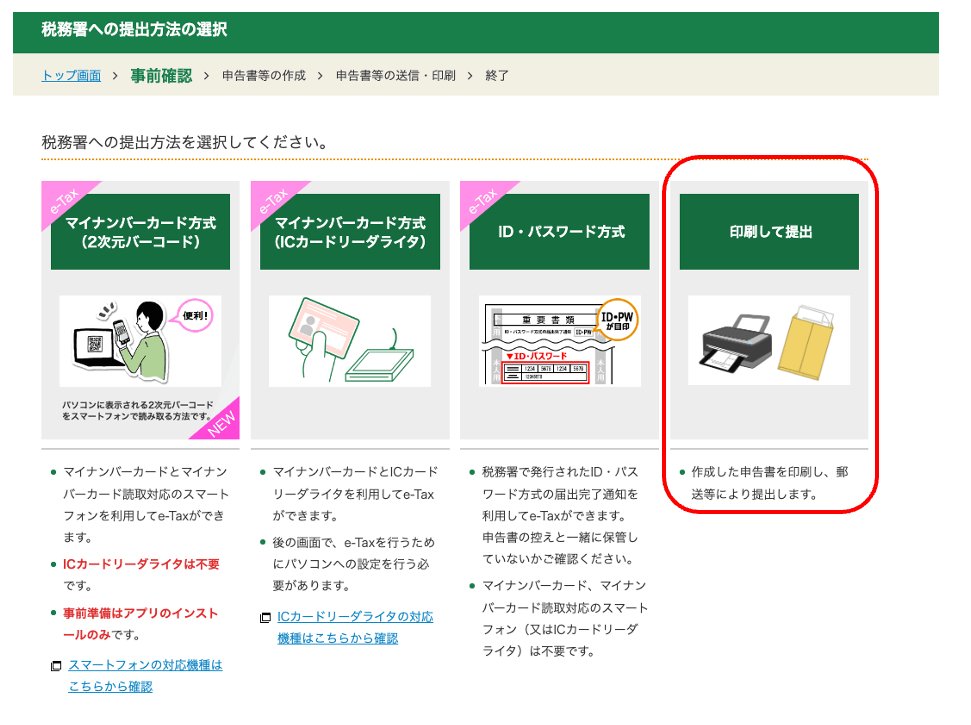
This section explains how to print and submit your tax return. Click "Print and Submit"
If you have a My Number Card, we recommend the "My Number Method," which allows you to complete the entire process using your smartphone
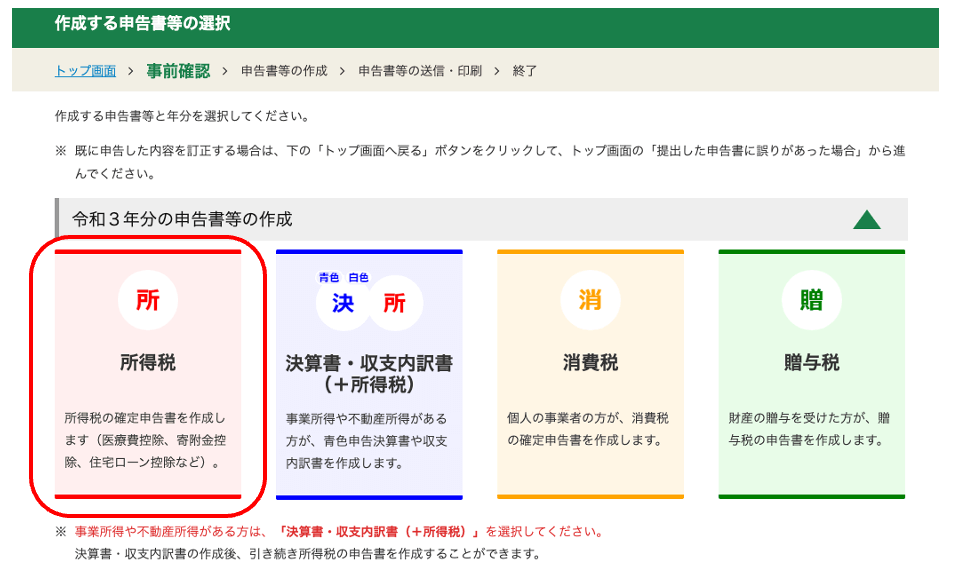
② Select "Income Tax" and start creating
Select the tax return form you wish to prepare
Select the year for which you will be filing your tax return, and then click "Income Tax"
Before you begin preparing your tax return, you will need to select the person filing the return's "date of birth" and whether or not they have "income other than salary."
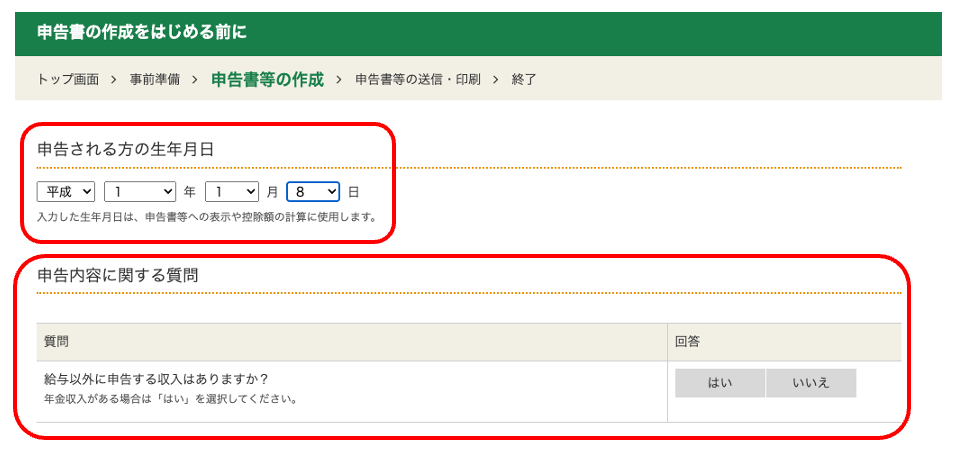
Now we'll begin the actual tax return process
③ Enter your salary income and other details according to the instructions on the screen
Enter your income or earnings
Please enter your income if you have any income other than salary or overseas forex trading
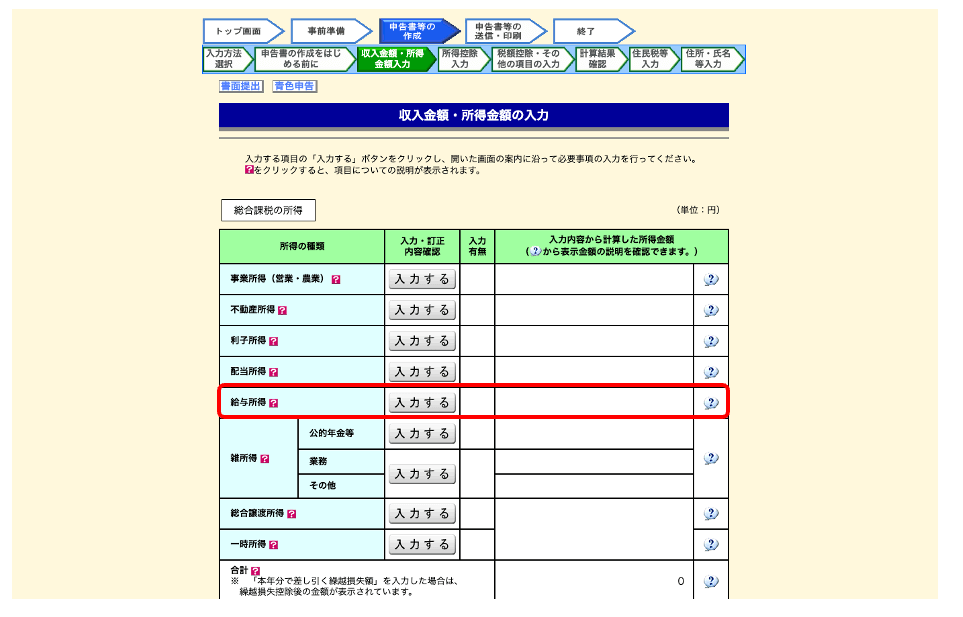
Those with salary income should enter their information based on the withholding tax statement issued by their employer
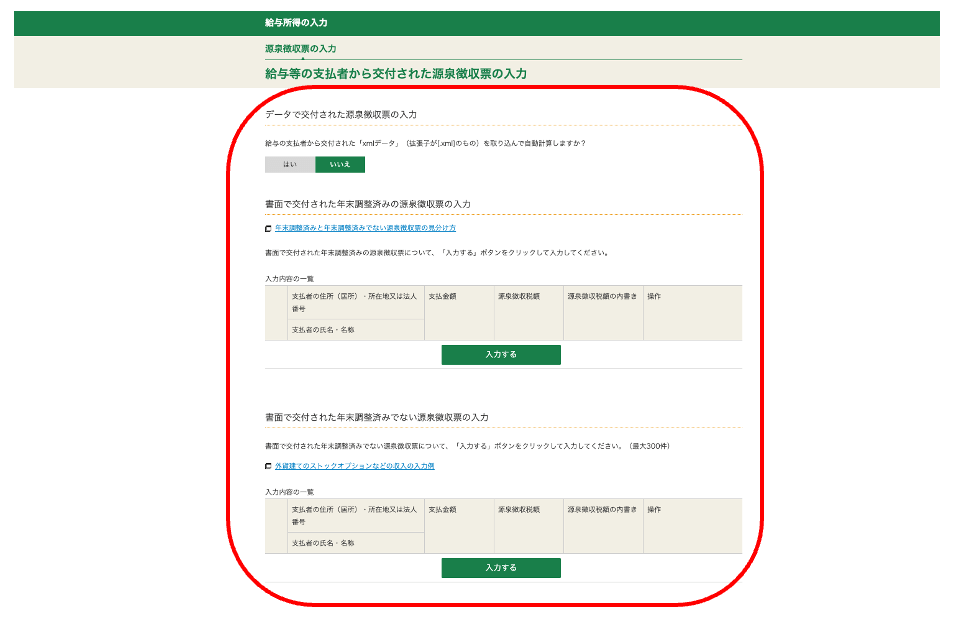
This completes the input regarding salary income, etc
If you are eligible for the specific expense deduction, select "Yes" for "Apply" and enter the information.
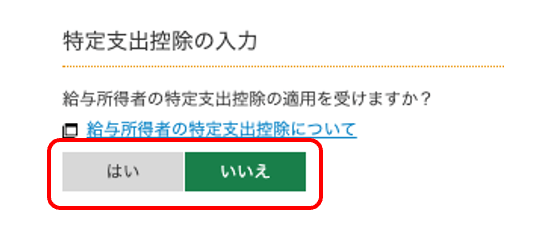
The specific expense deduction is a system that allows you to deduct business-related expenses from your income when you personally bear those expenses
If you incur personal expenses for the following seven items, you can claim a deduction as a specific expense
- Commuting expenses that are normally considered necessary
- Transportation expenses when working away from the usual workplace
- Relocation expenses due to job transfer
- Training fees for skills and knowledge necessary for the job
- Costs to obtain qualifications necessary for the job
- Transportation costs for employees working away from home to return home
- Books, clothing, and entertainment expenses necessary for work
However, proof from the employer is required to claim any of the specified expense deductions
④ Enter the actual profits you earned from FX trading
When filing your tax return, enter any income earned from overseas forex trading, etc., in the "Miscellaneous Income" section
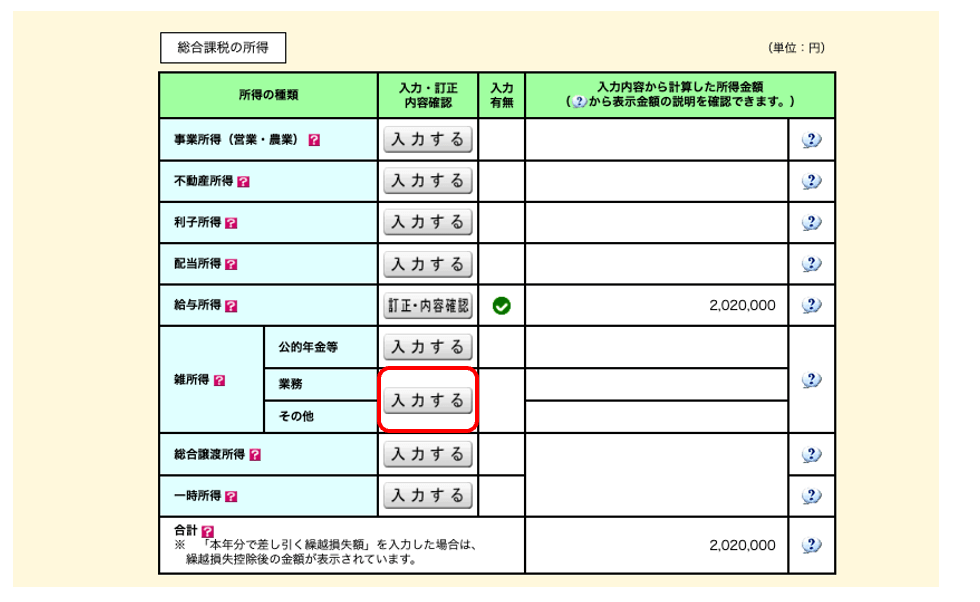
Enter your income from overseas forex trading, necessary expenses, and information about the overseas forex broker
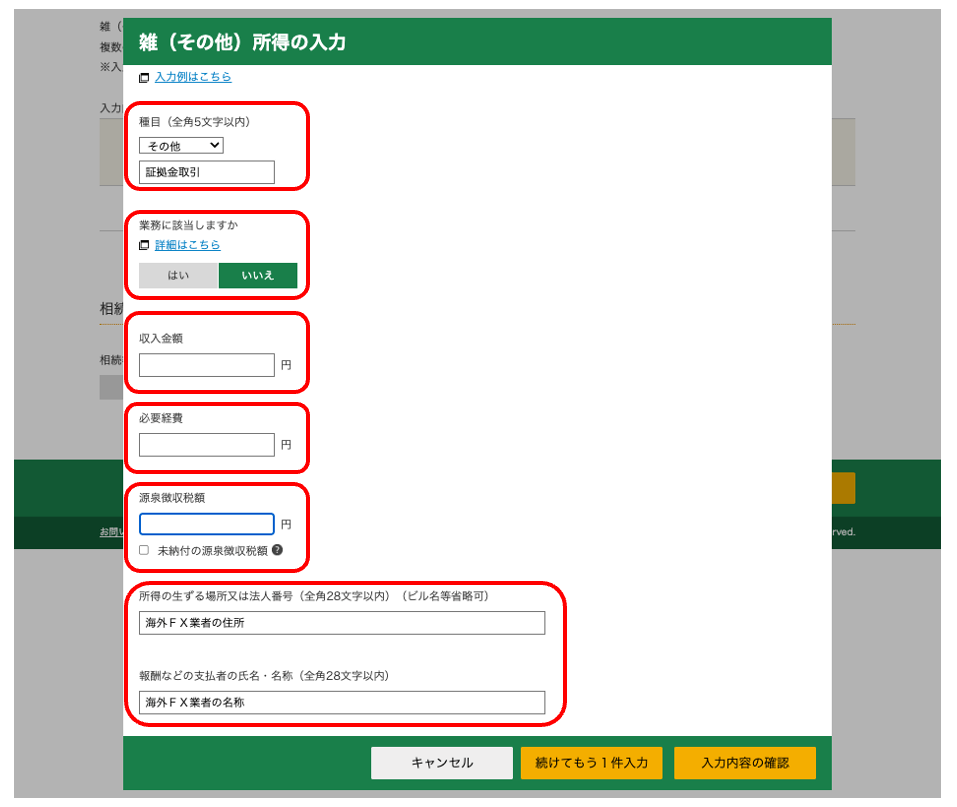
This concludes the input regarding income from overseas forex trading
When registering your income from overseas forex trading, you will need to enter the address and name of the overseas forex broker. Please check the overseas forex broker's official website and enter the information there. If you are unsure, please contact customer support
⑤ Enter any applicable deductions
If you are claiming various deductions such as medical expense deductions, life insurance premium deductions, or spousal deductions, please enter the applicable information

Since income deductions such as life insurance premium deductions and spousal deductions declared in your employer's year-end tax adjustment are already reflected in your withholding tax statement, you do not need to enter them here
⑤ Check the tax amount and proceed to the next step
Once you have finished entering your income deductions, the amount you need to pay will be displayed

Check the calculation results and proceed to the next step
⑥ Review the information regarding resident tax and business tax and proceed to the next step
After confirming the calculation result of the payment amount, please check the "Matters concerning resident tax and business tax."

After reviewing the content, we will proceed to the next step
In the resident tax input field, you can select the method for collecting resident tax on income other than salary and public pensions

If you choose special collection, the amount of resident tax incurred on your salary income and overseas forex trading will be notified to your employer, which could potentially reveal your side job
If you don't want your side job to be discovered, choose the "pay yourself" method for collecting your resident tax
⑦ Enter personal information such as address and name
You will need to enter personal information such as the address and name of the person filing the tax return

This completes the input of your personal information
⑧ Print your tax return
Finally, print out your tax return form and submit it to your nearest tax office either in person or by mail

This completes the tax return filing process
Points to note when filing tax returns for overseas forex trading
Below, we will introduce three points to keep in mind when filing your tax return for profits from overseas forex trading
- Losses cannot be carried forward
- Losses from domestic FX trading cannot be offset against profits from domestic FX trading
- Even if you don't need to file an income tax return if your profits are low, you will still need to file a local resident tax return
Losses cannot be carried forward
While losses from domestic FX trading can be carried forward,losses incurred from overseas FX trading cannot be carried over to the following year.
| If you incur losses in overseas forex trading, Year 1: Loss of 500,000 yen Year 2: Profit of 1,000,000 yen Since losses in overseas forex trading cannot be carried forward, taxes will be calculated on the 1,000,000 yen profit in Year 2. |
| If you incur losses in domestic FX trading, in the first year you will have a loss of 500,000 yen, and in the second year you will have a profit of 1,000,000 yen. Since losses from domestic FX trading can be carried forward, you will deduct 500,000 yen from the 1,000,000 yen profit in the second year, and calculate taxes on the remaining 500,000 yen. |
Therefore, taxes tend to be higher for overseas forex trading compared to domestic forex trading
The dividing line between overseas and domestic forex trading is approximately 3.3 million yen in taxable income when considering the marginal tax rate, and around 4.8 million yen when considering the amount of tax payable (overseas forex income only, with basic deductions applied). Those who consistently generate profits at this level will likely find domestic forex trading to be more tax-efficient
Losses from domestic FX trading cannot be offset against profits from domestic FX trading
Because overseas forex trading and domestic forex trading are categorized differently in terms of income, profits and losses from both cannot be offset against each other
Since income tax is calculated separately for each income category, if you use multiple overseas forex brokers, you can offset profits and losses against each other
| If you used three overseas forex brokers in the same year, for example: Broker A: Loss of 500,000 yen Broker B: Profit of 1,000,000 yen Broker C: Profit of 300,000 yen The loss of 500,000 yen from Broker A, the profit of 1,000,000 yen from Broker B, and the profit of 300,000 yen from Broker C are offset against each other, and taxes are calculated on 800,000 yen for that year. |
Furthermore, income earned from cryptocurrency trading or affiliate marketing is treated as miscellaneous income and can be offset against losses from overseas forex trading
Even if you don't need to file an income tax return if your profits are low, you will still need to file a local resident tax return
Even if your profits from overseas forex trading are small and not subject to income tax, you are still obligated to pay local inhabitant tax if you have made a profit
The local tax rate for overseas forex trading is a flat 10%, while the rate for domestic forex tradingis a flat 5%.
Please note that if your profits from overseas forex trading are less than 200,000 yen, you do not need to file a tax return. However, if you have income that cannot be declared through year-end adjustments, you will be obligated to file a local resident tax return
When filing your resident tax return, you will need to submit a document called the "Citizen and Prefectural Resident Tax Return Form" to the local government office. You can download the form from your local government's website and submit it by mail or in person at the counter
Tax-saving strategies for overseas forex trading
Below, we will introduce four tax-saving strategies for overseas forex trading
- Record all necessary expenses without fail
- Utilize various income tax deductions
- Losses from miscellaneous income are offset against each other
- Incorporate your business to lower your tax rate
Record all necessary expenses without fail
Profits from overseas forex trading are treated as miscellaneous income, and are calculated by deducting expenses from the profit
While the deductible expenses in overseas forex trading are limited, it's crucial to claim every single expense that qualifies as a tax-saving measure
Examples of expenses that are eligible are as follows:
- Cost of purchasing a computer or smartphone to be used for trading
- Communication costs
- Related book and newspaper expenses
- Seminar participation fee (including transportation and accommodation expenses)
- Rent and utilities
- VPS contract costs for automated trading
- Transaction fees
- Equipment costs (stationery, desks, chairs, etc. for business transactions)
Of the above, expenses such as smartphone and computer costs, and rent cannot be fully claimed as business expenses. Only the portion used for overseas forex trading is eligible as an expense, so you need to keep a record of daily usage time when claiming it
Furthermore,expensive equipment costing over 100,000 yen must, in principle, be expensed over several years(depreciation)
| Cost of purchasing a smartphone or computer | Distribution method |
|---|---|
| Less than 100,000 yen | Lump-sum accounting |
| 100,000 yen or more but less than 200,000 yen | Accounted over three years |
| Over 200,000 yen | Accounted over four years |
Utilize various income tax deductions
As a measure to reduce income tax, systems such as "income deductions"have been established.
The Income Tax Act provides for a system of income deductions
This is a system established to adjust the tax burden when calculating income tax, based on social policy requirements, consideration of each taxpayer's personal circumstances, and to guarantee a minimum cost of living. (
Source:National Tax Agency | Outline of Income Deductions)
When income deductions are applied, the amount of income subject to taxation decreases, which in turn reduces the burden of income tax and local taxes
The types of income deductions are as follows:
- Miscellaneous loss deduction
- Medical expense deduction
- Social insurance premium deduction
- Deduction for contributions to the Small Business Mutual Aid System, etc
- Life insurance premium deduction
- Earthquake insurance premium deduction
- Tax deduction for charitable contributions
- Disability deduction
- Widow's Deduction
- Single-parent deduction
- Working student deduction
- Spousal deduction
- Special spousal deduction
- Dependent deduction
- Basic deduction
Additionally,specialdeduction of up to 650,000 yen for filing a blue return.
*Please note that the special deduction for blue-form tax returns applies to business income, real estate income, etc. It does not apply to profits from overseas forex trading (miscellaneous income) itself
The more deductions you can subtract from your taxable income, the lower your tax liability will be. Therefore, be sure to check if you are eligible for any deductions before filing your tax return
Losses from miscellaneous income are offset against each other
If you have gains or losses from miscellaneous income other than overseas forex trading, you should offset those gains and losses against each other
Offsetting profits and losses: offsetting profits and losses for the same year
By offsetting gains and losses, taxable income decreases, thus reducing income tax
Please note that only miscellaneous income can be offset against profits and losses from overseas forex trading. Domestic forex trading, which falls under a different income category than overseas forex, cannot be offset against profits and losses from overseas forex trading
Incorporate your business to lower your tax rate
Incorporating your business can lower your tax rate, leading to significant tax savings
| Corporate account | Personal account | |
|---|---|---|
| Tax system | Corporate tax | income tax |
| tax rate | 23.2% flat rate | up to 45% |
| Loss carryforward | Possible | Not possible |
| Offsetting profits and losses | Possible | Possible |
Profits from overseas forex trading aresubject to progressive taxation, with the highest individual tax rate being 45%, compared to a flat corporate tax rate of 23.2%.
Furthermore, corporate accounts offer significant advantages, such as the ability to deduct more expenses, including executive compensation, and the possibility of carrying forward losses
However, incorporating a business requires initial registration fees and fixed costs such as fees for social insurance and tax accountants. Unless you can consistently generate substantial profits, you won't reap the benefits of incorporation
The break-even point for incorporating a businessis approximately 9 million yen. If you cannot consistently generate profits, incorporating is not recommended.
If you are considering incorporating your business, you should make your decision after considering the advantages and disadvantages beyond just tax savings
Frequently Asked Questions about Taxes on Overseas Forex Trading
Finally, we will answer some frequently asked questions regarding taxes on overseas forex trading
- If I use both overseas and domestic forex trading, will I be taxed twice?
- How do I pay taxes on overseas forex trading?
- When do I pay taxes on overseas forex trading?
- Are swap points from overseas forex trading taxable?
- Are bonuses and cashback offers from overseas forex trading taxable?
- Can I make hometown tax donations using overseas forex trading?
- Is it possible to offset profits and losses across multiple accounts in overseas forex trading?
- If I'm refused to withdraw funds from an overseas forex broker, will I have to pay taxes?
- If I don't withdraw the profits I earned from overseas forex trading, do I not have to pay taxes?
- If I file a tax return for my overseas forex trading, will I lose my dependent status?
If I use both overseas and domestic forex trading, will I be taxed twice?
Even if you use both overseas and domestic forex brokers,you will not incur double taxes.
However, since tax rates differ, you need to properly calculate and pay taxes on the income earned from transactions
Overseas Forex: Calculated under comprehensive taxation
Domestic Forex: Calculated under separate taxation
However, since tax processing can easily become complicated, you should consider consulting a tax professional or other expert if you have any questions
How do I pay taxes on overseas forex trading?
The methods for paying income tax are as follows:
- Tax payment by bank transfer
- Direct payment
- Internet banking
- Credit card payment
- Payment via smartphone app
- Convenience store payment
- Payment at the counter of a financial institution or tax office
You won't receive a payment slip or tax notice from the tax office;you need to choose your own payment method.
Please note that resident tax is paid using the method selected on your tax return form
If you choose special collection, your resident tax will be deducted from your salary. If you choose ordinary collection, you will pay using the payment slip sent to you or by bank transfer
When do I pay taxes on overseas forex trading?
The deadline for paying income tax is the same as for filing your tax return:from February 16th to March 15th. If you miss the deadline, you will be charged a late payment penalty equivalent to interest, so be sure to pay your taxes by the deadline.
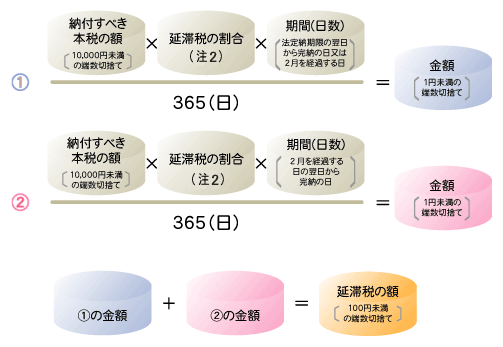
Regarding resident tax, if you pay through special collection, it will be deducted from your salary every month. If you pay through ordinary collection, you will pay the resident tax in a lump sum or in four installments (end of June, August, October, and January) using a payment slip. If you're unsure when to pay your taxes, remember that income tax is paid at the same time as filing your tax return, and resident tax is paid from June of the following year onwards
Are swap points from overseas forex trading taxable?
If you receive positive swap points from overseas forex trading , they will be subject to taxation
However, swap points received while holding a position are not included; only swap points received at the time of profit realization are eligible
Negative swap points can be recorded as an expense (loss)
Are bonuses and cashback offers from overseas forex trading taxable?
Cashback received through campaigns from overseas forex brokers is usually treated as "miscellaneous income" and is subject to comprehensive taxation
This is because cashback is typically obtained as a result of ongoing transactions or business activities. Even if the income is earned on a one-time basis, if it is related to a profit-making transaction, it will be taxed as "miscellaneous income" rather than "temporary income."
If it is taxed as miscellaneous income, the taxable portion is the profit amount after deducting necessary expenses from the amount received
Furthermore, salaried employees are required to file a tax return if their total annual miscellaneous income exceeds 200,000 yen. Non-salaried individuals, such as those with no salary income or self-employed individuals with side jobs, are generally required to file a tax return for all their miscellaneous income
For more details, please see the article below
Even if your place of residence is different, it may still be tax-exempt, so please consult a tax professional or the tax office if you have any questions
Regarding bonuses, those that can be withdrawn as cash are subject to taxation, while those that can be used as margin are tax-exempt
In short, account opening bonuses and deposit bonuses with a cushioning function are tax-free, but please note that profits earned using these bonuses are subject to tax
Can I make hometown tax donations using overseas forex trading?
Even with overseas forex trading, it is possible to use the Furusato Nozei (hometown tax donation) system to pay a portion of your taxes to the local government if you make a profit .
Furusato Nozei (Hometown Tax Donation): A system that allows you to donate to your hometown or a municipality you wish to support, and receive local specialty products and other gifts in return
Furusato Nozei (hometown tax donation) can be deducted from your income as a donation deduction, thus reducing your income tax and resident tax for that year
Instead of using the one-stop special exception system that allows you to file your hometown tax donation declaration by mail, you should file a tax return along with your income and expenses from overseas forex trading
Is it possible to offset profits and losses across multiple accounts in overseas forex trading?
If you have multiple accounts with overseas forex brokers, the income classification will be the same, so you can offset profits and losses
Profits from overseas forex trading are classified as miscellaneous income, and profits and losses from cryptocurrency trading and affiliate marketing can be offset against them
You cannot offset profits and losses between domestic and overseas FX trading. Even if you incur a 1 million yen loss in domestic FX and make a 1 million yen profit in overseas FX, you will still be taxed on the profit
Furthermore, you cannot carry forward losses in overseas forex trading
Loss carryforward is a system that allows you to offset losses and profits for up to three years. Even if your profits and losses were negative in the three years prior to last year, you will still be taxed if you make a profit this year
Domestic FX brokers allow loss carryover, so those using both overseas and domestic FX brokers should be careful not to make a mistake
If I'm refused to withdraw funds from an overseas forex broker, will I have to pay taxes?
If your withdrawal is rejected by an overseas forex broker,whether or not it is taxable depends on the circumstances.
- Transaction history exists → Subject to taxation
- No transaction history → Tax-exempt
If you have a transaction history, withdrawals are often refused due to errors in the withdrawal process. In this case, since there is still a profit remaining, taxes will be levied
On the other hand, if there is no transaction history, withdrawals are often refused due to the trader's misconduct, and since the profit is not treated as such, it is not subject to taxation
If you have any questions about tax implications when a withdrawal is refused, obtain your transaction history and consult with the tax office or a tax professional
If I don't withdraw the profits I earned from overseas forex trading, do I not have to pay taxes?
Profits earned from overseas forex tradingare subject to tax even if they have not yet been withdrawn.
The taxable amount is not the profits you withdraw, but the total profit or loss reflected in your account from January 1st to December 31st
If you want to minimize your taxes, one option is to delay closing any open positions at the end of the year
If you mistakenly believe that you don't need to declare your income because it hasn't been withdrawn, you could face severe penalties depending on the nature and extent of the situation if the tax office finds out. So, be sure to file your tax return
If I file a tax return for my overseas forex trading, will I lose my dependent status?
If you qualify as a dependent and your total income, including profits from FX trading, exceeds "580,000 yen per year" (the income requirement for dependent deductions from 2025 onwards), you will need to file a tax return, and at the same time, you will no longer be considered a dependent for tax purposes
Even if your profit from FX trading is only 100,000 yen, if your total annual income, including income from part-time jobs and other sources, exceeds 580,000 yen, you will no longer be considered a dependent
However, if you are a dependent under social insurance, you will be eligible for dependent status for two consecutive years if your income is only temporarily increased
summary
This concludes our explanation of taxes and tax filing methods for overseas forex trading
Finally, let's review the important points
- There are no loopholes when it comes to taxes on overseas forex trading! Tax evasion will always be discovered by the tax authorities
- The taxes on overseas forex trading are "income tax" and "resident tax"
- The dividing line between overseas and domestic forex trading is approximately 3.3 million yen in taxable income (or about 4.8 million yen in taxable income if only overseas forex trading income is involved)
- For salaried employees, a tax return is required if "annual income other than salary exceeds 200,000 yen," and for non-salaried employees, an annual income exceeds "580,000 yen" (for the year 2025 and onward)
- Losses cannot be carried forward, but losses can be offset against miscellaneous income (cryptocurrency trading and affiliate income)
- Tax-saving measures include "utilizing various deductions," "recording all expenses without fail," and "considering incorporating."
- Tax filing is done annually from February 16th to March 15th. If you have a My Number Card, filing via e-Tax is convenient
If you have any questions about taxes or filing tax returns, consulting a tax professional is one option
Forgetting to pay taxes can be considered tax evasion and may result in penalties, so be sure to file a tax return once you have earned a certain amount of profit

While overseas forex trading offers many advantages over domestic forex, such as greater leverage flexibility and more generous bonuses, it also has a progressive tax system based on comprehensive taxation, meaning the tax burden increases as income rises. Furthermore, it's important to note that preferential treatments like loss carryforward and separate taxation, as available with domestic forex, are not applicable. Additionally, tax treatment can vary depending on individual trading circumstances, so it's best to consult with the tax office or a specialist if you have any questions. Consider tax-saving strategies and the impact on dependents and resident taxes, and strive for planned trading and tax preparation