












Are you trading with overseas forex brokers and struggling with issues like "orders not going through at the price I want" or "not being able to scalp effectively"?
One of the causes is the "stop level"
Settings vary from one provider to another, and choosing one without comparing them could lead to missed profits or increased losses
■What you will learn from reading this article
- The basic mechanism and meaning of stop levels
- Reasons why comparison is necessary, and the advantages and disadvantages of a narrow space
- How to check on a PC or smartphone
- Comparison list of 12 major companies and recommended service providers
After reading this article, you will have the judgment to choose a broker that suits you and trade efficiently and safely
If you're new to overseas forex trading, we recommend reading the complete guide for overseas forex trading beginners
What is a stop level in overseas forex trading?

The stop level is the minimum distance from the latest market price at which a limit order or stop-loss order can be set
This value is set independently by each overseas forex broker and has a significant impact on the degree of trading flexibility
Let's explain using the example of entering a trade at approximately $0.94
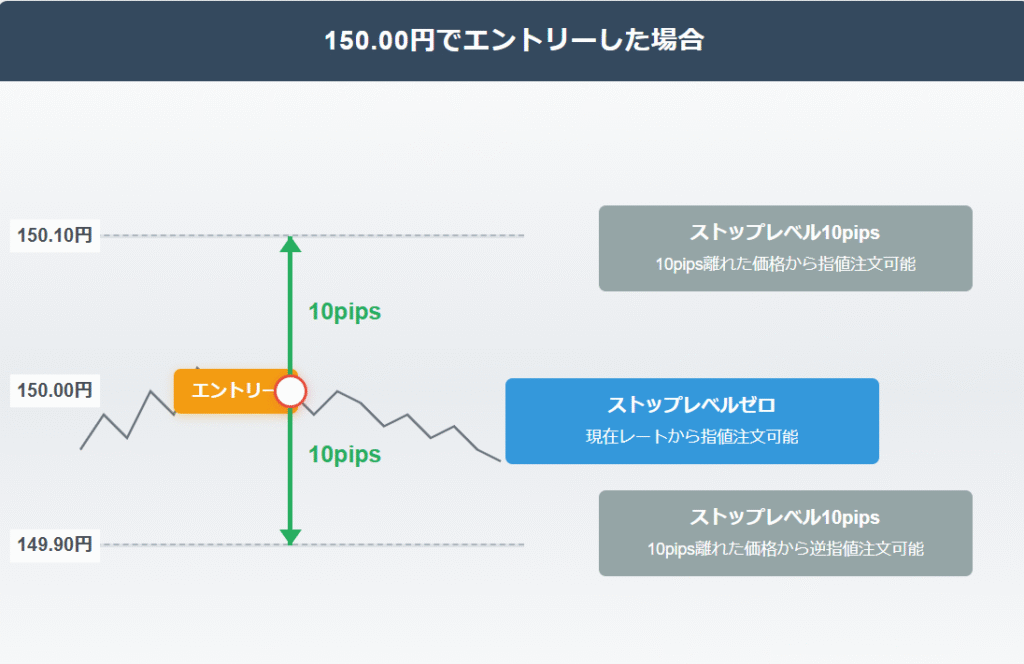
With brokers that have set their stop level to 10 pips, you can only place orders at a price 10 pips above or below (approximately $0.00) the current price
In other words,new limit and stop orders can only be placed at approximately $0.94 or higher, or approximately $0.94 or lower.
On the other hand, if you use a broker with a zero stop level, you can place an order near the current price
You can place orders even at positions as small as 1 pip away, such as approx. $0.94 or approx. $0.94
This difference is particularly important for traders who engage in short-term trading, as it directly impacts the timing of profit-taking and stop-loss decisions
Why you need to compare stop levels in overseas forex trading

Choosing an account in overseas forex trading without checking the stop-loss levels can significantly impact your trading results
This is because different companies use different numerical settings, which directly impacts profits and losses
With a narrower price setting, orders are more likely to be executed at a price close to your desired price, allowing for more efficient trading
However, if you choose a broker with a wide range of settings, you risk missing out on profits because you may not be able to place orders in the desired positions
For traders who want to make profits by effectively using their limited time as a side hustle, this difference cannot be overlooked
It is essential to compare stop levels and choose a broker that suits your trading style
It's easy to miss out on profits and losses increase
Using brokers with wide stop levels often means you can't place orders at your desired positions, causing you to miss opportunities
For example, there are cases where you want to set profit targets or stop-loss orders in 1-pip increments, but you can't place an order unless you're several pips apart
If the market reverses during that time, you will lose the profits you would have otherwise earned, and your losses will actually increase
In particular, in short-term trading and scalping, this difference significantly impacts the win rate and profit margin
Even with automated trading using Expert Advisors (EAs), failure to operate according to the settings can cause the strategy to break down
Failing to make comparisons means missing out on accumulating profits and only increasing the risk of losses
There is a risk of choosing a broker that does not suit your trading method
The importance of stop levels varies depending on the trading strategy
For example, in scalping, a difference of a few pips can directly impact profitability, so a narrow stop level is of paramount importance
However, in swing trading, positions are held for several days to several weeks, so swap points and transaction costs become more important
If you choose a broker without comparing options, you might end up using an account with conditions that don't suit your trading method, potentially preventing you from achieving your desired results
Failing to compare stop levels increases the risk of choosing an environment that doesn't suit your strategy
The advantage of narrow stop levels in overseas forex trading

Using an overseas forex broker with a narrow stop-loss level increases trading flexibility and makes it easier to execute your strategy as planned
This is because it makes it easier for orders to be executed at the desired price, reducing unnecessary losses and missed opportunities
However, rather than simply stating that "narrow = advantageous," it's important to understand specifically how it works to your advantage
The three main advantages of a narrow stop level are as follows:
Now, let's take a closer look at these three advantages
It becomes easier to get your order placed at your desired price
One advantage is that with brokers that offer narrow stop levels, it becomes easier to set profit-taking and stop-loss levels closer to your desired price
For example, when the USD/JPY exchange rate is approximately $0.94, a broker with a 3-pip stop-loss level cannot place their take-profit or stop-loss at approximately $0.94; they must be shifted to approximately $0.94 or $0.94
On the other hand, if you choose a provider with virtually no restrictions, you can set it exactly where you envision it
This difference is especially significant in short-term trading, and even a difference of a few pips can accumulate and greatly impact profits
Furthermore, during economic indicator announcements or periods of rapid market fluctuations, the ability to accurately place orders at the desired positions significantly impacts the outcome of the trade
A narrow stop level is an essential condition for executing your planned scenario exactly as intended
Become advantageous in scalping
The second advantage is that having a narrow stop level is a great asset in scalping
Scalping is a trading method that targets small price movements lasting from a few seconds to a few minutes. While the profit per trade is small, the goal is to achieve stable results by accumulating profits
However, with brokers that have wide stop levels, you need to set your take-profit and stop-loss orders several pips or more apart, making it impossible to place orders at the desired positions
As a result, you may incur larger losses than anticipated or miss out on the profits you were aiming for
Conversely, brokers with stop levels close to zero allow you to manage orders with minimal price fluctuations and execute your strategies with precision
Combined with a narrow spread, it's possible to accumulate profits efficiently
To achieve consistent results with scalping, a narrow stop-loss level is an essential condition
It can maximize the performance of the EA
A third advantage is that a narrow stop-loss level environment allows EAs (automated trading systems) to perform to their full potential
EAs automatically place orders based on their programs, but with brokers that have wide stop levels, the set profit targets and stop-losses may be hit by the limits, resulting in orders not being placed as intended
As a result, even trading logic that performed well in backtesting may become less reproducible in actual trading, leading to decreased profitability
Conversely, if the broker has a stop level close to zero, the EA can execute profit-taking and stop-loss orders with small price ranges as designed
This increases the reproducibility of the strategy and makes it possible to reduce the difference between backtesting and actual operation
For traders who want their EAs to run stably, a narrow stop level is an essential requirement
How to check stop levels in overseas forex trading

Stop levels may be listed on the broker's official website, but it's best to actually open the trading tool and check them there
MT4 and MT5 have detailed conditions set for each currency pair, so you can immediately understand the differences depending on the account type and instrument
From here, we will explain how to check the stop level on both the PC and smartphone versions
By checking these things in advance, you can create an environment where you can trade according to your envisioned strategy
For PC versions of MT4 and MT5
In the PC versions of MT4 and MT5, you can check the stop level from the detailed currency pair information
The process is simple: first, right-click on the currency pair you're interested in and select "Specifications" or "Properties."
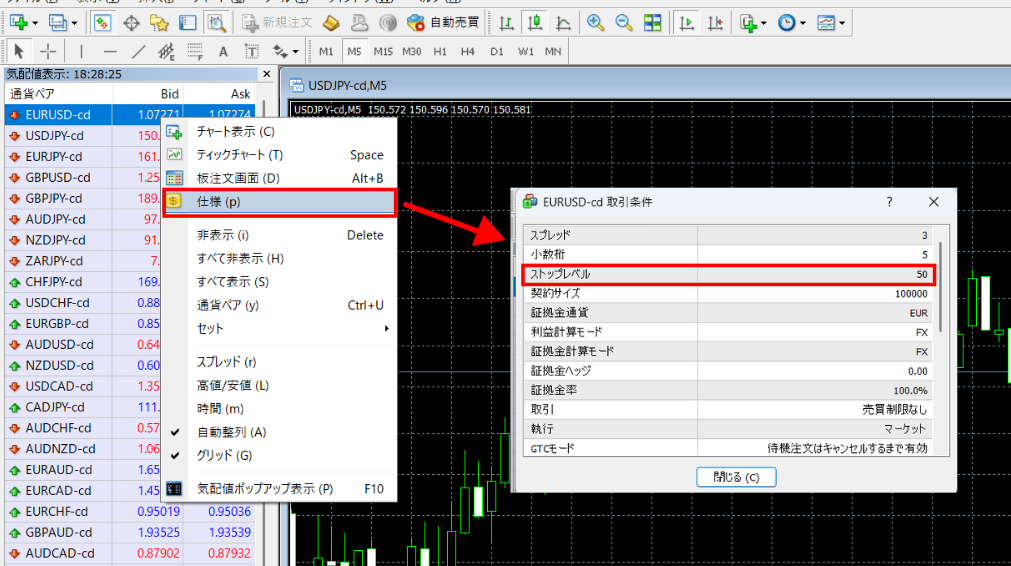
Then, alongside the spread and swap points, you'll find labels such as "Stop Level" and "Minimum Distance," with numerical values displayed there
For example, if it says "Stop Level 50," it means you need to place limit or stop-loss orders at least 5.0 pips away from the current price
Using this method, you can actually check the conditions on the trading tool even if they are not listed on the overseas forex broker's website
For the smartphone versions of MT4 and MT5
Checking stop levels is easy even with a smartphone app. Simply launch the app and tap the currency pair you want to check from the list of quotes (e.g., USD/JPY = US dollar/Japanese yen)
Then, an item called "Details" or "Properties" will appear, so tap on it
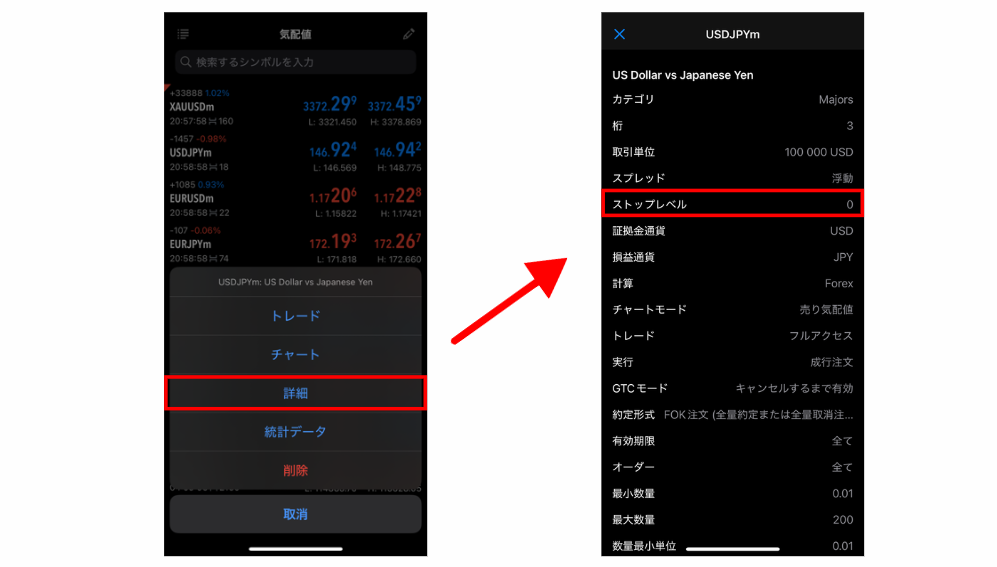
The displayed information includes terms such as "Stop Level" or "Minimum Distance," which can be used to confirm the minimum number of pips required to place an order (for example, 30 means 0.3 pips)
The same procedure could be used with the smartphone app, making it easy to determine the stop level
With this, you can quickly check the conditions even when you're out and about
It's easy to view on both PCs and smartphones, so be sure to check it. This extra step is important
Key points for choosing an overseas forex broker with a narrow stop-loss level

When choosing an overseas forex broker with a narrow stop-loss level, you shouldn't judge solely on the smallness of the number
Even if the display shows zero, the actual minimum distance you can place a trade can vary depending on the currency pair, account, and time zone
This chapter will introduce four checkpoints for identifying companies with narrow criteria
Compare the values on the official website with the "specifications (stop levels)" of MT4/MT5 to actually check how far apart you need to be to place limit and stop orders for each instrument
Also, since the numbers may temporarily widen during events or at the start of the week, it's reassuring to check them both during normal times and when they are fluctuating
Testing whether orders with the same conditions are executed on a demo account can help avoid mistakes in actual trading. Avoid trading with a live account without prior testing
Choose a provider that displays a stop level of zero
The first thing to look out for is companies that advertise "Stop Level Zero."
The narrower the stop level, the more advantageous it is, and the closer its minimum value is to zero, the more flexible trading becomes
However, simply seeing "zero" is not enough to guarantee safety
In reality, orders may not be possible unless the order is placed several points apart, so the stated order may not always reflect the actual situation
Please check the "Specifications (Stop Level)" in MT4/MT5 and be sure to check what the values are
Furthermore, it's also an effective method to test whether limit orders and stop orders are rejected by placing them at extremely close distances in a demo account
When testing in a real-world environment, it's safest to start with the smallest possible batch size and verify the actual behavior with a small investment
Don't assume that a company displaying "zero" always means zero. Checking the actual RMS value before choosing a company is the first step in identifying a reliable provider
When choosing a broker, be sure to check their ratings in overseas forex broker comparison rankings
Check the conditions for each currency pair
Even within the same broker, stop-loss levels can vary significantly depending on the currency pair
While highly liquid major currencies such as the dollar-yen and euro-dollar tend to have narrow exchange rates, emerging market currencies such as the Turkish lira-yen and South African rand-yen tend to have wider rates
Furthermore, for CFD instruments such as gold (XAUUSD), crude oil, stock indices, and cryptocurrencies, it is not uncommon for completely different benchmark values to be set
It is important to open the "specifications (stop level)" of the stock you actually want to trade, and compare the values in a list
For example, while orders for major currencies may only be placed at 0 to 1 pip, orders for minor currencies may require a gap of several tens of pips
First, confirming that the conditions for the currency pairs you primarily trade are sufficiently narrow is the quickest way to avoid constraints on your strategy
Additionally, since the market can temporarily widen during volatile periods such as when economic indicators are released or at the start of the week, it's reassuring to check both normal and volatile market conditions
Identify the differences by account type
The conditions for stop-loss levels vary significantly depending on the type of account
For example, the Standard account has wider spreads, but in return, there are no trading fees
However, the stop level is also somewhat wide, making it difficult to set profit targets or stop losses at very specific price levels
On the other hand, ECN accounts and Pro accounts offer much greater flexibility because they have very narrow spreads and stop levels that are close to zero
Instead,a commission of a few dollarsis charged in addition to the spread.
Furthermore, bonus accounts may have wider stop levels to ensure compliance with promotional conditions
In short, it's important to consider the "spread + commission + stop level" together and choose an account that suits your trading style
For example, if you want to place orders close to the current price, an ECN account is a good choice, while a standard account is better if you prefer a wider price range for more relaxed trading. Choosing an account that suits your trading style is key to avoiding mistakes
| Account type | spread | commission | Stop level | Suitable people |
|---|---|---|---|---|
| Standard | Wide range (1.0 to 1.5 pips) | none | Slightly spacious | Beginner-friendly, relaxed trading |
| ECN/Pro | Very narrow (0.1–0.3 pips) | Yes (a few dollars/lot) | Close to zero | People who want to place detailed orders |
| Bonus account | Average to spacious | none | Wide | People who want to make use of their bonus |
Adapt to your trading style
The evaluation of stop-loss level conditions will vary depending on whether they suit your trading style
For example, in a trading style that involves taking profits or cutting losses with small price increments, you won't be able to place orders at your desired positions unless you use a broker with a stop level close to zero
On the other hand, if your trading style involves trading over wide price ranges of several tens of pips, a slightly wider stop-loss level won't cause significant problems
Generally speaking,scalping requires zero swap points, day trading is advantageous with zero swap points but acceptable up to a few pips, and swing trading has almost no impact, with swap conditionsbeing more important.
Thus, what's important isn't the narrowness of the area itself, but whether you can secure the minimum distance necessary for your strategy
Using a demo account to test whether your orders are executed with your set profit-taking and stop-loss levels will reduce the chances of making mistakes when choosing a real account
The important thing is not to assume that "narrower is generally better," but rather to judge based on whether it suits your own trading style
Overseas Forex Broker Stop Level Comparison List

Some overseas forex brokers state their stop-loss level as "zero," while others require a stop-loss level of several pips or more before an order can be placed. In reality, there is a huge difference in the conditions
Furthermore, the total cost, including spreads and fees, varies from broker to broker, so it's not simply a case of "zero" being the most advantageous
Therefore, we have compiled a list of the trading conditions for USD/JPY (US dollar/Japanese yen) at 12 major companies
This list allows you to see the differences in terms and conditions of each provider at a glance, providing you with the information you need to choose the account that's right for you
| Company name | Main account types | Stop level | Average spread | Fees (round trip) | Features |
|---|---|---|---|---|---|
XMTRADING | Standard / Zero | 0.0 pips | Approx. 1.6 / approx. 0.1 pips | None / $10 | Zero limit, Zero account offers an effective 1.1 pips, and generous bonuses |
Exness | Standard / Raw | 0.0 pips | Approximately 1.0 / almost 0.0 pips | None / $7 | Raw accounts offer a stable, low-cost trading environment with an effective return of 0.7-0.8 pips |
FXTM | Advantage Plus / Advantage | 0.0 pips | Approximately 1.5 / 0.0~0.3 pips | None / $7 | No zero limit on any account, effective range is 0.7-0.8 pips |
Tradeview | X Leverage / ILC | 0.0 pips | Approximately 2.0/0.0~0.3 pips | None / $5 | ILC accounts offer some of the lowest fees in the industry and high transparency |
LandPrime | Standard / ECN | 1.2 pips | Approx. 1.3 / approx. 0.5 pips | None / $6 | Wide constraints, ECN is effectively around 1.1 pips |
Axiory | Standard / Nano | 0.0 pips | Approximately 1.4 / 0.0~0.2 pips | None / $6 | Nano accounts offer flexibility and stability via ECN |
TitanFX | Standard / Blade | 0.0 pips | Approx. 1.3 / approx. 0.3 pips | None / $7 | Blade accounts offer a real-world profit of around 1.0 pips, and are popular among brokers |
BigBoss | Standard / Pro Spread | 1.0 pips | Approx. 1.3 / approx. 0.4 pips | None / $9 | There are stop constraints, and the actual cost is somewhat high |
iFOREX | Single account | Wide range of restrictions | Approximately 1.8 pips | none | Wide stop-loss, disadvantageous for short-term trades, fixed spread adopted |
FXGT | Standard / Pro | 6.2 pips | Approx. 1.3 / approx. 0.6 pips | none | The stop constraints are extremely broad and not suitable for short-term trading |
ThreeTrader | Standard / Raw Zero | 0.0 pips | Approximately 1.2 / 0.0~0.2 pips | None / $8 | ECN offers high transparency but slightly higher fees |
TechFX | Standard / Zero | 0.0 pips | Approx. 1.5 / approx. 0.4 pips | None / $8 | Zero accounts offer a real-world return of around 1.0 pips, and are a growing broker |
Top 3 Recommended Brokers for Overseas Forex Trading with High Stop Levels

As you can see from the list, there are quite a few companies that set the stop level to zero
However, what's important isn't the "zero" notation itself, butwhether that number is actually functioning, and whether the overall trading environment, including spreads and fees, is superior.
From that perspective, XM,Exness, and FXTM stand out in terms of both reliability and cost-effectiveness
Now, let's take a closer look at the characteristics of each company
XM | Zero stop level on all currency pairs
Source:XMTRADING
XM is one of the few overseas forex brokers that sets the stop level to zero for all currency pairs
This feature is highly attractive because it allows you to freely place orders not only for major currencies like USD/JPY and EUR/USD, but also for minor and exotic currencies
When using scalping or automated trading (EA), even a difference of just a few pips can directly impact your results, but XM has no restrictions, so you can use your strategy as is
While the spread on a standard account is around 1.6 pips, which is about average, using a Zero account reduces the spread to around 0.1 pips. Even with the $10 round-trip commission added, the effective cost comes down to about 1.1 pips, which is a very attractive feature
Furthermore, there are plenty of perks such as new account opening bonuses, deposit bonuses, and trading bonuses, making it easy to start even with limited capital
The 24-hour Japanese language support, high user satisfaction, and long-standing support from Japanese traders are all reassuring factors
「XM's strength lies in its overall capabilities, combining a zero limit on all currency pairs, bonuses, and support
Exness| Effectively zero restrictions, flexible support for EAs and high-frequency trading
Source:Exness
Following XM,Exnesshas also set the stop level to zero for all currency pairs
Therefore, it allows traders to freely place orders across all currencies, from major to minor currencies, providing an ideal environment for short-term and high-frequency traders
In particular, the Raw Spread account has an average spread that is very close to 0.0 pips, and even with the round-trip commission of $7 added, the effective cost is 0.7 to 0.8 pips, which is among the lowest in the industry
Even with a standard account, the USD/JPY spread is stable at an average of 1.0 pips, which is more favorable than the standard accounts offered by other companies
In addition, its strengths include high execution speed and low requotes, and the transparency of trade execution is so thorough that it is published in official data
Furthermore,unlimited maximum leverage (after meeting certain conditions)anda 0% stop-loss levelit boasts unique features such as
The company holds financial licenses in multiple countries and is supported for both its transparency and trustworthiness
If you're looking for a broker that offers "zero fees on all currency pairs + the lowest costs + high flexibility," thenExnessis a must-consider option
FXTM | No stop levels for all account types
While FXTM (ForexTime) doesn't advertise "zero stop-loss limits on all currency pairs" like XM orExness, a major feature is that it doesn't impose stop-loss level restrictions on any account type
Whether you choose the standard-oriented Advantage Plus account or the ECN-based Advantageaccount, you can freely place orders close to the current price, allowing traders to choose the account that best suits their strategy
In particular, the Advantageaccount has extremely narrow spreads of 0.0 to 0.3 pips, and even with the round-trip commission of $7 added, the effective cost is 0.7 to 0.8 pips, which is among the best in the industry
Even with a standard account, the profit margin is kept to around 1.5 pips, which is a favorable condition compared to standard accounts offered by other companies
Furthermore, FXTM also holds multiple financial licenses and has a long track record of stable operations, which is another strength
While Japanese language support is limited, this broker offers a sense of security in terms of reliability and fund management,making it suitable for traders who prioritize a balance between cost and security.
Frequently Asked Questions about Stop Levels in Overseas Forex Trading

Stop levels are an important element when using overseas forex trading, but for beginners, the differences between similar terms and their impact on actual trading can often be confusing
There are several points that are easily confused, especially regarding "stop-out levels" and "differences between currency pairs."
Here, we've compiled essential knowledge to help you correctly understand stop levels , addressing common questions traders have
We will explain this from a perspective that will be useful in actual trading
Summary | This article explained why you need to compare stop levels in overseas forex trading and provided a comparison list

In overseas forex trading, differences in stop levels significantly impact the flexibility and win rate of trading strategies
With brokers that have a wide range of price ranges, you may not be able to place orders at your desired price, resulting in many missed opportunities, and the stop-loss range will also be unnecessarily wide, increasing the risk
Conversely, with brokers offering near-zero returns, it's easier to implement detailed strategies, including scalping and Expert Advisors (EAs), allowing for efficient fund management
In this comparison list, companies with excellent conditions stood out, such as XM andExness, which offer zero fees for all currency pairs, and FXTM, which has no restrictions on any account type
On the other hand, there are also brokers with extensive restrictions, such as iFOREX andFXGT, highlighting the importance of choosing the right broker
The important thing is not to blindly accept the "zero" indication alone, but to check the actual costs, including spreads and fees, and the overall trading environment
By choosing an environment that suits your trading style, you can achieve more consistent results