











This guide provides a clear explanation for those who want to start trading gold with overseas forex brokers but are unsure about what to learn or how to choose a broker
For those of you with such questions or concerns, this articlea thorough explanation of gold (XAUUSD) trading in overseas forex.
Conclusion | Overseas FX brokers strong in gold trading
- The overall number one isExness: Unlimited leverage (with conditions) x Gold swap-free, suitable for both short-term and long-term trading.
- For those prioritizing low spreadsThreeTrader,for those prioritizing bonuses, XMTrading andFXGT
- Gold has large daily price fluctuations,making it a good match for high-leverage, zero-cut overseas forex trading.
Furthermore,MoneyChat's cashback program, you can effectively lower your trading costs even with gold, which has wider spreads.
Based on the results of a survey of over 20,000 users and official information from each company, the MoneyCharger editorial team introduces overseas forex brokers that are truly recommended for gold trading
Supervisor of this article

Japan Securities Dealers Association Class 1 Securities Sales Representative
Ryota Ito
While a student,CFPand DC Advisor qualifications. I currentlya Class 1 Securities Sales Representativelicense. Subsequently, I worked in the sales and management planning departments of a securities company, and as a president's secretary (during which time I was involved in the sale of investment trusts and stocks, seminar planning, launching an FX business, and establishing an investment advisory company). I also worked in investment banking. In November 2007, I established Skiller Japan Co., Ltd. and became a director. I am currently working as a part-time lecturer at Toyo University's Faculty of Business Administration, Otemae University's Correspondence Education Department, Chiba Institute of Science's Faculty of Crisis Management, and as a financial planner.
*This article was created and updated by the MoneyCharger editorial team in accordance with their content creation policy , and supervised by Ryota Ito, who holds a CFP and a Class 1 Securities Sales Representative license (supervised in August 2026). Trading conditions such as spreads and leverage were confirmed on each company's official website, and publicly available information from government agencies such as the Financial Services Agency and the Consumer Affairs Agency was also reviewed before publication.
■ What you will learn from reading this article
- Basic knowledge of gold trading in overseas forex markets
- How to choose an overseas forex broker suitable for gold trading
- Practical Gold Trading Strategies
Gold trading in overseas forex is an attractive market where you can aim for significant profits if you have the right knowledge and strategy.
By reading this article to the end, youwill have a solid foundation for starting gold trading in overseas forex markets, and youwill be able to trade with confidence.
So, let's get started!
If you're looking for highly-rated overseas forex brokers, please refer to this ranking of popular and recommended overseas forex brokers
What is gold (XAUUSD) trading in overseas forex?

Gold (XAUUSD) trading in overseas forex is a type of CFD trading that deals with the currency pair of gold and the US dollar (USD)
Gold is a globally recognized asset, andit plays a particularly important role as a "safe-haven asset" during times of inflation and economic instability.
This has attracted the attention of many traders
Overseas forex brokersoffer high leverage, making it possible to make large trades even with a small amount of capital.
Furthermore,its high volatility (price fluctuations)makes it easier to aim for profits even with short-term trading.
However, rapid price fluctuationsincrease the risk of losses, so proper risk management is necessary.
This article will provide a detailed explanation of the advantages and precautions of gold trading, as well as how to choose the best overseas forex broker
If you'd like to learn more about CFD trading other than gold, please see this article below ↓
Factors influencing the price of gold

The price of gold (XAUUSD) is heavily influenced by the state of the global economy and financial markets
In particular,U.S. monetary policy, geopolitical risks, and economic cyclesinfluence price fluctuations.
Let's take a closer look at each of these factors
Fed's policies
The Federal Reserve (FRB), which determines U.S. monetary policy, has a significant impact on gold prices
In particular,trends in interest rate hikes and cutsare important.
the Federal Reserveraises interest rates (increases its policy interest rate), the value of the US dollar tends to rise, and the price of gold tends to fall.
This is because gold is an asset that does not generate interest , so when interest rates rise, its relative attractiveness as an investment decreases .
Conversely, when interest rates are lowered (policy interest rates are reduced),the price of gold rises due to the decline in the value of the currency and the progression of inflation.
The Federal Reserve's monetary policyis closely related to the inflation rate; when monetary easing is implemented,money is supplied to the market, and the value of the currency decreases.
At this time, investorstend to choose gold as a store of value, so the price of gold tends to rise.
Geopolitical risks
Geopolitical risks such as war, conflict, and political instabilityare one of the factors that significantly impact the price of gold.
In particular, when international tensions rise, such as those in the Middle East, US-China relations, and the Russia-Ukraine issue , gold tends to be bought more often as a safe-haven asset
For example,when war or terrorism occurs, the stock market becomes unstable, and investorstend to buy gold to avoid risk, causing its price to rise.
Furthermore, political turmoil can lead to a decline in the credibility of a currency and a drop in its value, so investors may choose to shift their funds to gold in search of a more stable asset
Therefore,increased geopolitical risksare likely to lead to a rise in gold prices.
The global economic cycle
The global economic cycle (booms and recessions) also significantly influences fluctuations in gold prices
Generally,when the economy is strong, the price of gold tends to fall, and when the economy is in a recession, ittends to rise.
During economic booms, corporate performance improves, and the stock market is active
In this situation, investment funds tend to flow into risky assets such as stocks and real estate, which reduces demand for gold and tends to lower its price
Conversely, when an economic downturn occurs,investors buy gold, a safe-haven asset, to avoid risk.
In particular, the price of gold rose sharply during economic crises such as the Lehman Shock (2008) and the COVID-19 shock (2020)
Furthermore, when a central bank implements monetary easing, interest rates fall, the value of the currency decreases, and consequently,the value of goldtends to rise relatively.
Therefore, understanding global economic trends is a crucial point in gold trading
The advantages of trading gold in overseas forex markets

Trading gold (XAUUSD) in overseas forex markets offers many advantages not found in other financial instruments
In particular, the following four characteristics can be highlighted:
- High leverage allows for investment starting with small amounts
- Zero-cut system eliminates margin call risk
- Strong resistance to inflation
- High volatility suitable for short-term trading
We will explain each of them in detail
High leverage allows for investment starting with small amounts
Some overseas forex brokers offer leverage of over 1,000 times for gold trading
Thisallows for large trades with a small amount of margin, resulting in highly efficient capital management.
For example, while leverage is limited to a maximum of 25 times in domestic FX trading,leverage of 100 times or even 500 times or more is common.
Therefore, the advantage is that you can take on a large position and aim for large profits even with capital of around 10,000 yen
However,using excessive leverage increases the risk of losses, so proper fund management is essential.
Properly managing the margin maintenance ratio and implementing risk control to prevent stop-loss orders are crucial
Let's also check out some recommended methods and tips for high-leverage trading to increase your capital starting from a small amount
If you want to learn more about stop-loss rules and how to avoid them, please see this article below ↓
Zero-cut system eliminates margin call risk
Most overseas forex brokers employ a "zero-cut system."
Therefore, even if your account balance goes negative, you will not be asked to deposit additional margin (margin call)
In the case of domestic FX trading, there is a risk that if losses exceed the margin due to sudden market fluctuations, you may have to deposit additional funds
However, with overseas forex trading,losses are automatically realized when the account balance reaches zero, so you won't incur any further debt.
Gold, in particular, is highly volatile (price fluctuates significantly), making it inherently susceptible to large losses due to sudden market changes
Therefore, with overseas forex brokers that employ a zero-cut system,it is possible to trade with limited risk.
If you'd like to learn more about the zero-cut system's mechanisms and drawbacks, please check out this article below ↓
Strong against inflation
Gold is known as an asset that is resistant to inflation
This is because when the value of a currency falls, the value of gold rises relatively
For example, when countries implement monetary easing, a large amount of money is supplied, making inflation more likely to occur
Whenfiat currency depreciates, gold is bought as a means of preserving assets.
Historically,gold prices tend to rise during periods of high inflation, making it an attractive long-term investment option.
High price movement and volatility make it suitable for short-term trading
Gold isa highly volatile financial instrument, makingit suitable for short-term trading.
In particular, when US economic indicators or Federal Reserve announcements are released, price movements of several hundred pips in a single day are not uncommon
High volatility also means there are many opportunities to aim for large profits in a short period of time
For traders who engage in scalping or day trading, this market offers a good opportunity to aim for profits in a short period of time
However, because price fluctuations are so volatile,the risk of losses is also higher, so it is necessary to carefully determine the timing of entry and exit.
In particular, gold isto fluctuations due to the US dollar and geopolitical risks, so it's important to keep up with news and economic indicators.
Also,the times of day when you are more likely to win in overseas forex tradingbe sure to check.
How to Win at Overseas Forex Gold Trading | Effective Trading Strategies

The key to success with gold is to "trade only during periods of high volatility, using only technically sound points, and with thorough risk management.
Gold (XAUUSD) is a highly volatile commodity, making it easier to profit from strategic trading
However, to consistently win, the followingfour points are important.
- Utilization of technical analysis
- Selecting the appropriate trading time
- Thorough risk management
- Identifying entry points
We will explain each strategy in detail
Utilization of technical analysis
In trading,making decisions based on technical analysisis essential.
The following are particularly effective indicators:
| Index name | overview | How to use it |
|---|---|---|
| Moving average line (MA) | An indicator that averages past prices and visualizes trends | A golden cross (short-term moving average crosses above the long-term moving average) indicates a buy signal, while a death cross (short-term moving average crosses below the long-term moving average) indicates a sell signal |
| RSI (Relative Strength Index) | An indicator that quantifies overbought and oversold conditions and measures the likelihood of a reversal | Use the RSI above 70 as a sell signal, and below 30 as a buy signal |
| Fibonacci retracement | Indicators for predicting price retracements and pullbacks | We will look for buying opportunities on dips and selling opportunities on rallies at the 38.2%, 50%, and 61.8% levels |
For example, if the RSI is above 70 (overbought) when moving averages cross, a pullback is predicted
Therefore,by combining multiple indicators and identifying entry points, highly accurate trading becomes possible.
Because gold's price fluctuates sharply in short periods, it's important to analyze it using a combination of long-term and short-term trends
Furthermore,scalping techniques are also effective for gold, which has.
Please also check out our recommended scalping methods and recommended accounts
A detailed explanation of how to scalp gold specifically (including RSI x EMA settings, optimal trading times, and broker comparisons) can be found in " Explanation of Gold Scalping Methods "
Selecting the appropriate trading hours for gold trading
Gold'sprice volatility varies depending on the trading time, so it's necessary to enter the market at the optimal time.
The period from 9:00 PM to 2:00 AM Japan time, when the London and New York markets overlap, sees high trading volume and is a time when trends are likely to emerge
The characteristics of each time slot are as follows:
- Asian time (8:00 AM to 3:00 PM Japan time): Price movements are small, and range-bound markets are common.
- London time (16:00-22:00 Japan time): Liquidity increases, and trends are more likely to emerge.
- New York time (22:00 to 5:00 JST): This is the time of year when many US economic indicators are released, resulting in the highest volatility.
Prices tend to fluctuate significantly, especially when US economic indicators are released (9:30 PM during daylight saving time / 10:30 PM during standard time), so it's important to consider price movements before and after the announcement when making trades
When scalping or day trading,you can efficiently generate profits by targeting periods of high volatility.
If you'd like to learn more about the best times to trade overseas forex, please check out this article below ↓
Thorough risk management
Gold trading is highly volatile, soproper risk management is essential.
In particular, it is important to thoroughly implement the following points
- Setting a stop-loss: Due to the high price volatility, clearly set a stop-loss line when entering a trade.
- Adjusting lot size: Avoid excessive leverage and choose a position size that matches your capital.
- Strict adherence to fund management rules: Limit the risk of each trade to within 1-2% of total funds.
For example, with a margin of 100,000 yen, setting a rule to limit losses to a maximum of 2,000 yen per transaction (2% of the capital) allows for stable operation
Furthermore, taking into account price fluctuations during economic indicator announcements,thoroughly managing positions before and after such announcementsis also part of risk management.
Identifying entry points (utilizing price action)
In gold trading,using price action to make entry decisionsis of utmost importance.
Price action is a technique that analyzes the movement of candlesticks on a chart to identify turning points and continuation points in the market.
The following are some representative candlestick patterns:
Pin Bar: When a candlestick with a long wick appears, there is a high probability of a reversal.

Inside Bar: Indicates energy accumulation in a range-bound market and is a precursor to a breakout.

Outside Bar: Indicates strong price movement and serves as a sign of trend reversal or continuation.

Thrust Up: Indicates strong upward pressure, a sign of trend continuation or further upward movement.

Thrust Down: Indicates strong downward pressure, which can be a sign of trend continuation or further decline.

In particular, by looking at price action in combination with support and resistance lines, it becomes possible to make more accurate entries
For example,if a pin bar with a long lower shadow appears near a support line, it can be seen as a sign of a rebound, andyou might consider it a good opportunity to enter a buy position.
On the other hand, if a long upper wick pin bar appears at the resistance line, you can consider entering a sell position
Furthermore, by basing not only your entry point but also your exit (settlement) timing on price action , you can more easily maximize your profits.
Points to note regarding gold in overseas forex trading

While gold trading offers the potential for profit, it also comes with unique risks and points to be aware of
In particular, it is important to understand factors such as the impact of swap points, differences in trading conditions, leverage management, high volatility, and correlation with the US dollar
I will explain each of them in detail
Consider the impact of swap points
In gold trading,swap points (interest rate adjustments when holding a position overnight) are often negative, so caution is advised when holding gold for the long term.
Swap points are calculated based on the interest rate difference between currency pairs, but since gold itself does not generate interest, it is common for most overseas forex brokers to have negative swaps for both buy and sell positions
For example,holding a buy position of 1 lot for a week can result in negative swap fees of several tens of dollars to over $100, making it more suitable for short-term trading than long-term investment.
If you want to minimize swap costs, it's important to choose a broker with relatively low swap rates
For swap-free brokers (those with no swap points) or those with low swap points, please see our thorough comparison of swap points for overseas forex brokers
The terms of the transactionare different.
Gold trading is similar to trading FX currency pairs, butthere are many differences in trading conditions, so cautionis necessary.
- Wider spreads: Compared to major FX currency pairs (such as EUR/USD), gold has wider spreads, which can result in higher costs for short-term trading.
- High price volatility: Compared to currency pairs, it has much higher volatility, and it's not uncommon for prices to move by tens of pips in an instant.
- Different trading hours: Some overseas forex brokers may have shorter trading hours for gold than forex currency pairs.
Asexplained above, trading with an FX mindset can lead to unexpected costs and risks, so it is important to check the trading conditions of each broker in advance.
Avoid excessive leverage
Because gold is highly volatile, it's important to be aware that excessive leverage can drastically increase the risk of a stop-loss
For example, some overseas forex brokers offer leverage of 500 to 1000 times
However, if you fully utilize this with highly volatile gold, yourisk being forced to close your position with just a few dozen pips of adverse movement.
As a guideline for appropriate leverage, it is recommended to keep the risk per trade within 1-2% of the margin
Furthermore,necessary to set a clear stop-loss line and implement a strategy to minimize losses even in the event of sudden price changes.
High volatility
Gold's price fluctuations make it suitable for short-term trading, but it's important to understand that this also carries the risk of unexpected losses
In particular, when events like the following occur,rapid fluctuations of several hundred pips or morecan happen in a short period of time.
- Federal Reserve's policy announcement (FOMC)
- Release of US employment statistics and CPI (Consumer Price Index)
- Rising geopolitical risks (war, conflict, political upheaval, etc.)
Therefore, when trading gold, it is important to check the release schedule of important economic indicators and be prepared for sudden price movements
It has an inverse correlation with the US dollar
Gold (XAUUSD) often has an inverse correlation with the US dollar (USD) , so it is important to trade while being mindful of the US dollar's movements
Generally,when the US dollar strengthens, the price of gold tends to fall, and when the US dollar weakens, the price of goldtends to rise.
This is because gold is traded in US dollars, so when the dollar is strong, the relative value of gold decreases, and when the dollar is weak, its value increases
■ Factors that cause the US dollar to rise
- The Fed's interest rate hike
- The US economy is doing well
- Risk-on market
■ Factors causing the US dollar to fall
- The Federal Reserve's interest rate cuts and monetary easing
- Deterioration of the US economy
- Risk-off market
When analyzing gold,checking the trends of the US dollar index (DXY) and US Treasury yields and confirming their correlation with goldwill enable more accurate trading.
How to choose an overseas forex broker suitable for gold trading

Next, when trading gold, the choice of overseas forex brokersignificantly impacts trading costs and profit margins.
Key factors to consider when choosing a brokerexecution speed, narrow spreads, maximum leverage, bonus programs, and low margin requirements.
We will explain each of them in detail
Choose a broker with high execution capabilities
■ Key points for choosing a contractor
- Choose a vendor with minimal slippage.
- Prioritizing brokers that offer ECN accounts or STP accounts.
- Check the server's stability and execution speed.
Gold is highly volatile , and brokers with low execution capabilities may experience slippage, increasing the risk of not being able to enter or exit trades at the desired price
Especially in short-term trading, smooth execution directly impacts profits, soimportant to choose a broker that offers ECN or STP accounts.
For recommended brokers with high execution speeds, please check out this comparison of execution speeds among overseas forex brokers
Choose a broker with a narrow spread
■ Key points for choosing a contractor
- Prioritize brokers with gold trading spreads of 1.0 pips or less
- If you're doing scalping or day trading,a broker with a zero-spread accountis ideal.
- Check the impact of times when spreads tend to widen
Gold has wider spreads compared to other FX currency pairs, sonarrow spreadsare important for keeping trading costs down.
Especially when scalping or day trading,the costs for each individual trade add up.
Choosing a broker with a narrow spreadcan improve your profit margin.
For recommended brokers with low spreads, please check out our spread comparison ranking of recommended overseas forex brokers
Choose a broker with a high maximum leverage
■ Key points for choosing a contractor
- Prioritize brokers with a maximum leverage of 500x or more
- Check if it's possible to change the leverage.
- Check the stop-loss level setting
In gold trading,high leverageis important to improve capital efficiency.
In particular, some overseas forex brokers offer leverage of up to 1000 times or even unlimited leverage , making it possible to conduct large trades even with a small amount of capital
However,when using high leverage, itis essential to thoroughly manage risk by considering stop-loss levels and margin maintenance ratios.
For brokers offering favorable conditions and high leverage, please refer to our recommended overseas FX broker ranking based on leverage comparison
Choose a company that offers bonus campaigns
■ Key points for choosing a contractor
- Choose a broker that offers generous deposit bonuses
- Check if you can take advantage of trading bonuses
- Check the bonus withdrawal conditions(are they too strict?)
By taking advantage of bonus campaigns, you can effectively increase your margin and trade more effectively
Choosing a broker with generous deposit bonuses is advantageous for traders with limited funds, as it allows them to increase their trading lot size while keeping their own capital low
However, bonusesoften have withdrawal requirements, so it's important to carefully check the terms and conditions.
For the latest bonus information from each overseas forex broker, please check our ranking of the latest bonus campaigns for overseas forex brokers
Choose a broker that allows trading even with a small margin
■ Key points for choosing a contractor
- Choose a broker with a low minimum deposit amount
- Check if micro accounts or mini accounts are available
- Choose a broker with a small trading unit of 1 lot
Because gold has a large trading volume per lot, if you are starting to trade with a small amount of capital, it is important to choose a broker with small trading units
Furthermore, by choosing a broker with a low minimum deposit or one that offers micro accounts (accounts that allow trading in units of 0.01 lots), you can start trading while minimizing risk
Ranking of recommended overseas forex brokers for gold trading

Based on the points mentioned above for choosing a broker, we will introduce recommended brokers for gold trading in a ranking format
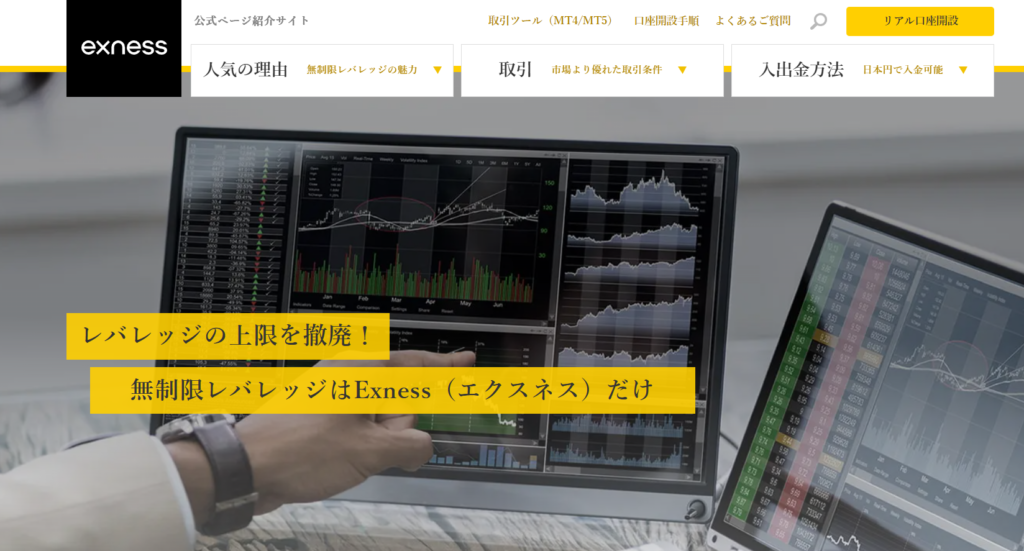
1st Place:Exness(Overall strength No. 1, attractive feature is swap-free)
Source:Exness
■ Recommended points
- Spread: Standard account approx. 2.0 pips / Low spread account approx. 1.3 pips (estimated at the time of editorial check; official rates are subject to change)
- Maximum leverage: Unlimited (conditions apply: effective margin less than $5,000 + trading history; gold is also included) / Up to 2,000x even without meeting the conditions
- Trading fees: None for Standard accounts / $7.0/lot for Low Spread accounts
- Swap points: Buy -35 / Sell -2.6 (Swap is zero when swap-free is applied)
- Execution speed and quality: High speed and low slippage for stable execution.
- Bonus system: None
- Minimum deposit: $10 (Standard) / $200 (Pro Low Spread Account)
Exnessoffers leverage up to 2,000 times and a swap-free system
Unlimited leverage is possible if certain conditions are met
The spreads are narrow, making it suitable for both short-term and long-term traders
With its high execution rate and low trading costs, it receives the No. 1 overall rating
Exnessis a broker eligible for MoneyChat's cashback program. You will receive 40% of the spread back as cashback for each trade, and the cashback amount will be larger for gold, which has a wider spread
Get cash back with every transaction!
2nd place: XMTrading (Beginner-friendly, bonus-focused)
Source:XMTrading
■ Recommended points
- Spread: Standard/Micro approx. 4.0 pips ~ / KIWAMI approx. 2.4 pips (estimate as of the time of editorial check)
- Maximum leverage: 1,000x
- Transaction fees: None (all accounts)
- Swap points: Buy -34.58 / Sell +18.67
- Execution Speed and Quality: Approximately 99% of orders are executed within 1 second, with no requotes.
- Bonus Program: Account opening bonus of 15,000 yen (currently increased for a limited time), 100% + 20% deposit bonus in two stages (maximum $10,500) *As of July 2026
- Minimum deposit: $5 (common to all accounts)
With account opening bonuses and 100% deposit bonuses, it's ideal for trading with small amounts
Leverage up to 1,000x is available, and while the spreads are relatively wide, this can be compensated for by bonuses
With excellent Japanese language support, it provides an ideal environment for beginners
XMTrading is also a broker eligible for MoneyChat's cashback program. Details on how to receive the cashback are explained in the "XM Cashback Complete Guide"
Get both bonuses and cashback!
3rd place: ECMarkets (Attractive due to its extremely narrow spreads and swaps)
Source:ECMarkets
■ Recommended points
- Spread: 0.6 pips and up (ECN account) *Effective cost is spread + trading fee (competitive even with fees included)
- Maximum leverage: 1,000x (effective margin less than $50,000, dynamic leverage system)
- Trading fee: $3.0/lot (round trip) (ECN account)
- Swap points: Check on MT4/MT5 (※Values not publicly disclosed). Swap-free accounts available (application required; eligible instruments must be confirmed officially).
- Bonus system: None
- Minimum deposit: $10 (all accounts)
ECMarkets is highly regarded not only for its low-cost ECN environment with a fee of $3.0/lot, but also for its fast execution speed and high execution rate
The spread for XAU/USD (gold) is 0.6 pips or more, which may seem wider than some competitors, but it is among the narrowest in the industry
Swap-free accounts are also available, making it easy to support medium- to long-term strategies, and it offers stability as a reliable emerging broker
\ Low-cost, swap-free emerging ECN /
4th place: TitanFX (emphasis on ECN environment & execution power)

Source:Titan FX
■ Recommended points
- Spread: Standard (STP) approx. 2.2 pips / Blade (ECN) approx. 2.1 pips (+ commission) *Official measured average as of July 2026
- Maximum leverage: 1,000x (including gold; restrictions apply before market close)
- Trading fees: Standard account: None / Blade account: $7.0/lot (round trip)
- Swap points: Buy -33.89 / Sell +13.5
- Execution speed and quality: 99.9% execution rate, low slippage
- Bonus system: None
- Minimum deposit: Approximately ¥5,000 (domestic bank transfer)
We offer ECN accounts and boast top-class execution capabilities in the industry
Blade accounts offer low costs, even including fees, and are suitable for scalping and day trading
The maximum leverage has been increased to 1,000 times, making it suitable for traders who seek a highly transparent trading environment
There is no bonus system
TitanFX is a broker eligible for MoneyChat's cashback program. You can receive up to $4 cashback per lot
Get cash back with every transaction!
5th Place:Axiory(Emphasis on stable trading environment and transparency)
Source:AXIORY
■ Recommended points
- Spread: Standard (STP) approx. 8.0 pips / Nano/Terra (ECN) approx. 5.9 pips (+ commission) *Based on official real-time table as of July 2026
- Maximum leverage: Gold trading is up to 100x (other currency pairs are up to 400x)
- Trading fees: Standard account: None / Nano/Tera account: $6.0/lot (round trip)
- Swap points: Buy -32.5 / Sell +9.5
- Execution speed and quality: 99.99% execution rate, using Equinix servers.
- Bonus system: No permanent bonuses (occasional campaigns such as mid-year and New Year's gifts are offered).
- Minimum deposit: $10 (all accounts)
We utilize Equinix servers to provide a stable trading environment with a 99.99% execution rate
While ECN accounts offer narrow spreads, the maximum leverage for gold trading is limited to 100x
While there are no permanent bonuses, the platform actively runs irregular campaigns, making it suitable for traders who prioritize stable trading
AXIORYis a cashback eligible broker for MoneyChat. You can receive up to $7.20 in cashback per lot
Get cash back with every transaction!
6th Place:FXGT(Emphasis on high leverage and bonuses)

■ Recommended points
- Spread: STANDARD account approx. 2.9 pips ~ / ECN ZERO account approx. 1.6 pips ~ (+ commission) *Official specifications as of July 2026
- Maximum leverage: Gold up to 2,000x (Optimus account) / Other accounts 1,000x (dynamic leverage based on equity)
- Trading fees: STANDARD account: None / ECN ZERO account: Up to $5.0/lot (round trip)
- Swap points: Buy -34.5 / Sell +16.6
- Execution speed and quality: Standard
- Bonus Program: $70 account opening bonus (Optimus account only, no deposit required), 120% first deposit bonus (up to $400), 50% Milestone bonus, 20-30% Loyalty bonus (as of July 2026)
- Minimum deposit: $5 (all accounts)
With an Optimus account, you can trade gold at leverage of up to 2,000 times, and it also offers a wealth of bonuses, including an account opening bonus and a 120% bonus on your first deposit
It also supports cryptocurrency trading, making it suitable for people considering investments other than FX
While the spreads are relatively wide, you can effectively reduce trading costs by taking advantage of bonuses
FXGTis a broker eligible for MoneyChat's cashback program. You can effectively lower your costs by combining bonuses and cashback
Get cash back with every transaction!
7th Place:ThreeTrader(Emphasis on narrow spreads and execution speed)

Source:ThreeTrader
■ Recommended points
- Spread: Pure Spread approx. 1.3 pips / Raw Zero approx. 0.8 pips (+ commission)
- Maximum leverage: 1,000x (tiered to 500x for effective margin of $5,000 or more)
- Trading fees: Pure no spread / Raw zero account $4.0/lot (round trip)
- Swap points: Buy -31.8 / Sell +19.7
- Execution speed and quality: No limit order restrictions with stop level 0.
- Bonus system: No permanent bonuses (point system and occasional campaigns available)
- Minimum deposit: 10,000 yen (first deposit only; no minimum for subsequent deposits)
Offering some of the narrowest spreads in the industry, it's ideal for scalping and day trading
With a Raw Zero account, you can trade at a low cost of effectively 0.8 pips
With no limit order restrictions and a point system based on trading volume, this platform is suitable for traders who prefer to trade with their own capital while keeping costs down
ThreeTraderis a broker eligible for MoneyChat's cashback program. You can receive up to 0.8 pips in cashback for each trade
Get cash back with every transaction!
Summary (Ranking List)
| Rank | Maximum leverage | spread | Transaction fees | Swap-free | Bonus system |
|---|---|---|---|---|---|
1st place:Exness | Unlimited (with conditions) | 1.3 pips ~ | $7.0/lot (Low account) | 〇 | × |
2nd place:XMTrading | 1,000 times | 2.4 pips ~ | none | × | 〇 |
3rd place:ECMarkets | 1,000 times | 0.6 pips ~ | $3.0/lot (ECN) | 〇 | × |
4th place:TitanFX | 1,000 times | Approximately 2.1 pips~ | $7.0/lot (ECN) | × | × |
5th place:Axiory | 100 times | 0.5 pips ~ | $6.0/lot (ECN) | × | × |
6th place:FXGT | Up to 2,000x (Optimus) | Approximately 1.6 pips ~ | Maximum $5.0/lot (ECN) | × | 〇 |
7th place:ThreeTrader | 1,000 times | Approximately 0.8 pips | $4.0/lot (ECN) | × | × |
The terms and conditions for trading gold (XAU/USD) vary depending on the FX broker
Comparison of trading conditions for gold in overseas forex markets

Here, we compare major overseas forex brokers from three perspectives: spread, swap points, and leverage
Overseas Forex Gold (XAU/USD) Spread Comparison Ranking
Because gold has wider spreads than FX currency pairs,choosing a broker with narrow spreadsis key to reducing trading costs.
| Company name | Standard account spread | ECN account spread (including fees) |
|---|---|---|
| ECMarkets | — | Approximately 0.6 pips (with fees) |
| ThreeTrader | Approximately 1.3 pips | Approximately 0.8 pips (with fees) |
| Exness | Approximately 2.0 pips | Approximately 1.3 pips (with fees) |
| FXGT | Approximately 2.9 pips ~ | Approximately 1.6 pips (with fees) |
| TitanFX | Approximately 2.2 pips | Approximately 2.1 pips (with fees) |
| XMTrading | Approximately 4.0 pips ~ | Approximately 2.4 pips (KIWAMI - no commission) |
| Axiory | Approximately 8.0 pips | Approximately 5.9 pips (with fees) |
*As of July 2026, estimated by the editorial team (1 pip = $0.10). Spreads are variable and will widen during periods of sharp rises in gold prices. ECMarkets officially provides an average ECN spread of 0.6 pips, and since there is no publicly available guideline for STD, it is indicated with "-".ExnessandThreeTraderdo not have officially published fixed values, so these are estimates as of the time of editorial team's verification
Recommended points
- For scalping and short-term trading , low-spread accounts from ECMarkets,ThreeTrader, andExness are ideal.
- If you want to keep costs down simply by eliminating trading fees,XMTrading's KIWAMI accountis a strong contender.
- If you want to trade while taking advantage of bonuses,XMTrading andFXGTare good options.
Overseas Forex Gold (XAU/USD) Swap Point Comparison Ranking
Gold swap points tend to be negative for long positions, while short positions often show positive or small negative swap points (figures are as of July 2026 and are approximate, confirmed by the editorial department)
| Company name | Buy swap (long) | Sell swap (short) | Swap-free account |
|---|---|---|---|
| Exness | -35 | -2.6 | ○ (Swap-free option available) |
| Axiory | -32.5 | +9.5 | × |
| TitanFX | -33.89 | +13.5 | × |
| XMTrading | -34.58 | +18.67 | △ (KIWAMI Extreme offers swap-free trading for eligible stocks) |
| FXGT | -34.5 | +16.6 | × |
| ThreeTrader | -31.8 | +19.7 | × |
| ECMarkets | — | — | ○ (Swap-free option available) |
* "—" = The official fixed list is not yet publicly available (check daily with MT4/MT5 instrument specifications). ECMarkets can be made swap-free upon application
Recommended points
- For those considering long-term holding,Exness/ECMarkets, is the best choice.
- If you want to receive swap points by selling (shorting),ThreeTrader, XMTrading, and TitanFX are advantageous
- While swaps have little impact on short-term trading, swap costs must be considered in long-term trading
Overseas Forex Gold (XAU/USD) Leverage Comparison Ranking
It's important to note that the leverage for gold trading may differ from that for FX currency pairs
| Company name | Maximum leverage (Gold) | Whether or not leverage restrictions are in place |
|---|---|---|
| Exness | Unlimited (with conditions) / Normally 2,000x | Unlimited access is available only if you have an effective margin of less than $5,000 and a trading history |
| FXGT | Up to 2,000x leverage (Optimus) / 1,000x leverage for other accounts | Dynamic leverage based on equity |
| XMTrading | 1,000 times | none |
| ThreeTrader | 1,000 times | Yes (500x leverage for effective margin of $5,000 or more) |
| ECMarkets | 1,000 times | Yes (tiered balance system) |
| TitanFX | 1,000 times | Restrictions apply before market close |
| Axiory | 100x (Gold only) | none |
Recommended points
- For those who want to make large trades with small amounts using high leverage,Exness,FXGT, XMTrading,ThreeTrader, andECMarketsare ideal.
- If you want both a stable trading environment and 1,000x leverage, then TitanFX is the place for you
- Axioryis not suitable for high-leverage trading because its leverage for gold is limited to 100x
Gold 1 Lot Required Margin Simulation
Gold is typically traded in lots of 100 ounces, and if the price of gold is approximately $4,000 per ounce (as of July 2026), the transaction value for one lot would be approximately $400,000 (approximately 60 million yen)
The required margin for each leverage level is as follows:
| Leverage | Required margin (per lot) | Required margin (0.1 lot) |
|---|---|---|
| 25x leverage (maximum for currency pairs in domestic FX) | $16,000 | $1,600 |
| 100 times | $4,000 | $400 |
| 500 times | $800 | $80 |
| 1,000 times | $400 | $40 |
| 2,000 times | $200 | $20 |
With leverage of 1,000x, you can start trading gold with a margin of approximately $400 (about 60,000 yen) for one lot, or just $4 for 0.01 lots。
Due to the soaring price of gold, the required margin is increasing year by year, making overseas forex trading, which allows for high leverage, particularly advantageous for gold. Note that the actual required margin is calculated based on the latest gold price on each company's trading platform
Conclusion: Which company should you choose?
| item | Spread-focused | Swap-focused | Emphasis on leverage |
|---|---|---|---|
| Recommended companies | ThreeTrader / TitanFX / Exness/ ECMarkets | Exness(Swap-free) / ECMarkets (Swap-free) /ThreeTrader(High selling swap) | Exness(unlimited leverage) ・ XMTrading / FXGT / ECMarkets (1,000x leverage) |
How to choose based on your trading style
- Scalping/Day Trading → ThreeTrader, TitanFX, ECMarkets (narrow spreads and low fees)
- Long-term holding considering swaps → Exness/ECMarkets (swap-free),ThreeTrader
- Want to take advantage of high leverage? → Exness(unlimited),FXGT / XMTrading / ECMarkets (1,000x)
Comparing the differences between gold trading and currency pairs in FX

Gold (XAU/USD) trading has different characteristics from FX currency pair trading
Here,trading hours, volatility, and spread—to understand the characteristics of gold trading.
Trading time comparison
Gold (XAU/USD) and FX currency pairs have different trading hours
| item | Gold (XAU/USD) | FX currency pairs |
|---|---|---|
| Trading hours | Almost 24 hours(5 days a week) | 24 hours(5 days a week) |
| Market Open | Monday 7:05~ | Monday 7:00~ |
| Market close | Saturday 6:55 | Saturday 7:00 |
| Active trading hours | London and New York markets(16:00 to 3:00 the following day) | It varies depending on the currency pair |
point
- Gold, like FX currency pairs,can be traded 24 hours a day, 5 days a week.
- Trading is most activeduring the hours when European and US markets are open (16:00 to 3:00 the following day).
- The market fluctuates particularly sharply when important economic indicators (such as US employment statistics and FOMC announcements) are released
Volatility comparison
Gold hashigher volatility (price fluctuations) compared to currency pairs, which means that while it's possible to aim for large profits in a short period, it also carries higher risks.
| item | Gold (XAU/USD) | FX currency pairs (e.g., EUR/USD) |
|---|---|---|
| Average daily fluctuation range | Approximately $30-$80 (estimated based on a gold price of $4,000 in 2026) | 50-100 pips |
| Characteristics of volatility | There are many rapid price fluctuations | Relatively stable trend |
| Factors affected | Interest rate policy, inflation, and geopolitical risks | Interest rate policy, economic indicators, and statements by key figures |
point
- Gold is more volatile than currency pairs, making it easier to incur large profits or losses in a short period of time
- High volatility allows for short-term trading (scalping and day trading)
- Because sudden fluctuations can be difficult to predict, setting a stop-loss order is essential
Spread comparison
The spread for gold (XAU/USD) tends to be wider compared to major FX currency pairs (such as EUR/USD and USD/JPY)
| Contractor | Gold (XAU/USD) Spread | EUR/USD spread |
|---|---|---|
| Exness | Approximately 2.0 pips (Standard) | 0.1–0.8 pips |
| XMTrading | Approximately 4.0 pips | 1.0 to 1.5 pips |
| TitanFX | Approximately 1.6 pips | 0.0 to 0.5 pips |
| Axiory | Approximately 2.5 to 3.0 pips | 0.1–0.8 pips |
point
- Gold spreads are 2 to 4 times wider than those of major FX currency pairs
- When scalping, it's important to choose a broker with a narrow spread
- Using an ECN account (such asExness Raw, TitanFX Blade, orAxioryNano) can help reduce spreads
Summary: Differences from FX currency pairs
| Comparison items | Gold (XAU/USD) | FX currency pairs |
|---|---|---|
| Trading hours | 5 days a week, 24 hours a day (almost the same as forex trading) | 5 days a week, 24 hours |
| Volatility | High (fluctuations of tens of dollars per day) | Medium to low (about 50 to 100 pips per day) |
| spread | Wide range (2.0 to 4.0 pips) | Narrow (0.1 to 1.5 pips) |
| Transaction costs | Slightly high (be aware of swaps and fees) | Low (many accounts have no fees) |
| Main influencing factors | Interest rate policy, inflation, and geopolitical risks | Economic indicators, policy interest rates, and statements by key figures |
Recommended trading styles
- Short-term trading (scalping, day trading)
- Gold: Offers the potential for large price movements, but be aware of spreads and sudden fluctuations
- FX currency pairs: Narrow spreads and stable trading are possible
- Long-term trading (swing trading and position trading)
- Gold: Effective as an inflation hedge, but be aware of swap costs
- FX currency pairs: If you choose a currency pair with positive swap rates (such as USD/JPY), you can also aim for interest income
Frequently Asked Questions (FAQ) about Gold Trading in Overseas Forex Markets

If you're considering trading gold, please use this as a reference
This article addresses common questions traders have when starting to trade gold (XAU/USD)
Is trading gold through overseas forex brokers more advantageous than trading through domestic forex brokers?
Conclusion: Generally, overseas forex trading offers more favorable conditions
- High maximum leverage(500 to unlimited for overseas FX, up to 25 times for domestic FX)
- There is a zero-cut system(no risk of margin calls).
- The spread is relatively wide, but it offers a high degree of trading flexibility
- Some brokers offer generous bonuses, making it easier to keep margin requirements low
However, there are some points to be aware of
- You need to choose a trustworthy overseas forex broker
- The tax system differs(domestic FX is subject to comprehensive taxation, while overseas FX is treated as miscellaneous income).
Do you have a demo account or mini account for gold?
Yes, it is offered by many overseas forex brokers
- Demo Exness, XMTrading, TitanFX, andAxioryare available from major brokers such as accounts
- Mini accounts (small-amount trading) → XMTrading (Micro account),Exness(Standard account),FXGT(Nano account)
Benefits of a demo account
- You can practice trading without using real money
- You can check the price movements and trading conditions of gold in advance
What are the tips for avoiding failure when trading gold (XAU/USD) in overseas forex?
The three basics for consistently winning in Gold are as follows:
1. Use appropriate leverage
- Because gold is highly volatile,using too much leverage increases the risk of a margin call.
- Recommended leverage: 100-500x (100x or less recommended for beginners)
2. Always set a stop-loss order
- Trading without stop-loss orders is risky(especially with gold, which is prone to sharp fluctuations).
- Set a stop-loss (SL) and thoroughly manage risk
3. Exercise caution when trading during economic indicator announcements
- Gold prices fluctuate sharply when employment statistics (NFP) or FOMC announcements are released
- Since the spread will widen temporarily, avoid making risky trades
Is trading gold (XAU/USD) in overseas forex safe?
Choosing a trustworthy vendor ensures safe transactions
- Choose a company that holds a financial license
- Exness(FSA), XMTrading (IFSC), TitanFX (VFSC),Axiory(IFSC) , etc.
- Check execution speed and server stability
- Choose a broker with fast execution speed
- Check whether a zero-cut system is in place
- One of the advantages of overseas forex trading is that you can trade with peace of mind because there are no margin calls (zero cut)
What is the difference between XAUUSD and GOLD?
Bothrefer to the price of "gold (spot gold) and the US dollar," representing the same trading instruments; the differencelies in the symbol notation used by different brokers. Many overseas forex brokers use the notation "XAUUSD," but some, like XMTrading, use "GOLD." Note that gold in the futures market (GC, etc.) is a different product with an expiration date, so be careful not to confuse them.
Can I trade XAUUSD (Gold) on domestic FX platforms using MT4/MT5?
There are only a limited number of domestic brokers that support MT4/MT5 and allow trading of gold as a CFD. Furthermore, domestic commodity CFDs are limited to a maximum leverage of 20x due to regulations.If you want to trade gold with high leverage using MT4/MT5, overseas forex brokers, which offer leverage of 1,000x or more,are a more realistic option.
How much profit or loss can be expected from a given price movement in gold?
Gold is typically traded in lots of 100 ounces, so a$1 movement in the price of gold results in a $100 profit or loss per lot. For 0.1 lots, it's $10, and for 0.01 lots, it's $1. Note that the definition of "1 pip" (whether it's in increments of $0.1 or $0.01) varies by broker, so be sure to check the units when comparing spreads.
What is the required margin for gold trading?
If the price of gold is $4,000 per ounce, with 1,000x leverage, one lot would cost approximately $400, and 0.01 lots would cost approximately $4. For detailed amounts at different leverage levels, please see " Gold 1 Lot Required Margin Simulation "
Summary| A thorough explanation of gold trading in overseas forex! We introduced the appeal, risks, and recommended brokers for XAUUSD.
This article provided a detailed explanation of gold trading in overseas forex markets
Gold tradingan attractive market that offers high volatility and leverage, but risk management is crucial.
Here's a summary of the key points
Key points of gold trading in overseas forex markets
- Gold is a highly volatile financial instrument
- Federal Reserve policies and geopolitical risks influence prices
- With overseas forex trading, leverage of over 2,000 times is possible
- With the zero-cut system, there is no risk of margin calls
- Compare the differences in spreads and swaps across different brokers
- Price action and technical analysis are effective
- The best time to trade gold is during the European and American markets (4 PM to 3 AM)
- Be aware that swap points tend to be negative
- By utilizing the bonus system, trading is possible even with a small amount of capital
- Proper risk management and identifying entry points are crucial
Gold tradinga market where you can aim for profits while minimizing risk, provided you understand trading strategies and choose the right overseas forex broker.
For those just starting out in gold trading,comparing trading conditions and choosing a broker that suits your needsis key to success.
If you're thinking of starting gold trading, I recommend practicing with a demo account first to familiarize yourself with the trading environment。

Overseas forex brokers allow you to trade gold with high leverage.
Therefore, it's possible to earn profits efficiently.
While gold prices are generally more stable than forex prices, they can rise significantly in situations like monetary easing or conflicts. This makes it easier to capitalize on opportunities.
\ Registration and use are completely free /