










"What areHFM(HFM Markets)'s spreads really like?" and "Are their costs cheaper compared to other companies?" are questions that traders who prioritize transaction costs have probably wondered at some point
HFMemploys a variable spread system, meaning the spread can fluctuate significantly depending on the account type, instrument, and time of day
By understanding accurate figures and comparative data, you can make the best choice for your trading style
This article provides a thorough explanation using actual figures, fromHFM's spreads across all instruments to detailed comparisons with other companies and fluctuations by time of day
■What you will learn from reading this article
- Specific spread figures for all HFMinstruments (currency pairs and CFDs)
- Spread comparison by account type with major overseas brokers
- Trends in spread fluctuations depending on time of day and market conditions
- How to choose and use an account to minimize transaction costs
- How to check real-time spreads and points to note
Please use this as a reference when choosing an environment that allows you to minimize transaction costs and maximize profits
We have thoroughly investigated HFM's reliability and instances of withdrawal refusals through HFM's reputation and customer reviews
Features and Mechanism of HFMSpreads

HFMspreads have two important characteristics
The first reason is that they employ a variable spread system that constantly changes according to market conditions, and the second reason is that they offer different spread settings for each account type
Understanding these mechanismswill allow you to choose the environment that best suits your trading style.
With variable spreads, the values displayed on the official website are only estimates; it's crucial to check real-time values using MT4 or MT5 when actually trading
Furthermore, spreads can fluctuate significantly depending on the time of day and whether or not there are economic events, so gathering information in advance is essential
Variable spreads are used
HFMuses a variable spread rather than a fixed spread
This is a system where the spread constantly changes depending on market liquidity and trading volume
Liquidity tends to decrease and spreads tend to widen, especially during weekday evenings and the period immediately following weekends.
The spread will temporarily widen when economic indicators are released or important news is announced
Understanding the characteristics of variable rates makes it possible to develop efficient trading strategies that target periods with narrow spreads
For example, liquidity tends to be high and spreads narrow during the time when the London and New York markets overlap (around 9 PM to 12 AM Japan time), while spreads tend to widen during the early morning hours (around 6 AM to 8 AM Japan time) and around the New Year holidays
By understanding these fluctuation patterns and adjusting your trading timing accordingly, you can effectively reduce transaction costs
Spreads differ depending on the account type
HFMoffers six account types, each with different spread settings
Premium accounts and bonus accounts offer commission-free trading with spreads starting from around 1.2 pips, making them suitable for beginners
The Pro account is commission-free and allows trading from around 0.6 pips, making it suitable for intermediate traders
The Zero account offers the lowest trading costs, with spreads starting from 0.0 pips, but a separate trading fee applies.
Zero Account fees are $6 round trip for major currency pairs and $8 round trip for minor currency pairs
For example, when trading 1 lot of USD/JPY, the commission is approximately 0.6 pips with a Pro account and approximately 0.7 pips with a Zero account
For scalping traders who trade frequently, a zero-cost account is recommended because it often results in the lowest overall trading costs, even including fees
The Cent account is designed for small-amount transactions, while the HF Copy account is specifically configured for copy trading
| Account type | spread | Transaction fees | Features |
|---|---|---|---|
| Premium Account | 1.2 pips ~ | free | Beginner-friendly |
| Bonus account | 1.2 pips ~ | free | Bonus eligible |
| ProDrive | 0.6 pips ~ | free | Intermediate level |
| Zero Account | 0.0 pips ~ | Round trip: $6-8 | Advanced |
| Cent account | 1.2 pips ~ | free | For small transactions |
| HF Copy Account | 1.2 pips ~ | free | Copy trading only |
HFMSpread List [All Currency Pairs and CFD Instruments]

HFMoffers a wide range of trading products, with over 1,200 instruments available, from FX currency pairs to CFD products
The spread for each instrument varies significantly depending on the account type, so it's important to check before trading
In particular, the Zero Account offers some of the narrowest spreads in the industry for many instruments, which is a significant advantage for cost-conscious traders
The instruments we handle are diverse, including major and minor currency pairs, precious metals, energy commodities, stock indices, cryptocurrency CFDs, individual stock CFDs, bond CFDs, and ETFs
Because each category has different spread characteristics, selecting stocks that suit your trading style will be key to maximizing profits
Below, we will provide detailed spread information for each major category
Spreads on major currency pairs
HFM's spread levels on major currency pairs are highly competitive compared to industry standards
With a Zero account, the EUR/USD tradeis at a low level of around 0.1 pips, and the USD/JPY trade is at around 0.4 pips, making it ideal for scalping and short-term trading.
In addition, the Pro account maintains a narrow trading range of 0.6 to 0.9 pips on average while being commission-free, making it exceptionally cost-effective
On the other hand, the Premium Bonus Cent HF Copy account has a slightly wider spread of around 1.7 to 2.8 pips, but both have a simple design with no trading fees
It is designed to be particularly user-friendly for beginners and small-scale traders
By selecting currency pairs and strategies based on the characteristics of each account, you can minimize trading costs
For detailed figures, please refer to the spread comparison table below (these are average guideline values under normal market conditions)
■ Comparison table of spreads for major currency pairs
| currency pair | Premium Account | Bonus account | ProDrive | Zero Account | Cent account | HF Copy Account |
|---|---|---|---|---|---|---|
| EUR/USD (Euro/US Dollar) | 1.7 pips | 2.0 pips | 0.7 pips | 0.1 pips | 1.7 pips | 1.7 pips |
| USD/JPY (US Dollar/Japanese Yen) | 2.4 pips | 2.3 pips | 0.9 pips | 0.4 pips | 2.4 pips | 2.4 pips |
| GBP/USD (British Pound/US Dollar) | 2.0 pips | 2.4 pips | 0.7 pips | 0.1 pips | 2.0 pips | 2.0 pips |
| EUR/JPY (Euro/Japanese Yen) | 2.8 pips | 2.8 pips | 1.1 pips | 0.5 pips | 2.8 pips | 2.8 pips |
| GBP/JPY (British Pound/Japanese Yen) | 3.8 pips | 3.5 pips | 1.5 pips | 0.6 pips | 3.8 pips | 3.8 pips |
| USD/CHF (US Dollar/Swiss Franc) | 2.0 pips | 2.3 pips | 0.6 pips | 0.1 pips | 2.0 pips | 2.0 pips |
| USD/CAD (US Dollar/Canadian Dollar) | 2.2 pips | 2.5 pips | 0.8 pips | 0.2 pips | 2.2 pips | 2.2 pips |
| AUD/USD (Australian Dollar/US Dollar) | 1.7 pips | 2.0 pips | 0.6 pips | 0.0 pips | 1.7 pips | 1.7 pips |
*A separate trading fee (US$6 round trip per lot for major currencies) will be charged for Zero Accounts. (Spreads are variable and may widen depending on the time of day and market liquidity.)
Spreads on minor currency pairs
HFMoffers relatively stable spreads even for minor currency pairs
In particular, by utilizing Pro accounts or Zero accounts,it is possible to trade at costs that are not significantly different from those of major currency pairs.
For example, minor currencies such as NZD/USD, EUR/GBP, and AUD/NZD tend to have lower liquidity and wider spreads, but these are kept to around 0.3-0.5 pips in the Zero account and around 1.0-1.5 pips in the Pro account
On the other hand, bonus accounts, premium accounts, and cent accounts have slightly wider trading limits of around 2.5 to 4.0 pips, which may make them unsuitable for frequent trading
Below is a comparison table of spreads for some representative minor currency pairs. Please use it as a reference when choosing an account
■ Comparison table of spreads for minor currency pairs
| currency pair | Premium Account | Bonus account | ProDrive | Zero Account | Cent account | HF Copy Account |
|---|---|---|---|---|---|---|
| EUR/GBP (Euro/Pound) | 1.6 pips | 1.9 pips | 0.6 pips | 0.0 pips | 1.6 pips | 1.6 pips |
| EUR/AUD (Euro/Australian Dollar) | 2.8 pips | 3.2 pips | 2.0 pips | 1.8 pips | 2.8 pips | 2.8 pips |
| AUD/NZD (Australian Dollar/New Zealand Dollar) | 3.5 pips | 4.0 pips | 2.2 pips | 1.9 pips | 3.5 pips | 3.5 pips |
| NZD/USD (New Zealand Dollar/US Dollar) | 2.3 pips | 2.5 pips | 1.4 pips | 0.9 pips | 2.3 pips | 2.3 pips |
| CHF/JPY (Swiss Franc/Japanese Yen) | 3.3 pips | 3.1 pips | 1.5 pips | 1.7 pips | 3.3 pips | 3.3 pips |
| CAD/JPY (Canadian Dollar/Japanese Yen) | 3.7 pips | 3.7 pips | 1.1 pips | 0.7 pips | 3.7 pips | 3.7 pips |
| GBP/CHF (Pound/Swiss Franc) | 3.6 pips | 4.0 pips | 1.3 pips | 0.9 pips | 3.6 pips | 3.6 pips |
| EUR/NZD (Euro/New Zealand Dollar) | 3.8 pips | 4.2 pips | 2.5 pips | 2.0 pips | 3.8 pips | 3.8 pips |
*With a Zero account,a commission of $8 per lot (round trip)is charged for trading minor currency pairs. (All spreads are variable and fluctuate depending on market conditions.)
Traders who prioritize spreads will find trading with a Pro account or Zero account advantageous
However, minor currencies can experience volatile price movements at certain times, so careful consideration is needed when timing trades
Precious metals spread
HFMoffers a wide variety of precious metal CFDs, including XAU/USD (gold) and XAG/USD (silver), and the spread settings vary significantly depending on the account type
XAU/USD (gold) is particularly popular, and its spreadis kept low, at approximately 1.2 to 1.7 pips in a Pro account and around 1.0 pip in a Zero account, allowing for trading with low spreads.
On the other hand,premium accounts, bonus accounts, and cent accounts have a slightly wider spread of around 3.0 pips, which may make them less suitable for frequent scalping.
Furthermore, minor precious metal CFDs such as platinum (XPT/USD) and palladium (XPD/USD)have extremely wide spreads of around 1,000 to 1,600 pips,making them unsuitable for short-term trading.
Below is a table comparing the average spreads for representative precious metals across different account types
■ Comparison Table of Precious Metal Spreads
| Brand | Premium Account | Bonus account | ProDrive | Zero Account | Cent account | HF Copy Account |
|---|---|---|---|---|---|---|
| XAU/USD (Gold/US Dollar) | 3.0 pips | 3.1 pips | 1.2-1.7 pips | 1.0 pips | 3.0 pips | 3.0 pips |
| XAU/EUR (Gold/Euro) | 2.9 pips | 4.0 pips | 3.0 pips | 3.0 pips | 2.9 pips | 2.9 pips |
| XAG/USD (Silver/US Dollar) | 2.9 pips | 2.9 pips | 2.9 pips | 2.9 pips | 2.9 pips | 2.9 pips |
| XAG/EUR (Silver/Euro) | 3.1 pips | 3.1 pips | 3.3 pips | 3.3 pips | 3.1 pips | 3.1 pips |
| XPT/USD (Platinum/US Dollar) | 954 pips | 990 pips | 954 pips | 990 pips | 990 pips | 990 pips |
| XPD/USD (Palladium/US Dollar) | 1408 pips | 1630 pips | 1408 pips | 1630 pips | 1630 pips | 1630 pips |
*With a Zero account,trading fee of approximately $10 round trip per lotwill be charged. (All spreads are average values and may fluctuate depending on market conditions.)
As such,gold and silver have relatively low spreads, making Zero Account and Pro Account advantageous for traders who prioritize costs.
On the other hand, minor precious metals are subject to significant price fluctuations and high transaction costs, so careful consideration is required when investing in them
Energy product spread
HFMoffers three types of energy commodities for trading: WTI crude oil (USOIL), Brent crude oil (UKOIL), and natural gas (NATGAS)
In particular, our natural gas spread is extremely narrow at 0.01 pips, and we achieve industry-leading competitiveness across all energy products
WTI crude oil has a trade-off of approximately 0.11 pips, and Brent crude oil has a trade-off of approximately 0.07 pips. These figures are overwhelmingly narrower compared to other companies
The Pro account offers even narrower spreads, providing an astonishingly tight 0.03 pips for WTI crude oil and 0.04 pips for Brent crude oil
With the Zero account, in addition to the spreads mentioned above, a commission of approximately $6-8 per round trip lot is charged, but even taking that into account, the total cost is very competitive
Energy commodities are susceptible to geopolitical risks, OPEC meetings, and the release of US crude oil inventory statistics, and spreads may widen during these events
Please note that this service is not available for cent accounts
■ Comparison table of energy product spreads
| Brand | Premium Account | Bonus account | ProDrive | Zero Account | Cent account | HF Copy Account |
|---|---|---|---|---|---|---|
| WTI crude oil (USOIL) | 0.11 pips | 0.11 pips | 0.03 pips | 0.11 pips | Not available | 0.11 pips |
| Brent crude oil (UKOIL) | 0.07 pips | 0.07 pips | 0.04 pips | 0.07 pips | Not available | 0.07 pips |
| Natural gas (NATGAS) | 0.01 pips | 0.01 pips | 0.01 pips | 0.01 pips | Not available | 0.01 pips |
*With a Zero account,trading fee of approximately $6-8 per lot (round trip)will be charged. (All spreads are average values and may fluctuate depending on market conditions.)
Trading hours for energy commodities are from Monday 01:05 to Saturday 00:00 (server time). Spreads can widen sharply during important events such as crude oil inventory statistics releases and OPEC meetings, so checking the economic calendar and appropriate risk management are essential
Cryptocurrency CFD spreads
HFM,including popular ones such as Bitcoin (BTC/USD) and Ethereum (ETH/USD).
Here, we'll pick out 15 representative stocks and compare their average spreads (in pips) for each account type
For example,with Bitcoin (BTC/USD),there is a significant difference in gains: approximately 6032.8 pips in a premium account and approximately 1828.5 pips in a pro account. Choosing the right account for your trading style is crucial.
Premium accounts and bonus accounts have wider spreads but no commissions, while pro accounts and zero accounts have narrower spreads but incur commissions
Cent accounts do not offer cryptocurrency CFDs, while HF Copy accounts have spread levels equivalent to premium accounts
■Cryptocurrency CFD Spread Comparison Table
| Brand | Premium Account | Bonus account | ProDrive | Zero Account | Cent account | HF Copy Account |
|---|---|---|---|---|---|---|
| BTC/USD (Bitcoin) | 6032.8 pips | 6221.8 pips | 1828.5 pips | 1820.6 pips | ― | 6032.8 pips |
| ETH/USD (Ethereum) | 487.4 pips | 687.9 pips | 152.2 pips | 151.1 pips | ― | 487.4 pips |
| XRP/USD (Ripple) | 23.0 pips | 25.0 pips | 8.2 pips | 8.2 pips | ― | 23.0 pips |
| LTC/USD (Litecoin) | 2890.2 pips | 3075.4 pips | 1825.0 pips | 1835.1 pips | ― | 2890.2 pips |
| BCH/USD (Bitcoin Cash) | 251.1 pips | 252.7 pips | 74.0 pips | 73.1 pips | ― | 251.1 pips |
| BNB/USD (Binance Coin) | 193.9 pips | 195.4 pips | 61.3 pips | 60.5 pips | ― | 193.9 pips |
| ADA/USD (Cardio Dam) | 21.7 pips | 23.7 pips | 5.2 pips | 5.3 pips | ― | 21.7 pips |
| SOL/USD (Solana) | 101.1 pips | 103.1 pips | 31.9 pips | 32.0 pips | ― | 101.1 pips |
| DOT/USD (Polka Dot) | 3.9 pips | 4.1 pips | 1.3 pips | 1.3 pips | ― | 3.9 pips |
| DOGE/USD | 8.1 pips | 8.4 pips | 2.5 pips | 2.4 pips | ― | 8.1 pips |
| TRX/USD (Tron) | 8.1 pips | 8.7 pips | 4.7 pips | 4.8 pips | ― | 8.1 pips |
| SHIB/USD (Shiba Inu) | 3.7 pips | 3.9 pips | 0.8 pips | 0.8 pips | ― | 3.7 pips |
| XLM/USD (Stellar) | 9.9 pips | 10.1 pips | 3.2 pips | 3.2 pips | ― | 9.9 pips |
| AVAX/USD (Avalanche) | 2.2 pips | 2.2 pips | 0.7 pips | 0.7 pips | ― | 2.2 pips |
| XMR/USD (Monero) | 17.4 pips | 20.1 pips | 8.6 pips | 9.8 pips | ― | 17.4 pips |
*With a Zero account, a separatetrading fee of approximately $6-8 per lot round tripwill be charged. (All spreads are average values and are subject to change depending on market conditions and liquidity.)
Since cryptocurrency CFDs can be traded on weekends, trading takes place under different liquidity conditions than on weekdays
Spreads tend to widen, especially on weekends and in the early morning , so checking trading hours and managing risk are essential. Understanding the cost structure of each account and choosing the best conditions for you is the first step to success.
Commodity spreads
At HFM, you can trade major commodity CFDs such as sugar, copper, coffee, cocoa, and cotton
These platforms offer narrow spreads, making them attractive for their low-cost access to the commodity market
For example,Sugar #11 offers a very low spread of 0.06 pips across all accounts, and Copperoffers a very low spread of 0.008 pips.
Furthermore,coffee is trading at 0.98 pips,US cocoa at 10.0 pips,and US cotton No. 2at 0.30 pips, all at stable levels.
These commodities are available for trading in "Premium Accounts," "Bonus Accounts," "Pro Accounts," "Zero Accounts," and "HF Copy Accounts," but they are not available in Cent Accounts
■ Comparison Table of Commodity CFD Spreads
| Brand | Premium Account | Bonus account | ProDrive | Zero Account | Cent account | HF Copy Account |
|---|---|---|---|---|---|---|
| Sugar (Sugar #11) | 0.06 pips | 0.06 pips | 0.06 pips | 0.06 pips | ― | 0.06 pips |
| Copper | 0.008 pips | 0.008 pips | 0.008 pips | 0.008 pips | ― | 0.008 pips |
| Cocoa (US Cocoa) | 10.0 pips | 10.0 pips | 10.0 pips | 10.0 pips | ― | 10.0 pips |
| Coffee | 0.98 pips | 0.98 pips | 0.98 pips | 0.98 pips | ― | 0.98 pips |
| Cotton (US Cotton No. 2) | 0.30 pips | 0.30 pips | 0.30 pips | 0.30 pips | ― | 0.30 pips |
*With a Zero account, a separatetrading fee of approximately $6 per lot (round trip) will be charged.(All spreads are average values and are subject to change depending on market conditions and liquidity.)
Thus,HFM's commodity CFDstheir stable spreads, with virtually no difference across all account types.
Many of these stocks have relatively stable price movements and are suitable for the medium to long term,them a good choice for those looking to incorporate them as part of a diversified investment strategy.
Stock index CFD spread
At HFM, you can trade a wide range of leading global stock index CFDs, including the Nikkei 225, Dow Jones Industrial Average, S&P 500, Nasdaq 100, and German DAX 40
These indices are popular alongside FX, and understanding their price movement characteristics can lead to significant trading opportunities
A notable featurethat the same spread applies to all account types.
Whether you have a premium account, a pro account, or even a beginner-friendly cent account, you can trade stock index CFDs under fair conditions
For the Zero account, the spread itself is the same as other accounts, but a separate trading commission of $6-8 per lot (round trip) is required
Below is a summary of the stock index CFD spreads for 15 representative stocks, categorized by account type
■ Stock Index CFD Spread Comparison Table
| Brand | Premium Account | Bonus account | ProDrive | Zero Account | Cent account | HF Copy Account |
|---|---|---|---|---|---|---|
| JP225 (Nikkei 225) | 1.8 pips | 1.8 pips | 1.8 pips | 1.8 pips | 1.8 pips | 1.8 pips |
| US30 (Dow Jones Industrial Average) | 2.4 pips | 2.4 pips | 2.4 pips | 2.4 pips | 2.4 pips | 2.4 pips |
| US500 (S&P500) | 0.4 pips | 0.4 pips | 0.4 pips | 0.4 pips | 0.4 pips | 0.4 pips |
| NAS100 (NASDAQ 100) | 1.4 pips | 1.4 pips | 1.4 pips | 1.4 pips | 1.4 pips | 1.4 pips |
| DE40 (German DAX40) | 1.6 pips | 1.6 pips | 1.6 pips | 1.6 pips | 1.6 pips | 1.6 pips |
| UK100 (FTSE100) | 1.0 pips | 1.0 pips | 1.0 pips | 1.0 pips | 1.0 pips | 1.0 pips |
| FRA40 (French CAC40) | 1.5 pips | 1.5 pips | 1.5 pips | 1.5 pips | 1.5 pips | 1.5 pips |
| EU50 (Eurostoxx 50) | 1.0 pips | 1.0 pips | 1.0 pips | 1.0 pips | 1.0 pips | 1.0 pips |
| AUS200 (Australian ASX200) | 1.2 pips | 1.2 pips | 1.2 pips | 1.2 pips | 1.2 pips | 1.2 pips |
| HK50 (Hong Kong Hang Seng) | 5.8 pips | 5.8 pips | 5.8 pips | 5.8 pips | 5.8 pips | 5.8 pips |
| SPA35 (Spanish IBEX35) | 5.0 pips | 5.0 pips | 5.0 pips | 5.0 pips | 5.0 pips | 5.0 pips |
| NL25 (Netherlands AEX) | 1.4 pips | 1.4 pips | 1.4 pips | 1.4 pips | 1.4 pips | 1.4 pips |
| SWI20 (Swiss SMI) | 3.2 pips | 3.2 pips | 3.2 pips | 3.2 pips | 3.2 pips | 3.2 pips |
| IT40 (Italian MIB) | 8.5 pips | 8.5 pips | 8.5 pips | 8.5 pips | 8.5 pips | 8.5 pips |
| NOR25 (Norway) | 2.5 pips | 2.5 pips | 2.5 pips | 2.5 pips | 2.5 pips | 2.5 pips |
*With a Zero account,trading fee of approximately $6-8 per lot (round trip) will be charged.(The spread is an average and may fluctuate depending on market conditions.)
Stock index CFDs have different price movement and volatility characteristics depending on the specific stock
It's important to understand the characteristics of each index and use them accordingly. For example, the S&P 500 is suitable for short-term trading due to its stable price movements, the Nasdaq 100 is attractive for its light price fluctuations, and the Nikkei 225 and DAX 400 tend to show clear trends
Spreads on individual stock CFDs
At HFM, you can trade shares of world-leading companies such as Apple, Tesla, and Amazon as CFDs
Similar to stock index CFDs,there are no spread differences between account types; the same spread levelis offered across all account types.
Even with a Zero account, the same spreads apply as with other accounts, and no additional fees are charged
In short, the appeal lies in the fact that you can trade under fair conditions regardless of which account you use
Below is a comparison table of average spreads for 20 representative stocks
Stock CFDs cannot be traded in a cent account, hence the "-" symbol
■ Individual Stock CFD Spread Comparison Table
| Brand | Premium Account | Bonus account | ProDrive | Zero Account | Cent account | HF Copy Account |
|---|---|---|---|---|---|---|
| Apple | 2.4 pips | 2.4 pips | 2.4 pips | 2.4 pips | ― | 2.4 pips |
| Amazon | 82.7 pips | 82.7 pips | 82.7 pips | 82.7 pips | ― | 82.7 pips |
| Tesla | 28.0 pips | 28.0 pips | 28.0 pips | 28.0 pips | ― | 28.0 pips |
| Alphabet (Google) | 38.0 pips | 38.0 pips | 38.0 pips | 38.0 pips | ― | 38.0 pips |
| Meta (Facebook) | 6.6 pips | 6.6 pips | 6.6 pips | 6.6 pips | ― | 6.6 pips |
| Microsoft | 2.8 pips | 2.8 pips | 2.8 pips | 2.8 pips | ― | 2.8 pips |
| NVIDIA | 3.5 pips | 3.5 pips | 3.5 pips | 3.5 pips | ― | 3.5 pips |
| AMD (Advanced Micro Devices) | 1.2 pips | 1.2 pips | 1.2 pips | 1.2 pips | ― | 1.2 pips |
| Netflix | 12.4 pips | 12.4 pips | 12.4 pips | 12.4 pips | ― | 12.4 pips |
| Alibaba | 3.6 pips | 3.6 pips | 3.6 pips | 3.6 pips | ― | 3.6 pips |
| Coca-Cola | 0.6 pips | 0.6 pips | 0.6 pips | 0.6 pips | ― | 0.6 pips |
| Disney | 1.4 pips | 1.4 pips | 1.4 pips | 1.4 pips | ― | 1.4 pips |
| Johnson & Johnson (JNJ) | 2.3 pips | 2.3 pips | 2.3 pips | 2.3 pips | ― | 2.3 pips |
| JP Morgan | 2.0 pips | 2.0 pips | 2.0 pips | 2.0 pips | ― | 2.0 pips |
| Boeing | 5.0 pips | 5.0 pips | 5.0 pips | 5.0 pips | ― | 5.0 pips |
| ExxonMobil | 1.6 pips | 1.6 pips | 1.6 pips | 1.6 pips | ― | 1.6 pips |
| McDonald's | 2.2 pips | 2.2 pips | 2.2 pips | 2.2 pips | ― | 2.2 pips |
| Visa | 3.2 pips | 3.2 pips | 3.2 pips | 3.2 pips | ― | 3.2 pips |
| Uber | 0.5 pips | 0.5 pips | 0.5 pips | 0.5 pips | ― | 0.5 pips |
| Goldman Sachs (GS) | 4.8 pips | 4.8 pips | 4.8 pips | 4.8 pips | ― | 4.8 pips |
*All individual stock CFDs, including those in Zero Accounts, are commission-free.(The spread is an average estimate and may fluctuate depending on market conditions.)
A key characteristic of individual stock CFDs is the large spread difference between different stocks
For example, stable stocks like Apple and Coca-Cola can be traded at very narrow price levels, typically between 1 and 3 pips
On the other hand, for stocks with high price levels and high volatility, such as Amazon and Tesla, the spread can be as wide as several tens of pips or more
In CFD trading, it's important to be aware that choosing stable instruments helps keep costs down, while highly volatile instruments offer opportunities for short-term trading
Bond CFD spreads
HFMoffers three types of bond CFDs: US 10-year Treasury bonds, German 10-year government bonds (Eurobund), and UK 10-year government bonds (Gilt)
All of these are safe-haven assets representing their respective countries, and theirstable price movements and narrow spreadsare attractive features.
While its volatility is lower compared to stock indices and currency pairs, it can be widely used for speculation and hedging as a security that reflects interest rate trends
Below is a summary of the average spreads for bond CFDs by account type. Cent accounts and HF Copy accounts have the same conditions as premium accounts
■ Bond CFD Spread Comparison Table
| Brand | Premium Account | Bonus account | ProDrive | Zero Account | Cent account | HF Copy Account |
|---|---|---|---|---|---|---|
| US 10-Year Treasury Bond | 0.6 pips | 0.6 pips | 0.6 pips | 0.5 pips | 0.6 pips | 0.6 pips |
| German 10-year government bond (Eurobund) | 0.5 pips | 0.5 pips | 0.5 pips | 0.5 pips | 0.5 pips | 0.5 pips |
| UK 10-year government bond (Gilt) | 0.5 pips | 0.5 pips | 0.5 pips | 0.5 pips | 0.5 pips | 0.5 pips |
*With a Zero account,a separate trading fee of approximately $6-8 per lot (round trip) will be charged.(The spread is an average and may fluctuate depending on market conditions.)
In particular, the U.S. 10-year Treasury bond is widely referenced as a global interest rate benchmark and is an important indicator that influences the dollar and stock markets
German 10-year government bonds (Eurobund) are a representative safe-haven asset in the Eurozone and can be considered a barometer reflecting the ECB's monetary policy
The UK 10-year government bond (Gilt) is also attracting attention as a security that incorporates the UK interest rate outlook
HFMallows you to trade these bond CFDs with leverage up to 50 times, making them effective for hedging during risk-off periods and for portfolio diversification
ETF stock spread
HFMallows trading of stock indices, individual stocks, and CFDs of ETFs (Exchange Traded Funds)
ETFs are products that bundle multiple stocks, offering high diversification benefits and potentially more stable price movements than individual stocks
In particular, representative ETFs such as SPY (S&P 500-linked) and QQQ (Nasdaq 100-linked) have high liquidity andsmall price discrepancies, making them suitable for short- to medium-term trading.
On the other hand, thematic ETFs and some overseas ETFs tend to have lower liquidity and slightly wider spreads, making them suitable for medium- to long-term investment
Just like with stock index CFDs and individual stock CFDs, the spread levels for ETFs are the same across all account types
This also contributes to the ease of understandingHFM's ETF trading
Below is a summary of the average spreads for 15 representative stocks, broken down by account type
Cent accounts and HF copy accounts are subject to the same terms and conditions as premium accounts
■ETF Spread Comparison Table
| ETF stocks | Premium Account | Bonus account | ProDrive | Zero Account | Cent account | HF Copy Account |
|---|---|---|---|---|---|---|
| SPDR S&P 500 ETF Trust (SPY) | 2.0 pips | 2.0 pips | 2.0 pips | 2.0 pips | 2.0 pips | 2.0 pips |
| Invesco QQQ Trust (QQQ) | 2.0 pips | 2.0 pips | 2.0 pips | 2.0 pips | 2.0 pips | 2.0 pips |
| SPDR Gold Shares (GLD) | 1.8 pips | 1.8 pips | 1.8 pips | 1.8 pips | 1.8 pips | 1.8 pips |
| WTI crude oil indexed ETF (USO) | 1.5 pips | 1.5 pips | 1.5 pips | 1.5 pips | 1.5 pips | 1.5 pips |
| Materials Select SPDR (XLB) | 1.0 pips | 1.0 pips | 1.0 pips | 1.0 pips | 1.0 pips | 1.0 pips |
| Energy Select SPDR (XLE) | 0.9 pips | 0.9 pips | 0.9 pips | 0.9 pips | 0.9 pips | 0.9 pips |
| Financial Select SPDR (XLF) | 0.8 pips | 0.8 pips | 0.8 pips | 0.8 pips | 0.8 pips | 0.8 pips |
| Technology Select SPDR (XLK) | 0.9 pips | 0.9 pips | 0.9 pips | 0.9 pips | 0.9 pips | 0.9 pips |
| SPDR (XLP) - A selection of essential household goods | 0.8 pips | 0.8 pips | 0.8 pips | 0.8 pips | 0.8 pips | 0.8 pips |
| Public Utilities Select SPDR (XLU) | 0.8 pips | 0.8 pips | 0.8 pips | 0.8 pips | 0.8 pips | 0.8 pips |
| Healthcare Select SPDR (XLV) | 0.9 pips | 0.9 pips | 0.9 pips | 0.9 pips | 0.9 pips | 0.9 pips |
| General Consumer Goods Select SPDR (XLY) | 1.0 pips | 1.0 pips | 1.0 pips | 1.0 pips | 1.0 pips | 1.0 pips |
| iShares Russell 1000 (IWB) | 1.5 pips | 1.5 pips | 1.5 pips | 1.5 pips | 1.5 pips | 1.5 pips |
| Vanguard Total Global Stocks (VXUS) | 1.2 pips | 1.2 pips | 1.2 pips | 1.2 pips | 1.2 pips | 1.2 pips |
| iShares Corporate Bond ETF (LQD) | 1.0 pips | 1.0 pips | 1.0 pips | 1.0 pips | 1.0 pips | 1.0 pips |
*With a Zero account,a separate trading fee of approximately $6 per lot (round trip) will be charged.(All spreads are average values and may fluctuate depending on market conditions.)
HFMvs. other companies' spread comparison

When choosing an overseas forex broker, the level of the spread is one of the important factors to consider
However, it's not enough to simply compare numbers; you need to consider account types and trading conditions when making your decision
This section compares the spreads ofHFMand other major brokers (such asTitan FX, XMTrading,AXIORY,Exness, andBigBoss), separated into standard and zero-spread accounts
Furthermore, by organizing the overall levels and trends, you can use this information to help you choose an account that suits your trading style
Standard account spread comparison
The spread on a standard account (called a "premium account" atHFM) is one of the most frequently compared points when choosing an overseas forex broker
Here, let's compare the standard account spreads of five major overseas forex brokers, includingHFM, for 10 major currency pairs
■ List of average spreads for the 10 major currency pairs (excluding trading fees)
| currency pair | HFM | Titan FX | XMTrading | Axiory | Exness | BigBoss |
|---|---|---|---|---|---|---|
| USD/JPY | 1.76 pips | 1.28 pips | 1.80 pips | 1.51 pips | 1.42 pips | 1.47 pips |
| EUR/USD | 1.44 pips | 1.24 pips | 1.76 pips | 1.26 pips | 1.12 pips | 1.42 pips |
| GBP/JPY | 3.80 pips | 2.38 pips | 3.76 pips | 2.10 pips | 2.69 pips | 2.30 pips |
| GBP/USD | 2.12 pips | 1.75 pips | 2.03 pips | 1.62 pips | 1.56 pips | 1.62 pips |
| EUR/JPY | 2.42 pips | 1.43 pips | 2.28 pips | 1.54 pips | 2.15 pips | 1.72 pips |
| AUD/JPY | 2.53 pips | 1.76 pips | 3.21 pips | 1.89 pips | 2.40 pips | 1.79 pips |
| NZD/JPY | 2.19 pips | 1.90 pips | 3.01 pips | 1.93 pips | 3.57 pips | 2.29 pips |
| AUD/USD | 1.90 pips | 1.12 pips | 1.81 pips | 1.68 pips | 1.49 pips | 2.31 pips |
| AUD/NZD | 3.77 pips | 1.92 pips | 4.07 pips | 1.94 pips | 2.85 pips | 2.11 pips |
| (Reference) EUR/GBP | 1.82 pips | 1.32 pips | 2.00 pips | 1.45 pips | 1.36 pips | 2.00 pips |
*All spreads in the tableaverage values. (Actual spreads will fluctuate depending on market liquidity and time of day.)
Looking solely at the average spread, there are some currency pairs where this broker lags behind certain narrow-spread brokers such asTitan FXandExness
However,HFMmaintainsa mid-to-upper-tier spread level within the industry as a wholeparticularlyconsidered "excellent" amongcan be
Furthermore,the Zero Account, which will be explained next, offers more competitive spreads, so those who focus on short-term trading such as scalping should definitely check it out.
Zero Account Spread Comparison
HFM's Zero account is an account type designed for traders who prioritize narrow spreads
Here, we compare the spreads of 10 major currency pairs with spread-focused accounts from other companies (Titan FXBlade account, XMTrading Zero account,AxioryNano account,ExnessLow Spread account,BigBossPro Spread account)
■Zero Account Spread Comparison Table
| currency pair | HFM | Titan FX | XMTrading | Axiory | Exness | BigBoss |
|---|---|---|---|---|---|---|
| USD/JPY (US Dollar/Japanese Yen) | 0.4 pips | 0.33 pips | 0.2 pips | 0.4 pips | 0.0 pips | 0.6 pips |
| EUR/USD (Euro/Dollar) | 0.0 pips | 0.2 pips | 0.2 pips | 0.4 pips | 0.0 pips | 0.3 pips |
| GBP/JPY (British Pound/Japanese Yen) | 0.6 pips | 1.45 pips | 1.2 pips | 1.7 pips | 0.5 pips | 1.1 pips |
| GBP/USD (British Pound/Dollar) | 0.1 pips | 0.57 pips | 0.9 pips | 0.9 pips | 0.1 pips | 0.5 pips |
| EUR/JPY (Euro/Japanese Yen) | 0.5 pips | 0.74 pips | 1.2 pips | 0.7 pips | 0.6 pips | 0.7 pips |
| AUD/JPY (Australian Dollar/Japanese Yen) | 1.5 pips | 1.12 pips | 1.5 pips | 0.9 pips | 0.3 pips | 1.0 pips |
| NZD/JPY (New Zealand Dollar/Japanese Yen) | 1.3 pips | 1.62 pips | 1.5 pips | 1.0 pips | 1.4 pips | 1.1 pips |
| AUD/USD (Australian Dollar/US Dollar) | 0.0 pips | 0.52 pips | 0.8 pips | 0.6 pips | 0.0 pips | 0.6 pips |
| AUD/NZD (Australian Dollar/New Zealand Dollar) | 1.9 pips | 2.03 pips | 2.0 pips | 1.2 pips | 0.3 pips | 1.4 pips |
| EUR/GBP (Euro/Pound) | 0.0 pips | 0.53 pips | 0.7 pips | 0.8 pips | 0.4 pips | 0.3 pips |
HFM's Zero Account offers extremely favorable spreads , especially for major currency pairs such as EUR/USD, AUD/USD, and EUR/GBP, achieving a spread of 0.0 pips
On the other hand,a slightly wider spreadis observed in pairs such as AUD/JPY and NZD/JPY.
Nevertheless, overall,Titan FXandExnessan attractive option for traders who prioritize short-term tradingmaking it
In the next section, we will also compare them from the perspective of overall spread levels
Comparison of overall spread levels
Overall,HFM's spreads are quite competitive compared to other companies
Especially with its Zero Account, it's on par withExnessandTitan FX, making it attractive to traders who focus on short-term trading
The followinga list comparing the average spreads of various brokers for standard and zero-spread accounts, using the USD/JPY pair, which is familiar to Japanese traders, as the benchmark.
| Broker name | Standard Account | Zero-series accounts |
|---|---|---|
| HFM | 2.4 pips (premium) | 0.4 pips (zero) |
| Titan FX | 1.3 pips (Zero Standard) | 0.3 pips (blade) |
| XMTrading | 1.6 pips (Standard) | 0.1 pips (zero) |
| Axiory | 1.4 pips (Standard) | 0.5 pips (nano) |
Exness | 1.1 pips (Standard) | 0.0 pips (zero) |
| BigBoss | 1.8 pips (Standard) | 0.6 pips (Pro Spread) |
HFM's Zero Account is competitive within the industry, even when compared to other companies' low-spread accounts, and is definitely worth considering as an option
On the other hand, standard accounts tend to be slightly larger, so if cost is a major concern, it's more practical to consider a zero-cost account
Factors that cause fluctuations HFMspreads

HFMuses a spread system that fluctuates in real time according to market conditions, rather than a fixed spread
This approach aims to always offer the most favorable trading conditions, but is characterized by significant fluctuations in spreads due to external factors such as time of day, market liquidity, and the release of economic indicators
For example, wider spreads may be offered during periods of low liquidity, such as late at night or at the start of the week, or immediately before or after the release of important economic indicators
Therefore, understanding the factors that cause spread fluctuations and adjusting your trading strategy accordingly is essential for stable trading
Spread widening depending on the time of day
With overseas forex brokers, including HFM, there are significant differences in spread width depending on the trading time
Particularcaution is needed during periods of low liquidity, such as early morning hours in Japan, immediately after the start of the week, and just before the New York market closes.
During this time, the number of market participants decreases, making it more difficult to place orders, and in some cases, the spread can widen to more than twice its normal size
On the other hand, the period from 9 PM to 1 AM (Japan time), when the London and New York markets overlap, is a time when trading activity increases and spreads tend to be more stable
Even with HFM, spreads tend to narrow during this time, making it crucial for determining entry and exit timings
By understanding the trend of widening spreads at different times of the day, you can achieve both reduced trading costs and risk avoidance
Impact of economic indicator announcements
Around the time important economic indicators are released, spreads widen significantly at many FX brokers, includingHFM
Representative indicators include US employment statistics, CPI, and FOMC policy interest rates. When these indicators attract the attention of market participants, liquidity temporarily decreases and volatility increases
As a result, the USD/JPY spread, which is normally 0.2 to 0.3 pips,can widen to several pips, or even up to around 10 pips, during events such as US employment statistics releases or FOMC meetings.
Furthermore, during the release of economic indicators, the risk of slippage, where the execution price shifts due to sharp price fluctuations, increases, requiring a more cautious approach
HFM, we strive to provide highly transparent pricing even during times like these, butcrucial for traders themselves to thoroughly manage risk by checking the economic calendar, refraining from entering trades, or adjusting their positions.
Fluctuations due to increased market volatility
When global risk events or sudden news break, market volatility tends to increase sharply, and consequently,HFMspreads also tend to fluctuate significantly
Examples include geopolitical risks, natural disasters, statements by key figures, and changes in monetary policy
These events can instantly shake market sentiment and trigger sudden price changes that are unthinkable under normal circumstances
In that case, the spread will also widen significantly, and there is a possibility that trading costs will be higher than expected when entering or closing positions
Even in environments with extremely narrow spreads, such as Zero Account, spreads can widen to 5-10 pips or more during volatile market conditions
Furthermore, if volatility becomes extremely high,even major currencies could see price movements widen to around 20 pips,so caution is advised.
In highly volatile markets, more sophisticated risk control is required, such as reviewing position sizes and resetting stop-loss levels
How to check the spread on HFM

HFMspreads are variable and therefore not always the same
Therefore, traders need to monitor the situation in real time while making trades
There are three main ways to check this: using the quote window in the trading tools MT4 or MT5, referring to the spread information posted on the official website, and using a smartphone app to check it while on the go
All of these tools are free to use, and a major advantage is that you can instantly obtain accurate figures, especially if you use the official tools
Here, we will explain each step
How to check in MT4/MT5
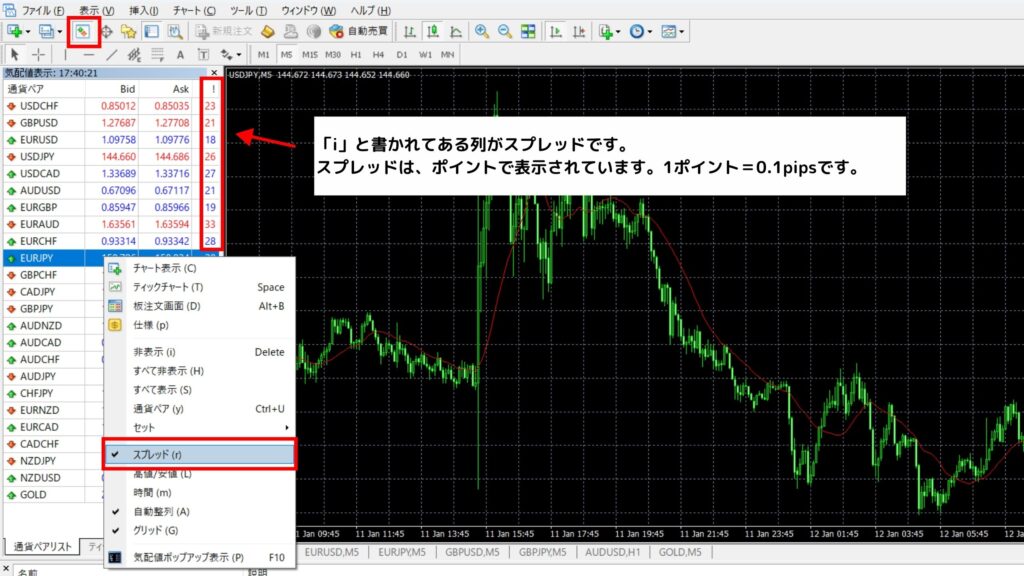
The most accurate way to understand HFMspreads is to use trading platforms such as MT4 or MT5
Once you log into your account and open the quote window, the "BID" and "ASK" prices for each currency pair and CFD product will be displayed in real time
In this state, right-click on the currency pair you want to check and select "Spread"
Then, the spread for that stock will be displayed. The column labeled "i" is the spread
The spread is displayed in points.1 point = 0.1pips.
For example, if the BID price for USD/JPY is 144.660 and the ASK price is 144.686, the current spread is the difference of 0.26 pips
Furthermore, by setting a spread indicator on the chart, you can check not only the numerical values but also the spread visually
A major advantage of checking on the official platform is that you can see the actual trading conditions without any discrepancies
Beginners are advised to check using this method first
How to check on the official website
HFMalso publishes spreads for each account type on its official website
A table is available that shows the average gains for USD/JPY, such as 0.4 pips for Zero accounts and 2.4 pips for Premium accounts, and anyone can check it
The official page provides reference values, and the actual spreads displayed during trading will fluctuate depending on market conditions, but it is still useful for getting a general idea of the level
Especially when considering opening a new account, the most efficient way to learn about this is to check the spread table on the official website and compare it with other companies
While it's inferior to MT4/MT5 in terms of real-time capabilities, it's a convenient tool for getting an overview
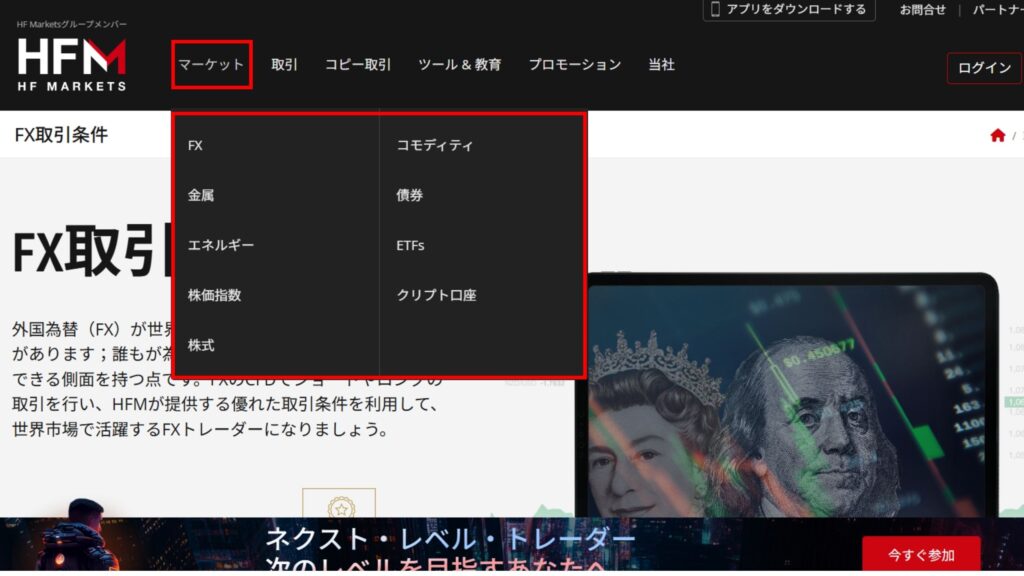
Source:HFM
First,HFMplease openHFMClick here for.
In the upper left corner, there is a menu called "Market." Hover your cursor over it, and then click on the category for which you want to see spread information
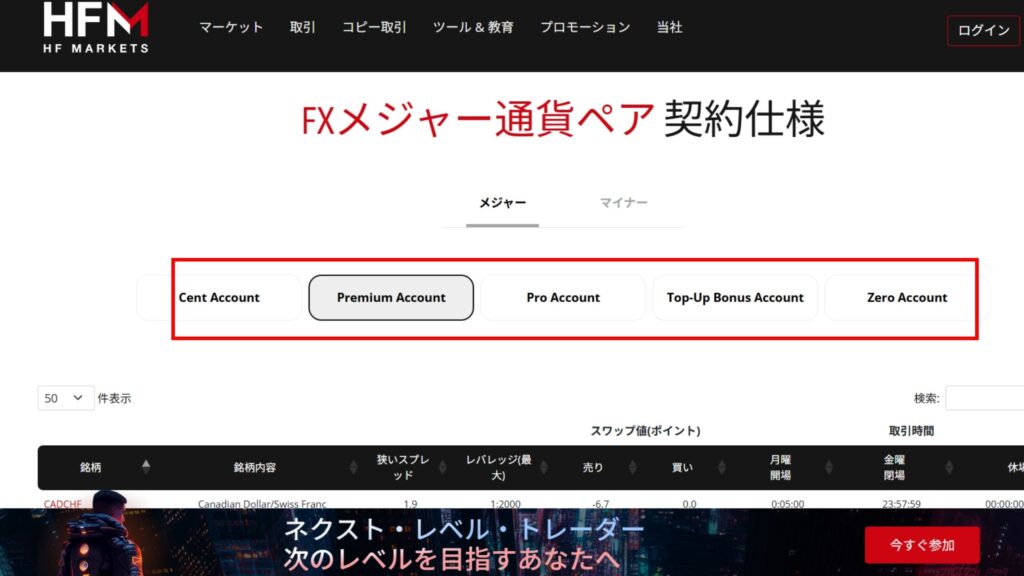
Select the account type you want to view
Please select whether you want a major or minor currency, as needed
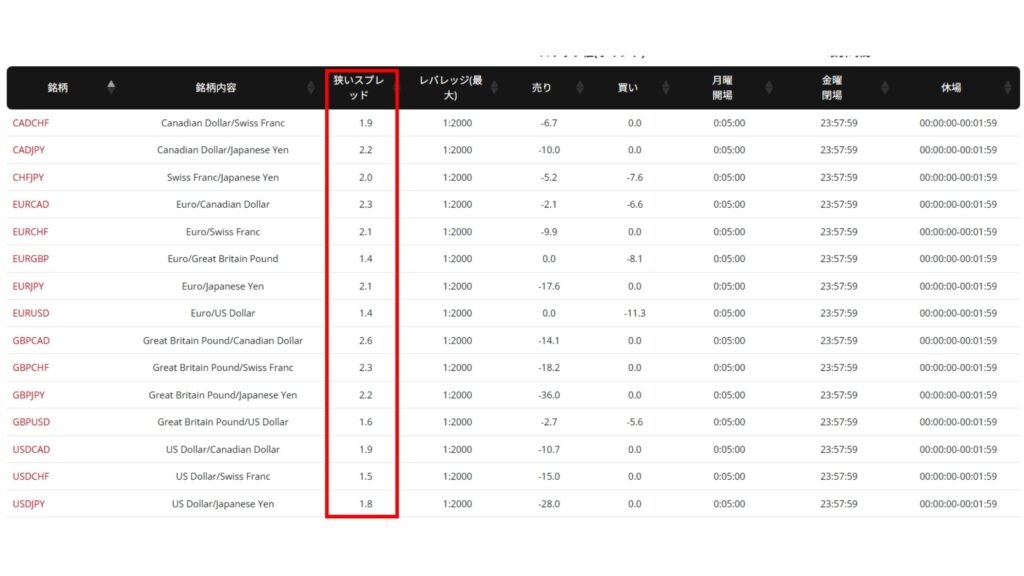
This will display a list of applicable currency pairs, allowing you to check the spread for the pair you want to view
The above is the procedure for checking on the official website
How to check using a smartphone app
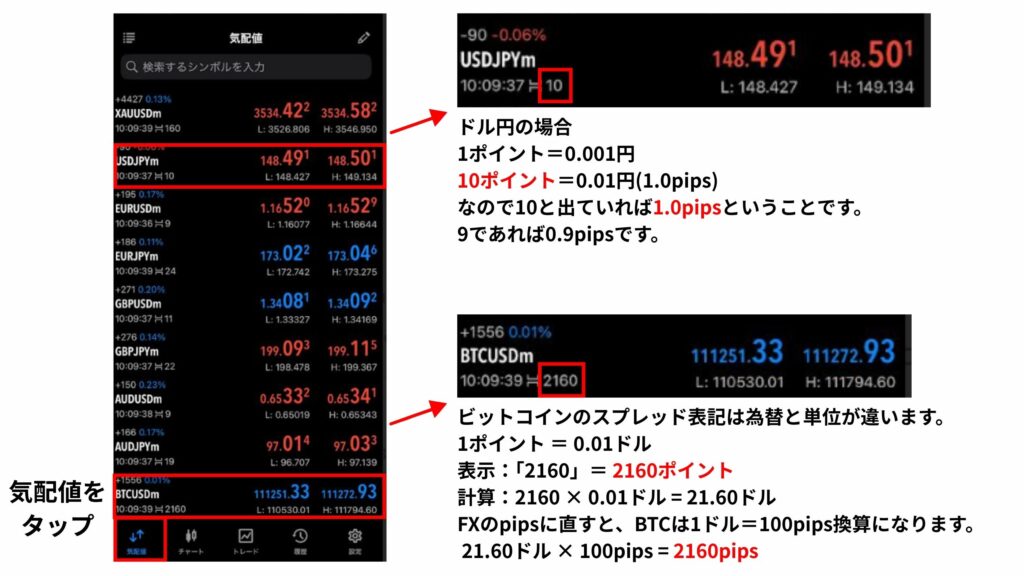
Even when you're out and about or can't access your PC, you can check spreads usingHFM's dedicated smartphone app or the mobile version of MT4/MT5
By logging into the app and viewing the stock list, you can see the current "buy price" and "sell price" in real time, and the difference between them is the spread
The smartphone app has features such as notification functions and simple charts, which is an advantage as it allows you to quickly grasp the movement of the spread
A major advantage is that you can check it even during short breaks, such as while commuting or during breaks, making it less likely to miss trading opportunities
However, the display is affected by the network environment, so if you want accuracy, it is advisable to use it in conjunction with the PC version
Frequently Asked Questions about HFMSpreads

Many questions arise regarding HFMspreads, depending on the account type and trading environment
Questions such as "Is a zero-spread account truly zero-spread?" and "What kind of spread is incurred for gold?" are common concerns for both beginners and experienced traders
Furthermore, questions such as "Which account has the narrowest spread?", "What times of day do spreads widen?", and "Where can I check real-time figures?" are also important
By resolving these questions, you can confidently develop strategies and avoid unnecessary costs
This chapter compiles frequently asked questions and provides detailed explanations for each one
<!– wp:acf/faqblock { "id": "block_68b859837642e", "name": "acf/faqblock", "data": { "faqrepeat_0_title": "ゼロスプレッド口座は本当にゼロなの?", "_faqrepeat_0_title": "field_68872d9625422", "faqrepeat_0_text": "<a i=0> HFM's Zero Spread account, as the name suggests, emphasizes that you can trade with spreads starting from 0.0 pips. However, it's not actually maintained at zero all the time; depending on market liquidity and time of day, it can widen to around 0.1 to 0.3 pips. Furthermore, the Zero account has a trading commission, which is approximately $6 round trip per lot. Therefore, while the spread alone is very advantageous, the actual cost is not zero. What's important is to compare the total cost, including commissions, with other companies. For traders who frequently use short-term trading or scalping, the advantage of being able to execute trades at a low average cost is significantIt's important to understand that the name "Zero" simply means that it's offered at the lowest possible levelFor more details, see "Zero Account Spread ComparisonPlease check the following: ````, ``_faqrepeat_0_text'': ``field_68872d9d25423'', ``faqrepeat'': 1, ``_faqrepeat'': ``field_68872d8a25421'' }, ``align'': ``'', ``mode'': ``auto'' } /--> <!– wp:acf/faqblock { "id": "block_68b85ada76432", "name": "acf/faqblock", "data": { "faqrepeat_0_title": "HFMvaries greatly depending on the account type. rnrnThe official average is that the Zero account has the narrowest spread at 1.0 pips, the Pro account is around 1.2 to 1.7 pips, the Premium, Cent, and HF Copy accounts are all around 3.0 pips, and the Bonus account is set at 3.1 pips. rnrnAs you can see, the Zero and Pro accounts offer particularly favorable conditions. rnrnHowever, gold is more volatile than currency pairs, and the spread can temporarily widen to more than 10 pips due to economic indicators and geopolitical risks. rnrnTo trade stably, it is important to choose times with high liquidity and avoid the risks of sudden fluctuations. rnrnFurthermore,Precious metals spreadThis is explained in more detail in another section, so checking that as well will give you a complete picture. <!– wp:acf/faqblock { "id": "block_68b85e1e76434", "name": "acf/faqblock", "data": { "faqrepeat_0_title": "どの口座タイプが一番スプレッドが狭いの?", "_faqrepeat_0_title": "field_68872d9625422", "faqrepeat_0_text": "<a i=0> HFM offers several account types, but the Zero account has the narrowest spreads. The Zero account allows trading of major currency pairs such as USD/JPY from 0.0 pips, maintaining an extremely low average of 0.2-0.3 pips. Furthermore, even for gold (XAU/USD), it offers a favorable average of 1.0 pips compared to other account types. The next narrowest is the Pro account, which offers stable spreads of 1.2-1.7 pips for both currency pairs and precious metals, making it suitable for scalping and other short-term trading. On the other hand, the Premium account, Cent account, and HF Copy account have wider spreads of around 3.0 pips, and the Bonus account has a wider spread of 3.1 pips, making them somewhat less advantageous in terms of trading costsIf you want to minimize costs, a zero-fee account is a wise choice, while a pro account is a better option if you prioritize a balance between fees and costs“, “_faqrepeat_0_text”: “field_68872d9d25423”, “faqrepeat”: 1, “_faqrepeat”: “field_68872d8a25421” }, “align”: “”, “mode”: “auto” } /–> <!– wp:acf/faqblock { "id": "block_68b85f0076436", "name": "acf/faqblock", "data": { "faqrepeat_0_title": "リアルタイムスプレッドはどこで確認できるの?", "_faqrepeat_0_title": "field_68872d9625422", "faqrepeat_0_text": "HFM's official website also publishes estimated spreads for each account type, which can be used for comparison and account selection. Furthermore, using the smartphone app allows you to check the values even when you're on the go, and the notification function makes it easier to respond to sudden fluctuations. For specific checking procedures, please see "How to check the spread on HFMThis is explained in more detail in the section belowMaking it a habit to check spreads in real time is fundamental to preventing unnecessary costs and trading in a more favorable environment“, “_faqrepeat_0_text”: “field_68872d9d25423”, “faqrepeat”: 1, “_faqrepeat”: “field_68872d8a25421” }, “align”: “”, “mode”: “auto” } /–>Summary | We thoroughly investigatedHFM's spreads for all instruments, broken down by time of day and account type

This article provides a detailed explanation ofHFMspreads, including their characteristics, differences by account type, and spread levels for major currency pairs and CFD instruments
Factors that cause spreads to fluctuate include the time of day, the impact of economic indicators, and market volatility. Understanding the situations that require particular attention can significantly reduce trading costs
A comparison with other companies revealed thatHFMoffers some of the most favorable terms in the industry, particularly with its zero-interest account
With Zero Account, the average return on USD/JPY is around 0.4 pips (effectively 0.6-0.8 pips including fees), and with gold, it's around 1.0 pips (effectively 1.3-1.4 pips), which are competitive levels and suitable for traders who engage in short-term trading or scalping
Furthermore, by introducing how to check spreads in real time and providing practical tips, we have covered information that can be used with confidence by both beginners and experienced traders
Understanding the characteristics of spreads and choosing an account that suits you is the first step to success
Check the actual figures on the official website or MT4 right now and find the environment that suits your trading style