










Exness is one of the few overseas forex brokers that offers "unlimited leverage."
usually,While leverage of 1,000 to 2,000 times is common in overseas forex brokers, Exness allows for virtually unlimited trading if certain conditions are metThis is what it will be
On the other hand, while unlimited leverage allows for efficient use of funds, it also increases the risk of losing money with even a few pips of adverse movement
This article provides a clear explanation of Exness's maximum leverage mechanism, limiting rules, and key points for risk management
Contents
- 1 Exness's maximum leverage and features
- 2 Exness leverage limit rules
- 2.1 Leverage restrictions by trading instrument
- 2.2 Leverage restrictions based on margin balance | Tiered system
- 2.3 Leverage restrictions before and after the release of economic indicators
- 2.4 Leverage regulations for precious metals CFDs
- 2.5 Leverage restrictions on stock CFDs
- 2.6 Leverage restrictions on weekends, Monday mornings, and public holidays
- 2.7 How to handle positions affected by leverage restrictions
- 3 How to check Exness's leverage limits
- 4 Exness's unlimited leverage and risk management
- 5 Frequently Asked Questions about Leverage at Exness
- 6 Summary of Exness leverage
Exness's maximum leverage and features
Here, we will summarize the following points regarding Exness's maximum leverage, the conditions for using unlimited leverage, and the margin system
- Exness offers leverage up to "unlimited"
- Conditions for unlimited leverage (margin, number of trades, lot size)
- Exness leverage calculation and margin system
Let's take a closer look at Exness's leverage, which boasts some of the highest multipliers in the industry
Exness offers leverage up to "unlimited"
The biggest feature of Exness is that it offers "unlimited leverage (effectively 2.1 billion times)."
Even with overseas forex brokers that offer high leverage, the upper limit is generally between 1,000 and 2,000 times, but with Exness, there is effectively no upper limit if certain conditions are met
| Transaction volume | 25 times | 1,000 times | Unlimited |
|---|---|---|---|
| 1 lot | 580,000 yen | 14,500 yen | Less than 1 yen |
| 0.5 lots | 290,000 yen | 7,250 yen | Less than 1 yen |
| 0.1 lot | 58,000 yen | 1,450 yen | Less than 1 yen |
This unlimited leverage allows you to take on large positions with a small amount of margin, significantly increasing capital efficiency

The higher the maximum leverage ratio, the surprisingly lower the required margin becomes
Exness leverage is the same for all account types. There are no leverage restrictions, allowing you to trade while taking advantage of the unique features of each account type. For details on the specifications of each account type, please see "A Complete Guide to Exness Account Types."
Conditions for unlimited leverage (margin, number of trades, lot size)
Exness's unlimited leverage isn't available to everyone from the start
To use unlimited leverage, you must meet the following conditions:
- Effective margin is less than $1,000
- More than 10 transactions
- Total trading history of 5 lots or more
Completing these three tasks will unlock "unlimited leverage"
The conditions are likely in place to prevent inexperienced traders from suddenly engaging in high-risk transactions
Incidentally, once you meet the conditions, you'll be able to freely use unlimited leverage, including for additional accounts
Exness leverage calculation and margin system
Here, we will explain the basic specifications and concepts of leverage in Enxess for beginners, focusing on the following three points
- How to calculate effective margin
- How to calculate required margin
- The difference between effective leverage and maximum leverage
Knowing these things will help you accurately understand the level of risk you are taking
Even though Exness offers unlimited maximum leverage, in actual trading, your trading capacity is determined based on your effective margin and required margin, so be sure to understand the basics
How to calculate effective margin
Effective margin refers to the account balance plus the profit or loss of open positions
This effective margin becomes trading power and plays an important role when opening new positions
Formula for calculating effective margin
Effective margin = Account balance + Unrealized gains - Unrealized losses
Example of calculating effective margin
Account balance: 100,000 yen;
Unrealized profit: +5,000 yen;
Unrealized loss: -2,000 yen
Effective margin = 100,000 + 5,000 - 2,000 = 103,000 yen
As such, effective margin constantly fluctuates when you hold a position, so if you don't keep track of your available margin, the risk of a forced stop-loss increases
To ensure thorough fund management, it is essential to check your effective margin before each trade
How to calculate required margin
Required margin is the minimum amount of money that must be in your account when opening a position
The results vary greatly depending on the leverage setting, so be sure to check it before trading
Required margin calculation formula
Required margin = (Trading volume × Rate) ÷ Leverage
Calculation example (USD/JPY 145 yen, 1 lot = 100,000 units of currency, leverage 2,000 times):
Required margin = (100,000 × 145) ÷ 2,000 = 7,250 yen
For example, the required margin is 3,625 yen for 0.5 lots and 725 yen for 0.1 lots .
While high leverage significantly reduces the required margin, it's important to note that the risk also increases proportionally
Effective leverage and maximum leverage
Maximum leverage refers to the upper limit set for your account, but in actual trading, "effective leverage" is what's important
Effective leverage indicates the trading volume relative to the current effective margin
Formula for calculating effective leverage
Effective leverage = Trading volume × Rate ÷ Effective margin
Calculation example (USD/JPY 145 yen, effective margin 100,000 yen, 1 lot trade):
Effective leverage = (100,000 × 145) ÷ 100,000 = 145 times
In other words, even if the maximum leverage is 2,000 times, the actual leverage used will be 145 times
To determine "how much risk a trader is taking," it's essential to check the effective leverage, not the maximum leverage of the account
Exness leverage limit rules
Here, we will explain the following seven leverage restriction rules of Exness
- Leverage restrictions by trading instrument
- Leverage restrictions based on margin balance | Tiered system
- Leverage restrictions before and after the release of economic indicators
- Leverage regulations for precious metals CFDs
- Leverage restrictions on stock CFDs
- Leverage restrictions on weekends, Monday mornings, and public holidays
- How to handle positions affected by leverage restrictions
Unlimited leverage is not always available; it is restricted depending on the stock, margin balance, economic indicators, and the timing of the weekend
Knowing this in advance will help you avoid sudden margin calls and forced liquidations
Leverage restrictions by trading instrument
At Exness, the maximum leverage available varies depending on the currency pair and type of CFD.
Major and minor currency pairs can be used without limit if certain conditions are met, but there are limits on exotic currencies, stocks, and cryptocurrencies
The table below summarizes the maximum leverage for each major product offered
| Brands we handle | Maximum leverage |
|---|---|
| Major currency pairs | Unlimited |
| Minor currency pairs | Unlimited |
| Exotic currency pairs | 200 times |
| Precious metal CFD | 100x to unlimited |
| Energy CFD | 200 times |
| Major stock index CFD instruments (Dow Jones Industrial Average, SPX, Nasdaq) | 400 times |
| Other Stock Index CFDs | 200 times |
| Stock CFDs | 20 times |
| Cryptocurrency CFDs (BTC, ETH) | 400 times |
| Cryptocurrency CFDs (XRP, BCH, LTC) | 200 times |
| Other Cryptocurrency CFDs | 20 times |
Thus, while unlimited leverage is possible in FX trading, lower leverage is set for stocks and some cryptocurrencies
When trading a stock you don't normally handle for the first time, be sure to check its maximum leverage
If you would like to check the spreads for each of Exness's trading instruments, please see " List of Actual Exness Spread Data ." The MoneyChat editorial team has compiled the results of their unbiased investigation into actual Exness spreads.
Leverage restrictions based on margin balance | Tiered system
At Exness, the maximum leverage available changes in stages depending on the effective margin balance of your account
With small amounts of capital, you can use unlimited leverage, but the leverage limit is lowered as your balance increases
The table below summarizes the maximum leverage for each effective margin balance
| Effective margin balance | Maximum leverage |
|---|---|
| Up to $4,999 | Unlimited (2.1 billion times) |
| $5,000 to $29,999 equivalent | 2,000 times |
| $30,000 to $99,999 equivalent | 1,000 times |
| Over $100,000 worth | 500 times |
For example, if your balance is $4,000, you can use it without limits, but once it exceeds $5,000, it will automatically be limited to 2,000x
Furthermore, the leverage is reduced to 1,000 times for accounts exceeding $30,000 and to 500 times for accounts exceeding $100,000, meaning that accounts with larger funds are designed with a greater emphasis on security
Since the effective margin includes unrealized gains, it's important to be aware that the leverage limit can change suddenly
As your funds increase, adjust your leverage limits by withdrawing funds as needed
Leverage restrictions before and after the release of economic indicators
Leverage is restricted before and after the release of important economic indicators due to increased market volatility
That's why we cap leverage at 1:200 during news releases for all new positions for instruments impacted.
For affected stocks, the leverage of any new positions opened at the time of the news announcement is uniformly limited to a maximum of 1:200
This rule prevents you from taking large positions with unlimited leverage when economic indicators are announced
Existing positions are not subject to leverage restrictions, but caution is advised when making additional entries
You can check for economic indicators that trigger leverage restrictions on Exness's official " Economic Indicators Calendar
Leverage regulations for precious metals CFDs
Gold and silver are usually eligible for unlimited leverage, but there are restrictions during early morning hours on weekdays
- Daylight Saving Time: 05:29 - 05:59 [Japan Standard Time]
- Winter time: 06:29 - 06:59 [Japan Standard Time]
For approximately 30 minutes as described above, the multiplier will be limited to a maximum of 1,000x
During this time of day, liquidity is low and spreads tend to widen, so it's important not to oversize your positions
Leverage restrictions on stock CFDs
Stock CFDs already have a relatively low leverage of up to 20x, but these are further restricted during earnings announcements
- From 6 hours before the earnings announcement until 20 minutes after the start of business on the next business day
- Weekdays, 15 minutes before market closing to 20 minutes after opening the next day
During the above time period, a uniform leverage restriction will be imposed on stock CFDs, reducing the maximum leverage from 20 times to 5 times
Because stock prices fluctuate significantly during earnings announcements and at the opening and closing of trading, this system reduces risk by limiting leverage
Leverage restrictions on weekends, Monday mornings, and public holidays
Exness automatically limits leverage before and after weekends and holidays
- Three hours before market close [Saturday 03:00 to 06:00 (Japan time)]
- The first two hours after the market opens [Monday, 06:00-08:00 (Japan time)]
During this time period, the multiplier is limited to a maximum of 200x
Especially at the start of the week, prices tend to gap up (so-called gap openings), and there is a risk of a sudden shortage of margin, so you should carefully consider whether to trade over the weekend
If you're using unlimited leverage to its fullest potential, scalping and day trading—types where you don't hold positions overnight and keep your stop-loss range narrow—are ideal
How to handle positions affected by leverage restrictions
Exness's leverage restrictions generally apply to new orders, but the leverage restriction based on margin balance also affects existing positions
If your balance exceeds a certain level, the required margin will increase, the maintenance margin will decrease, and this may lead to a forced liquidation, so caution is advised
To mitigate the risks associated with these leverage restrictions, take the following measures depending on the type of restriction
| Types of restrictions | subject | Main countermeasures |
|---|---|---|
| Tiered system based on margin balance | New and existing positions | - Adjust your balance by making partial withdrawals before it exceeds the threshold. - Control your balance by partially realizing profits if unrealized gains increase |
| Restrictions before and after the release of economic indicators | New Order | - Adjust positions before the announcement - Reduce lot size - Add margin to maintain margin ratio |
| Precious metals early morning time restrictions | New Order | - Avoid trading during restricted hours. - Add margin in advance when holding large positions |
| Stock CFDs (before and after earnings announcements) | New Order | - Lighten positions before earnings announcements. - Switch from short-term to long-term holding strategies |
| Weekend and public holiday restrictions | New Order | - Ensure sufficient margin for positions that span the weekend. - Reduce risk by partially closing positions before closing |
To mitigate the risks associated with these leverage restrictions, take the above measures for each type of restriction
Leverage restrictions are an unavoidable rule, but you can prevent unexpected forced liquidation and insufficient funds by preparing in advance
How to check Exness's leverage limits
Here, we will explain how to check and change the leverage of your current account with Exness, in the following order
- How to check on your member page (personal area)
- How to change leverage settings (can be changed for each account)
The available leverage ratio affects the number of lots you can trade and your available funds, so be sure to check this before actually entering a position
How to check on your member page (personal area)
This guide explains how to check the maximum leverage currently applied to your account at Exness
Exness leverage verification procedure
① Open the login screen for the member page (personal area)
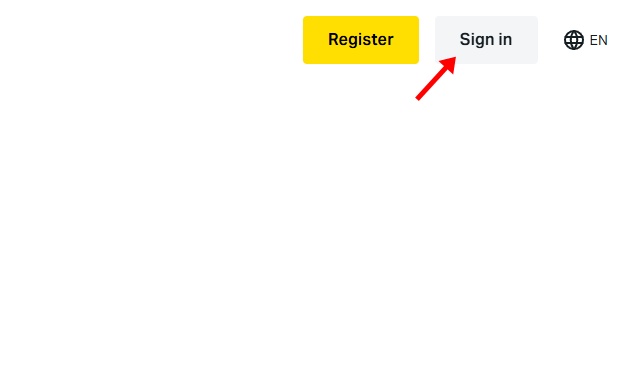
Open the official Exness website and click "Sign in" in the upper right corner
② Log in to your member page (personal area)
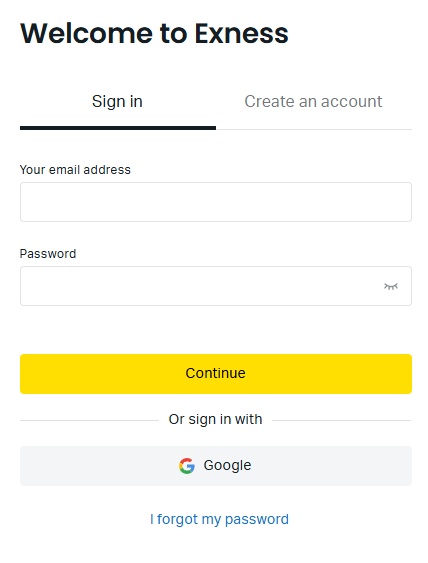
Enter your email address and password to log in to your Exness member page (personal area)
③ Open the account menu
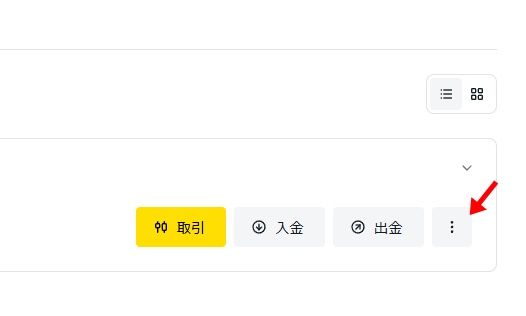
Open the menu for the account for which you want to check the maximum leverage
④ Open account information
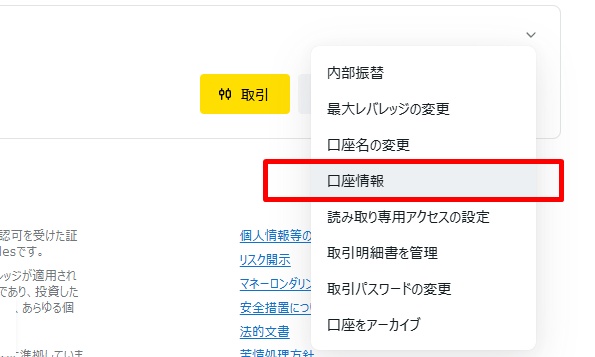
Open the menu for the account for which you want to check the maximum leverage
⑤ Check the maximum leverage
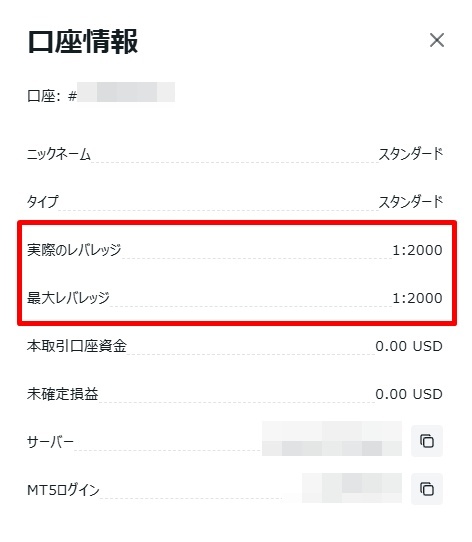
You can check the maximum leverage and effective leverage (labeled as "actual leverage" on the member page) currently applied to your account
How to change leverage settings (can be changed for each account)
This guide explains how to change the maximum leverage currently applied to your account with Exness
Exness leverage verification procedure
① Open the login screen for the member page (personal area)
Open the official Exness website and click "Sign in" in the upper right corner
② Log in to your member page (personal area)
Enter your email address and password to log in to your Exness member page (personal area)
③ Open the account menu
Open the menu for the account for which you want to change the maximum leverage
④ Open the screen to change the maximum leverage
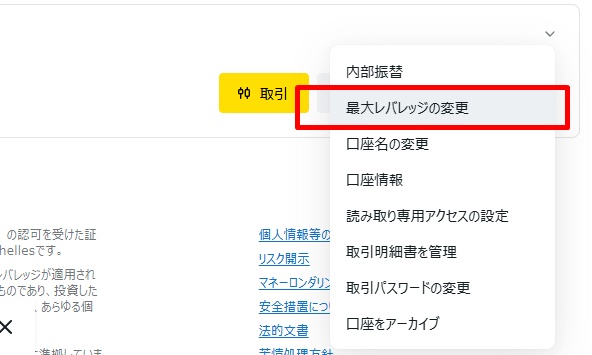
From the account menu, open "Change Maximum Leverage"
⑤ Change the maximum leverage
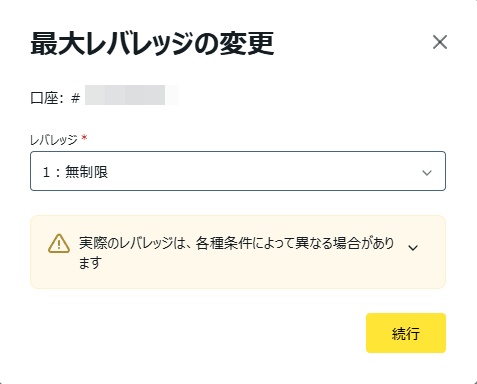
Select the maximum leverage you wish to change and click "Continue" to apply the change
Exness's unlimited leverage and risk management
This article explains the risk management methods you should be aware of when using Exness's "unlimited leverage," divided into the following four points
- Unlimited leverage and a mandatory stop-loss level (zero-cut system)
- The advantages and disadvantages of unlimited leverage
- Tips for fund management (points for adjusting balance and margin)
- Guideline for lot size when trading with Exstyle unlimited leverage
While the unlimited access environment can significantly improve capital efficiency, if not used correctly, there is a risk of losing all your account funds in an instant
We've compiled some key considerations for traders to use Exness safely
Unlimited leverage and a mandatory stop-loss level (zero-cut system)
Exness employs unlimited leverage while also using a "zero-cut system" to protect customers from negative balances
Exness's forced stop-loss level is triggered when the margin maintenance ratio reaches 0%, and even if the account balance goes negative, Exness will cover the deficit with a zero-cut
Therefore, even with high-leverage trading, losses are limited to the account balance, and there is no need to worry about incurring debt as a result of trading
However, zero-cut is a mechanism that "resets the balance after all funds have been lost."
In other words, even if you use unlimited leverage at Exness, it doesn't mean you won't lose money
Traders should consider zero-cut protection as their last resort and thoroughly implement stop-loss strategies and money management with ample margin
The advantages and disadvantages of unlimited leverage
The advantage of using Exness's unlimited leverage is that the required margin is very low, allowing you to take on large positions even with a small amount of capital
For example, a trade that requires a margin of 100,000 yen at other companies can sometimes be opened with just a few hundred yen at Exness
For traders who engage in short-term trading or scalping, the capital efficiency offered by unlimited leverage is a major advantage
On the other hand, Exness's unlimited leverage also has clear drawbacks
Because the required margin is low, high-leverage trading carries a higher risk of losing account funds with even a slight adverse movement
Tips for fund management (points for adjusting balance and margin)
To safely use unlimited leverage on Exness, proper money management is essential
Instead of putting all your funds into your account, it's more effective to deposit only the amount you need and use it accordingly
In particular, with Exness, the maximum leverage is limited by the margin balance, so withdrawing funds to adjust the balance is one solution
For example, by depositing only a small amount of money that you can afford to lose, you can engage in high-leverage trading while limiting your risk, as there is no margin call due to the zero-cut system
Guideline for lot size when trading with Exstyle unlimited leverage
When using unlimited leverage with Exness, the most important thing is managing your lot size
Even though there's no upper limit on leverage, opening large lot sizes can lead to a sharp drop in your margin maintenance ratio with just a few pips of price movement, quickly resulting in a forced stop-loss. Opening large positions with a small amount of capital is especially risky
For example, here's a guideline for trading with 100,000 yen in capital:
- 0.1 lot: A level where you can trade with a relatively comfortable margin
- 0.5 lots: While it's possible to avoid a forced stop-loss even with a few tens of pips of adverse movement, the risk is increased
- 1 lot or more: There is a high possibility of losing funds even with slight adverse movements, making it unsuitable for beginners
With Exness's unlimited leverage, it's important to determine lot sizes based on "how much you can safely withstand" rather than "how much you can build."
Basically, the ideal balance for profiting while minimizing risk is to decide on an acceptable loss amount for each trade and cut losses within that range
Frequently Asked Questions about Leverage at Exness
How can I use Exness's unlimited leverage?
To use unlimited leverage on Exness, there are several conditions. You need to have made at least 10 trades and have accumulated a total trading record of at least 5 lots. Once you meet these conditions, unlimited leverage will be unlocked even if your effective margin is less than $5,000, and you can set it from the regular trading screen
Where can I check Exness's leverage limits?
You can check Exness's leverage restrictions on the account settings screen in your member page or on the trading platform (MT4/MT5). Restrictions related to economic indicators and weekends can also be found on Exness's official news calendar and email notifications. While information is also shared on external sites and Twitter, it is always safest to check the official Exness announcements
Does Exness's leverage limit change depending on economic indicators?
Yes, Exness imposes leverage restrictions when major economic indicators such as US employment statistics and FOMC announcements are released. Specifically, new orders are limited to a maximum leverage of 200x from 15 minutes before the announcement until 5 minutes after. The instruments subject to the restriction are limited to currency pairs and commodities related to the indicator
Does Exness's leverage limit change depending on the day or time?
Exness leverage restrictions are triggered depending on your account balance, economic indicator announcements, and the time of day on weekends and holidays. For example, you can find out when restrictions apply "today" by checking the official Exness economic calendar. The applicable securities and whether restrictions apply change from day to day, so you need to check each time
What happens if I get forcibly stopped out with Exness's unlimited leverage?
With Exness, even if you're trading with unlimited leverage, a forced stop-loss will be triggered if your margin maintenance ratio reaches 0%. However, thanks to the zero-cut system, your account balance will never go negative
Are Exness's leverage limits different for each account type?
Exness's leverage restrictions do not differ significantly depending on the account type. Basically, the same rules apply to all accounts (balance limits, 200x limit during economic indicator announcements, 200x limit on weekends, etc.)
Summary of Exness leverage
While Exness offers a powerful trading environment with unlimited leverage, it also employs a system that imposes restrictions based on margin balance, economic indicators, and weekend timings
By understanding "when restrictions will be triggered" and adjusting their balance or reducing their lot size, traders can prevent unexpected stop-losses
Unlimited leverage is very appealing, but without the right knowledge and money management, it's an environment where you're more likely to lose money
When using Exness, be mindful of both efficiency and risk, and find a trading style that suits you