











When choosing an overseas forex account, many people get stuck wondering, " What's the difference between an ECN account and an STP account ?" and " Which one is ultimately cheaper ?"
In short, the difference is thatECN accounts offer "narrow spreads + trading fees," while STP accounts offer "wider spreads + no fees." Both are classified as NDD (No Dealing Desk) accounts (where the broker's dealers do not intervene in orders) and belong to a different group than DD accounts.
However,"which is cheaper" cannot be determined solely by the account type.This is because the way trading fees are written varies from broker to broker, making direct comparison impossible. In this article,we checked the official websites of 20 companies on August 28, 2026, and compared the fees by standardizing them to "per round trip per lot.
Conclusion | Choosing between ECN and STP methods
- ECN (Electronic Conversion Network) trading offers narrow spreads but incurs transaction fees. The higher the trading volume, the more significant the burden of these fees becomes.
- STP method = No transaction fees, but wider spreads. Costs are consolidated into the spread, making calculations simpler.
- When the commission was standardized to a round-trip rate for one lot, the range we could confirm was approximately $3.00 to approximately $7.00, a difference of 2.3 times(calculated at approximately $1.00 per dollar).
- Four airlines did not provide a clear round-trip cost on their official websites(three did not specify whether it was one-way or round-trip, and one did not list the price). Since the round-trip price is double the "$3.50" for a single ticket, checking the stated price is essential.
- In fact, only 4 out of 20 brokers allowed you to check in their official specifications whether your account uses ECN or STP
*This article was created by the MoneyCharger editorial team based on their content creation policy , after individually reviewing the official websites (account types and trading conditions pages) of 20 overseas forex brokers on August 28, 2026. Dollar-denominated amounts are estimated using the exchange rate as of August 29, 2026 (1 dollar = approximately $1.00). Trading conditions are subject to change at the discretion of each company, so please be sure to check the latest information on the official website before opening an account. For a list of financial instrument business operators registered in Japan, please refer to the list of businesses licensed, permitted, or registered with the Financial Services Agency , and for examples of online trading troubles, please refer to the Consumer Affairs Agency's section on consumer troubles related to the internet
There are two main types of overseas forex trading methods, or more specifically, three types
Trading methods are first divided into two types: NDD (Non-Dealing Desk) and DD (Dealing Desk). The NDD method is further divided into ECN (Electronic Communication Network) and STP (StraightThrough Processing). In other words, you will actually choose from three types: ECN, STP, and DD.
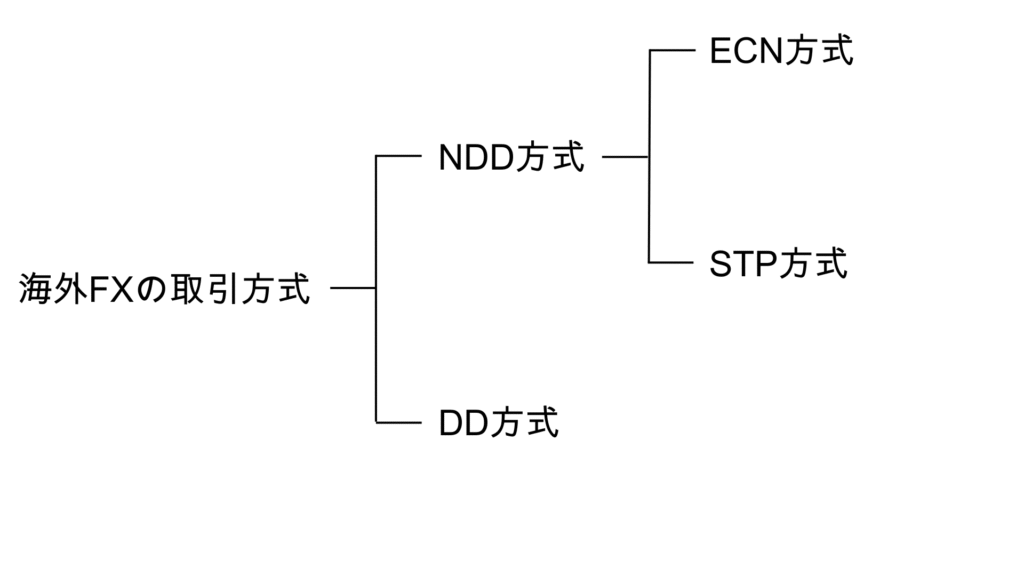
Most overseas forex brokers use the NDD (No Dealing Desk) system (ECN or STP), while domestic forex companies use over-the-counter (OTC) trading, which is equivalent to the DD (Dealing Desk) system. You can think of the choice between "overseas forex" and "domestic forex" as essentially the same as the choice of trading method
Let 's start by looking at the differences between ECN and STP, which are often the most confusing aspects
*In this article, we will use the terms "NDD method" and "DD method." "ndd method," "NDD," "non-dealing desk," and "A-Book" all refer to the same thing, and the DD method is sometimes called "B-Book."
Differences between ECN and STP methods [Comparison Table]
The biggest difference between the ECN method and the STP method lies in whether the counterparty to the order is "other participants" or "multiple financial institutions," and how costs are handled.Both are types of NDD methods, and they share the common feature that the broker's dealer does not intervene in the order.
| Comparison items | ECN method | STP method |
|---|---|---|
| Where the order is delivered | Direct matching with other participants on the electronic trading network | Multiple counterparties (financial institutions) that |
| spread | Narrow (many accounts start from 0.0 pips) | Wide range (mainly 1.0 to 1.8 pips) |
| Transaction fees | such | It doesn't cost |
| Cost breakdown | A two-tiered system: spread + commission | Unified into a single spread |
| Minimum deposit amount | It is often set at a high rate (e.g.,Monaxa Zero = $200). | Lower (e.g.,Monaxa Standard = $15) |
| Cost calculation | Somewhat complicated (need to confirm one-way/round-trip). | simple |
| Suitable people | with high transaction volume who want to minimize actual costs | For those who want to simplify calculations or start with a small amount. |
It's not as simple as saying "ECN is cheaper because it has a narrower spread."ECNs add fees, so what you should actually compareis the "effective cost," which is the sum of the spread and fees. This calculation method will be explained in detail in the next chapter.
What is the ECN system? | A system that directly matches orders with other participants
ECN stands for "Electronic Communications Network," a trading method that directly matches investors' orders with those of other participants on the network to complete transactions. Orders from those who want to sell and those who want to buy are automatically matched within the system.
Because brokers only act as intermediaries for orders and do not set prices,their profit margins are not added to the quoted rates. Instead, brokers receive a transaction fee as compensation for their mediation. This structure is why spreads on ECN accounts start at 0.0 pips.
Of the 20 companies we checked,explicitly stated "Order Method: ECN" in its official account type tableThreeTraderonly(for both Raw Zero and Pure Spread accounts). While several other brokers use ECN-type account names, ThreeTrader is the only one that lists ECN as an item in its specifications table.
What is the STP method? | A method that automatically selects the most favorable rate from multiple liquidity providers
STP stands for "Straight Through Processing," a method in which a broker compares rates from multiple connected financial institutions and automatically selects the most favorable price for the investor before executing the order.
The broker adds their own profit margin to the rate received from their counterparty before quoting it . This results in a wider spread than ECN, but there are no separate trading fees . Since the cost is consolidated into the spread, calculations are simpler with this method.
Of the 20 companies, explicitly stated "Execution Method: STP"JadeFOREX in its official specifications , Traders Trust stated "Execution Model: STP / No Dealing Desk," and stated "Order Method: NDD STP MethodBigBoss . "
Which should you choose? | The decision depends on "trading volume"
If you trade a large number of lots, the ECN method is suitable, while if you trade a small number of lots or want to simplify cost calculations, the STP method is better. Thisis because a fixed fee is charged for each trade, and as the number of lots increases, the impact of the fee becomes greater than the spread difference.
However, it's important to note that spreads are constantly fluctuating . The "0.0 pips" advertised by the official source is the best-case scenario; spreads widen significantly before and after economic indicator announcements and in the early morning hours. Even with ECN, trading during times when spreads are wide can end up being more expensive due to the added commission fees.
Don't assume that "ECN = low cost"; calculate based on the time of day you actually trade and the lot size per trade. If you only trade a few times a month, it's not uncommon for a commission-free STP account to be cheaper overall
Compare ECN account trading fees, standardized to a "round trip per lot" rate
ECN account fees vary widely from broker to broker on their official websites, making direct comparisons difficult. While"$3.50 one way" and "$3.50 round trip" are the same number, the actual cost differs significantly, and both formats are commonly used.
On August 28, 2026, I checked each company's official website and listed the six accounts that clearly stated whether it was a one-way or round-trip ticket and could be converted to a round-trip ticket for one lot, in descending order of price
| Business/Account | Official website description | Converted to one round trip lot | Yen conversion (1 dollar approx. $1.00) | Minimum deposit amount |
|---|---|---|---|---|
| Traders Trust VIP | $1.5 per side / lot | $3.00 | Approximately $3.00 | $5,000 |
| Axi Elite | $3.5 round trip | $3.50 | Approximately $3.50 | Cumulative total of $25,000 |
| Axi Pro | $4.5 round trip | $4.50 | Approximately $4.50 | $100 |
| VT Markets Low ECN | $6 (per round) | $6.00 | Approximately $6.00 | $100 |
| Traders Trust Pro | $3 per side / lot | $6.00 | Approximately $6.00 | $500 |
| Monaxa Zero | Handling fee (one way): $3.50 | $7.00 | Approximately $7.00 | $200 |
Even with the same "ECN-type account," there was a 2.3-fold difference in the cost per round trip lot, ranging from approximately $3.00 to approximately $7.00.Monaxa's "$3.50 one way" becomes $7.00 round trip,Axi exactly doubleWhile the numbers may appear the same, the actual burden is twice as different.

However, accounts with lower fees tend to have higher deposit requirements.The cheapest, Traders Trust VIP, requires a minimum deposit of $5,000, while the next cheapest,Axi Elite, requires a cumulative total of $25,000.If you're starting with a small amount,Axi Pro ($100) or VT Markets' Low ECN ($100).
There were four companies whose round-trip costs could not be determined solely from official sources
A further problem is that some brokers do not specify on their official websites whether the fee is for one-way or round-trip travel.In this case, users cannot determine the round-trip cost until they open an account and actually start trading.
| Business/Account | Official website description | Things that cannot be confirmed |
|---|---|---|
| ThreeTrader Raw Zero | Approximately $2.50 / 1 Lot | No mention of whether it's a one-way or round trip |
| Tradeview ILC | $2.50 commission per lot | No mention of whether it's a one-way or round trip |
| TitanFX Zero Blade | Transaction fee: US$3.5 (per 100,000 units of currency) | No mention of whether it's a one-way or round trip |
| AXIORY Zero/Nano/Terra | Only "Yes" is written | The amount itself is not listed in the account type table |
ThreeTrader's "approx. $2.50 / 1 Lot" isone of the few examples that fixes its commission in yen, which is commendable as it is not affected by exchange rates. However, it is not stated on the account comparison page whether this is a one-way or round-trip fee.
Before opening an account, be sure to check with the official website or support whether the price is for a one-way or round-trip trip.Mistaking this can result in a cost estimate being off by double.
How to calculate actual costs
The actual cost is calculated as "spread (in yen) + transaction fee (round trip)".When trading 1 lot (100,000 units) of USD/JPY, a spread of 1 pip = approximately $6.25.
| Account type | the spread is 0.3 pips | Transaction fee (round trip) | Actual cost (round trip per lot) |
|---|---|---|---|
| ECN type (round-trip fee: $3) | approx. $1.88 | Approximately $3.00 | Approximately $4.88 |
| ECN type (round-trip fee: $7) | approx. $1.88 | Approximately $7.00 | Approximately $8.88 |
| STP type (spread 1.3 pips) | approx. $8.13 | approx. $0.00 | Approximately $8.13 |
This calculation shows thatan ECN account with a round-trip fee of $3 is cheaper than an STP account, while an ECN account with a round-trip fee of $7 is more expensive.The numbers confirm that "ECN is not always cheaper."
How big will the difference become based on the number of trades?
Even if the difference per trade is only a few hundred yen, it becomes a significant amount when the number of trades accumulates.We calculated the cost of repeating one-lot trades using the three patterns above.
| Account type | 1 trip (1 round trip) | 20 times a month | 240 times a year |
|---|---|---|---|
| ECN type (round-trip fee: $3) | Approximately $4.88 | Approximately $97.50 | Approximately $1,169 |
| STP type (spread 1.3 pips) | Approximately $8.13 | Approximately $162.50 | Approximately $1,950 |
| ECN type (round-trip fee: $7) | Approximately $8.88 | Approximately $177.50 | Approximately $2,131 |
With 240 trades per year (20 per month), the difference between the cheapest and most expensive combinations was approximately $937.50.For trading methods with a high number of trades, such as scalping, the choice of account type directly impacts profits and losses.
Conversely,if you only trade a few times a month, the annual difference will only amount to a few thousand yen.In this case, it is more rational to prioritize a low minimum deposit and ease of cost calculation over low fees.
This calculation assumes the spread is as displayed. In reality, the spread widens several times before and after economic indicator announcements and in the early morning, so trading during those times will result in higher costs.Please calculate assuming that the narrow spread is "under normal conditions."
The actual spreads of each company are published in our " Overseas FX Spread Comparison | Narrowest Spread Ranking of 14 Companies Based on Actual Measurements" page . Please check them using the formula above
Three situations where actual costs skyrocket
Because the NDD (No Dealing Desk) system involves fluctuating spreads, calculating costs based on the official "0.0 pips" can result in a significant discrepancy from the actual cost.Spreads tend to widen in the following three situations:
| scene | Why does it spread? | handle |
|---|---|---|
| Early morning Tokyo time (roughly 5-8 am) | The market has the fewest participants and liquidity is lowest | Avoid trading during this time |
| Before and after the release of economic indicators | Prices tend to fluctuate, and streaming rates temporarily deviate | Refrain from placing new orders that span across announcements |
| Immediately after the start of trading on Monday | Weekend news is being incorporated into the opening of trading hours | Ensure sufficient margin for positions held overnight |
These are not flaws in the NDD system, butrather unavoidable characteristics as long as the broker does not create the price and simply passes on the rates from its liquidity providers. The reason the DD system can offer fixed spreads in principle is because the broker is in a position to set the price; this is due to the difference in the structure of the system.
Transaction fees may increase but remain unchanged
Since the trading commission for ECN accounts is a fixed amount, the amount does not change even when the spread widens.As a result, only the proportion of the commission in the actual cost decreases relatively.
Conversely,the narrower the spread during normal times, the greater the proportion of fees. As seen in the calculations in the previous chapter, where the fee was 480 to 7.00 against a spread of 0.3 pips (approximately $1.88), fees become the main cost component during favorable trading conditions.When choosing an ECN account, the amount of fees themselves becomes an important selection criterion.
Three things to check before opening an account
- Is the transaction fee one-way or round-trip? If this is not stated, check with support (three companies did not provide this information in this article).
- Minimum deposit. Accounts with lower fees tend to have higher minimum deposits (the cheapest, Traders Trust VIP, requires $5,000).
- Available trading platforms. ECN accounts may have restrictions, such as being limited to cTrader only or MT5 only (JadeFOREXis cTrader only,AXIORY's Terra account is MT5 only).
Differences between NDD and DD systems
The difference between the NDD (Non-Dealing Desk) and DD (Dealing Desk) methods is whether or not a dealer is involved in the ordering process.Both the ECN (Electronic Network System) and STP (Straight Through Processing) methods are classifications within the NDD method.

| Comparison items | DD method | NDD method (STP) | NDD method (ECN) |
|---|---|---|---|
| dealer intervention | can be | none | none |
| The other party to the order | There are situations where a contractor is the opposing party. | The financial institution that covers the coverage | Other participants on the network |
| Main sources of revenue | Profit from spread and cover trades | spread | Transaction fees |
| spread | It is narrow and easily fixed in place | Wide range, fluctuating | Narrow / fluctuating |
| Transaction fees | none | none | can be |
| Restrictions on trading methods | In some cases, it may be established. | Many businesses do not set this up. | Many businesses do not set this up. |
| Main recruitment | Domestic FX companies (over-the-counter trading) | Overseas Forex Brokers | Overseas Forex Brokers |
What is the NDD (Non-Dealing Desk) system? | A system without dealer involvement
NDD stands for "No Dealing Desk."The NDD method refers to a system where the broker's dealers do not intervene in orders, and the orders are passed directly to the liquidity provider. Many overseas forex brokers use this method.
Since brokers do not profit from the execution of trades themselves,their revenue comes from spreads and transaction fees. Because their profits increase with each trade, many brokers do not impose restrictions on high-frequency trading methods such as scalping and EAs.
The NDD (Non-Desktop) system is sometimes called "A-Book." The name is different, but they refer to the same thing
What is the DD (Dealing Desk) method? | A method in which a real estate company is the counterparty
DD stands for "Dealing Desk."The DD method refers to a system where a broker receives an order, processes it internally, and then performs cover transactions as needed. Over-the-counter (OTC) trading conducted by domestic FX companies falls under this category.
In the industry, the practice of a trading company processing orders internally without releasing them to the market is sometimes referred to as "drinking" (or "taking" ). However, the meaning of "drinking" varies depending on the context, and it can also refer to unethical practices. Over-the-counter trading after hedging is a legally recognized practice, so please understand that the two are distinct.
Because the brokers are in a position to set the prices,able to easily keep the spreads narrow and fixed. This structure is why domestic FX companies can offer spreads that are generally fixed and among the narrowest in the industry.
On the other hand, how orders are processed is not visible to the outside. It's important to check the terms and conditions beforehand, as some brokers may have restrictions on trading methods that involve frequent short-term trading, such as scalping . The DD (Dealing Desk) method is sometimes referred to as "B-Book."
You may come across explanations that "DD (Dealing Desk) system = brokers profit from customer losses," but this is not accurate. Domestic FX companies are registered as financial instrument business operators and offer over-the-counter trading after conducting cover transactions. What you should understand about the DD system is that"there are situations where the broker is the counterparty, and the processing of these transactions is not visible to outsiders," not that it is a definitive source of revenue.
How to check which account type yours is on the official website
Go to the "Account Types" and "Trading Conditions" pages on the official website and check if there are rows labeled "Order Type," "Execution Method," and "Execution Model" in the specifications table that lists spreads and minimum deposits.If they are listed there, the broker is presenting the trading method as a specification for comparison.
However,after checking 20 companies on August 28, 2026, only 4 companies clearly stated their ordering method in their specifications sheet.
| Contractor | Official specifications | Pages I checked |
|---|---|---|
| ThreeTrader | Ordering method:ECN (both Raw Zero and Pure Spread) | Account comparison |
| JadeFOREX | Execution method:STP | Account type |
| Traders Trust | Execution Model:STP / No Dealing Desk | Live trading account |
| BigBoss | Ordering method:NDD STP method | List of account types |
The remaining 16 companies, even if they advertise "NDD (Non-Dealing Desk)" on their homepage or company profile, do not have a section for ordering methods in their specification sheets . This does not mean they use the DD (Dealing Desk) method, but rather indicates that this information could not be verified in a place where anyone could check it using the same procedure
Also, look for information regarding order rejection and requotes . Traders Trust clearly states "Execution Quality: No rejection / No requotes" in its specifications sheet. If you can't find it, it may be written in a legal document called "Order Execution Policy"
Even after checking all of this,it's impossible to verify externally where orders are actually being sent.Speed of execution and minimal slippage can be achieved even with a DD (Dealing Desk) system if the server performance is high, so these aren't conclusive evidence. All users can verify is "how much is written in the official documentation."
For a list of brokers that use the NDD (Non-Dealing Desk) method, pleasesee "List of 20 Overseas Forex Brokers Using the NDD Method | Official Information Confirmed for All Companies," which publishes the results of verification for all 20 companies.
Advantages and disadvantages of the NDD method
The advantage of the NDD (No Dealing Desk) system is that there are fewer restrictions on trading methods, while its weakness is that spreads can fluctuate and widen during certain times of the year
| merit | Disadvantages |
|---|---|
| Many brokers do not impose restrictions on scalping or the use of EAs. | The spread fluctuates and widens depending on the time of day. |
| A structure that minimizes conflicts of interest with contractors | ECN accounts incur separate transaction fees. |
| It is said that order rejections and requotes are less likely to occur | Minor currency pairs have low liquidity and are difficult to execute. |
Less restriction on trading methods
In the NDD (No Dealing Desk) system, the more trades there are, the more revenue (spreads and fees) the broker earns, so there is no incentive to restrict scalping or EAs (Expert Advisors).This structure makes it well-suited for trading methods that repeat trades every few seconds to minutes, and for automated trading that runs 24 hours a day.
However, justbecause it's an NDD (Non-Dealing Desk) system doesn't mean it's always unlimited.The availability of trading methods is determined by each company's terms and conditions, so please check the terms and conditions before opening an account.
It is less likely that there will be a conflict of interest with the contractor
In the NDD (No Dealing Desk) system, the broker does not act as the counterparty to the order, so the profits and losses of the user and the broker do not directly conflict.For those who value this structure, it is a system that is easy to understand and use for trading.
However, as mentioned in the previous chapter,there is no way to verify from the outside whether the data is actually being streamed via NDD (Non-Desktop).A realistic guideline is to judge based on "how much detail is provided in the specifications sheet by the official source."
There are times when the spread fluctuates and widens
In the NDD (No Dealing Desk) system, the broker does not fix prices, so the spread fluctuates according to market conditions.During periods of low liquidity, such as before and after economic indicator announcements or in the early morning, the spread can widen to several times its normal size.
The "0.0 pips" and "1.0 pips" figures on the official websitethe best possible conditions. If you don't compare using actual average values, you may end up paying higher costs than expected.
Low leverage is not always the case
The explanation that "NDD (Non-Dealing Desk) methods have low leverage (at most 500 times)" is widely circulated, but official information confirmed on August 28, 2026, does not support this
| Contractor | Ordering method for official specifications sheet | Maximum leverage |
|---|---|---|
| JadeFOREX | Execution method: STP | Unlimited |
| Traders Trust | Execution Model: STP / No Dealing Desk | 3,000x leverage(MT4) |
| BigBoss | Ordering method: NDD STP method | 2,222 times |
| ThreeTrader | Ordering method: ECN | 1,000 times |
Of the four companies that officially state they use NDD, STP, or ECN, three had leverage significantly exceeding 1,000x. There is no correlation between using the NDD method and high leverage. Please understand that you cannot infer the trading method from the leverage value
Details of this verification are summarized in the list of 20 NDD-style overseas forex brokers . For broker comparisons by leverage, please see the recommended overseas forex broker ranking for leverage comparison
Advantages and disadvantages of the DD method
The advantage of the DD (Dealing Desk) system is that spreads tend to be narrow and fixed, while its weakness is that trading methods may be restricted
| merit | Disadvantages |
|---|---|
| narrow spreads and generally fixed rates. | Restrictions may be placed on scalping and other similar trading methods |
| No additional transaction fees are charged | The order processing process is not visible from the outside. |
| Minor currency pairs are also easy to trade. | Requotes and order rejections can occur during sudden market fluctuations. |
The spread tends to be narrow and fixed
In the DD (Dealing Desk) system, the broker is in a position to quote prices, allowing them to offer narrow and generally fixed spreads.This structure is why domestic FX companies can offer conditions such as "USD/JPY spread fixed at 0.2 pips."
The fact that the spread doesn't change with each trade,to determine costs in advance,is a major advantage. Those who don't trade frequently will benefit most from this stability.
Minor currency pairs are also easy to trade
In the DD (Dealing Desk) system, the broker receives and processes the order, making it easier to execute trades even for currency pairs with low market trading volume.In the NDD (No Dealing Desk) system, it is difficult to execute trades for currency pairs with low liquidity, and the spread is also wider.
Restrictions may be placed on trading methods
With DD (Dealing Desk) brokers, scalping and short-term, repetitive trading may be restricted in their terms and conditions.If you intend to engage in short-term trading, be sure to check the terms and conditions before opening an account.
The order processing process is not visible from the outside
In the DD (Dealing Desk) method, the broker processes orders internally, leaving users with no way to verify how their orders were handled.During periods of rapid market fluctuations, requotes (re-offering of the quoted price) or order rejections may occur.
However, thiscannot be completely eliminated even with the NDD (Non-Dealing Desk) method.Slippage and execution delays can occur in any method at the moment liquidity is depleted.
How to Choose a Trading Method | It's Decided by 3 Questions
Your trading method is determined by three factors: "trading frequency," "lot size per trade," and "desired trading strategy."Please fill in the information as shown in the table below.
| Your situation | Suitable method | reason |
|---|---|---|
| I want to use scalping or EAs | NDD method (ECN/STP) | Many brokers do not impose restrictions on trading methods. |
| We have a high trading volume and want to reduce costs. | ECN method | The benefits of a narrow spread often outweigh the burden of transaction fees. |
| Transactions occur only a few times a month | STP method | No fees, and cost calculation is simple. |
| I want to start with a small amount | STP method | ECN accounts tend to have higher |
| A narrow, fixed spread is the first priority. | DD method (domestic FX) | A structure that allows for the presentation of a fixed spread in principle. |
| I want to trade minor currency pairs. | DD method | Even with low liquidity currencies, it's easier to execute trades. |
Regardless of the trading method you choose, as long asit's an NDD (No Dealing Desk) system, a cost in the form of a spread or transaction fee will always be incurred with each trade.If you open an account through MoneyChat, a portion of that cost will be returned to you as cashback.Since the cashback is managed separately from your broker account balance, it will not affect the spread or execution conditions.
Frequently Asked Questions about ECN and STP Methods
Q. Which is recommended, the ECN method or the STP method?
If you trade frequently, the ECN method is suitable; if you only trade a few times a month, the STP method is better.This is because ECN has narrow spreads but charges transaction fees, while STP has no fees but wider spreads.
Please make your decision based on the actual cost, which includes the spread and fees. In the calculations in this article, an ECN account with a round-trip fee of $3 (approximately $4.88) was cheaper than an STP account (approximately $8.13), while an ECN account with a round-trip fee of $7 (approximately $8.88) was more expensive than an STP account
Q. What is the typical trading fee for an ECN account?
In the six accounts where we were able to officially confirm one-way and round-trip rates, the cost per lot for a round trip ranged from $3.00 to $7.00 (approximately $3.00 to $7.00).The cheapest was Traders Trust's VIP account ($3.00 round trip), and the most expensiveMonaxa's Zero account ($7.00 round trip).
However, accounts with lower fees tend to have higher minimum deposit requirements. Traders Trust VIP requires a minimum deposit of $5,000, whileAxi Elite requires a cumulative total of $25,000
Q. How can I tell if the fee is for a "one-way" or "round-trip" trip?
Please check the official website for terms such as "one way," "one side," "per side," "round trip," or "1 round."If these terms are not listed, your only option is to contact support.
As of August 28, 2026,ThreeTrader, Tradeview, and TitanFX did not specify whether the account type was one-way or round-trip on their respective account type pages, andAXIORYdid not even list the price in its table.Since the round-trip fare is double the "$3.50" for the same transaction, misinterpreting this can result in a cost estimate being off by double.
Q. Which is safer, NDD or DD?
There is no inherent superiority or inferiority in security between the different methods.While the NDD method has a structure that minimizes conflicts of interest with the broker, the reliability of the broker should be judged based on their financial license, fund management, and operational track record.
It should be noted that domestic FX companies are registered with the Financial Services Agency as financial instruments business operators and offer over-the-counter trading, and the regulations that apply to them differ from those of overseas FX brokers.It is more accurate to consider domestic and overseas FX companies separately, rather than comparing them using the same standards, as they operate under different regulations.
Q. Are "interbank direct connection" and NDD (Non-Dealing Desk) the same thing?
Although they are used with almost the same meaning, "interbank direct connection" is a promotional expression and not a term used in official specifications.The terms actually used in specification sheets are "NDD," "STP," and "ECN."
Furthermore, individual orders do not go directly into the interbank market;brokers route them through their counterparty financial institutions and networks.The image evoked by the term "direct connection" does not always match the actual route taken.
Q. What is the difference between a trade rejection and a requote?
A rejection of an order means that the order is not executed, while a requote is when an order is initially rejected and then the broker offers a different price.Both are more likely to occur when the market is experiencing significant volatility.
Scalping is the trading method most susceptible to these two factors because the profit margin per trade is small. Somebrokers, like Traders Trust, explicitly state "no rejection / no requotes" in their specifications, so if you mainly engage in short-term trading, check whether this is stated.
Q. Can Japanese people use ECN-based FX brokers?
You can use it if the overseas forex broker provides a Japanese website. However, as of August 28, 2026, FBS had discontinued providing a Japanese website , and FxPro always displayed the message "This site is not intended for residents of Japan" on its Japanese website
Additionally,HFMredirected Japanese pages from Japanese IP addresses to the English version, andExness's public page could not be reached.Before opening an account, please confirm that information and support are still available in Japanese.
Q. Can I later confirm whether my account is ECN or STP?
You can check the order type section on the account type page of the official website, but only 4 out of 20 companies listed it.If it's not listed, the presence or absence of trading fees can be a clue.
Accounts that charge transaction fees and have spreads starting from 0.0 pips are likely to be ECN type accounts, while accounts with no fees and spreads starting from around 1 pip are likely to be STP type accounts.However, this is just a guess and not a guarantee.
Summary | Choose based on "actual cost" rather than the name of the method
We have summarized the differences between ECN and STP methods, and between NDD and DD methods, based on official information from 20 companies. The key points are as follows:
- ECN method = narrow spread + trading fee, STP method = wider spread + no fee. Both are types of NDD (Non-Dealing Desk) methods.
- When the commission was standardized for a round trip of one lot, there was a difference of approximately $3.00 to approximately $7.00, a 2.3-fold difference. It's not possible to compare them based solely on the "$X" figure.
- Three companies did not officially state whether the trip was one-way or round-trip, and one company did not list the price itself in their table
- Accounts with lower fees tend to have higher minimum deposits(the cheapest, Traders Trust VIP, requires a minimum deposit of $5,000).
- Only 4 out of 20 companies (ThreeTrader,JadeFOREX, Traders Trust, andBigBoss) allow you to check whether your account uses ECN or STP in their official specifications.
- The statement that "NDD (Non-Dealing Desk) methods have low leverage" is incorrect. Of the four companies that officially state their leverage, three had leverage exceeding 1,000 times.
The name of the trading method is merely a label indicating how costs are calculated.What you should actually compareis the "spread + trading commission" amount when round-trip trading on one lot. Don't take the "0.0 pips ~" and "commission $3.50" figures on the official website at face value; calculate them based on your own trading volume before choosing an account.
This page provides information on which brokers use the NDD (No Dealing Desk) system , a list of 20 overseas forex brokers using the NDD system , actual spreads for each company , and recommended overseas forex accounts for scalping
*The trading fees, minimum deposit amounts, and order types mentioned in this article are all based on information confirmed on each company's official website (account type/trading conditions page) as of August 28, 2026. The yen conversion is an estimate based on the exchange rate as of August 29, 2026 (1 dollar = approximately $1.00). Trading conditions and exchange rates are subject to change, so please be sure to check the latest information on the official website before opening an account