











Are you busy working every day but want to earn some extra income through FX trading?
However, I lacked both the time and energy for short-term trading, and I wasn't able to earn as much as I wanted
For someone like you, we recommenda medium- to long-term trading style called "swing trading." Since you hold positions for several days to several weeks, you can aim for profits without having to constantly monitor charts.
In this article,This article explains two of the most powerful swing trading methods, complete with actual chart imagesThis guide covers everything from tips for increasing your win rate to the reasons why you might be losing
Conclusion | Key Points of FX Swing Trading
- Swing trading is a method that aims to capture medium-term trends by holding positions for several days to several weeks. It can be managed with just one chart check per day, making it easy to balance with work.
- The two most reproducible methods are① trend following (daily + 1-hour chart 20/75 SMA) and ② Ichimoku Kinko Hyo's three positive and three negative signals. This article explains the procedure with actual chart images.
- The biggest advantage of trading with overseas forex brokers iszero-cut (no margin calls) and low stop-loss levels. You can withstand unrealized losses while waiting for a trend. However,on maintaining a margin maintenance ratio of at least 250%and not increasing your lot size too much.
■What you will learn from reading this article
- Characteristics of swing trading and how it differs from other methods
- Advantages and disadvantages of swing trading in overseas forex markets
- Recommended overseas forex brokers and key points for choosing one
- Practical tips and precautions for increasing your win rate
- How to use the most effective method that even beginners can try
*This article was created by the MoneyCharger editorial teamtheir content creation policy, by individually checking the trading conditions on each broker's official website (as of August 2026). Leverage, stop-loss levels, and swap conditions may change, so please be sure to check the latest information on each broker's official website. The chart images shown are for explanatory purposes only and do not constitute a recommendation of any specific trade. For precautions regarding the use of overseas FX brokers, please alsoby the Financial Services Agency, and for consumer troubles,the Consumer Affairs Agency.
If you're new to overseas forex trading, we recommend reading the complete guide for overseas forex trading beginners
What is swing trading?

Swing trading is a style of trading where positions are held for several days to several weeks, aiming to profit by riding the medium- to long-term trends of the market
The term "swing" refers to the "range of fluctuation" or "volatility," and in FX trading,it refers to the upward and downward movement (wave) of the market itself. Swing trading is the process of capturing one complete cycle of that wave.
Since it eliminates the need for frequent buying and selling, it's also suitable for people who don't have time to check the market every day
In particular, overseas forex trading offers high leverage, allowing for highly efficient capital management
You can trade while carefully identifying trends based on technical analysis and economic news
Furthermore, because it doesn't require constantly monitoring charts, it's popular among people with limited time, such as office workers
Its key feature is that it makes trading easy and calm, even for beginners
Characteristics of Swing Trading
A key characteristic of swing trading is that positions are held for periods ranging from several days to several weeks
This allows you to trade calmly without being swayed by short-term price fluctuations
Entry and exit timings are often determined primarily using technical analysis
For example, indicators such as moving averages, MACD, and Ichimoku Kinko Hyo are used to grasp market trends
Furthermore, fundamental factors are also incorporated, so we pay attention to economic indicators and statements from key figures
When trading with overseas forex brokers, you also need to pay attention to the swap points and spread conditions
Since you're not constantly trading several times a day, the mental burden is relatively light, making it easier to stick with, which is a major advantage
Differences between swing trading and other trading methods
Swing trading involves fewer trades compared to scalping and day trading, with positions held for several days to several weeks. The differences between them are summarized in the table below
| Trading style | Holding period | The timeframes I primarily look at | Estimated profit margin per transaction | Suitable people |
|---|---|---|---|---|
| Scalping | seconds to minutes | 1-minute chart, 5-minute chart | A few pips | People who stick to the market |
| Day trading | A few hours to a day | 15-minute chart / 1-hour chart | 10-50 pips | People who have time during the day |
| Swing trading | Several days to several weeks | 1-hour chart / Daily chart | You can aim for over 100 pips | Busy people with limited time |
| Position trading | Several months to several years | Daily chart / Weekly chart | Hundreds of pips or more | People who want to build long-term assets |
Swing trading doesn't require constant market monitoring, making it easy for busy people to practice
Unlike position trading, where positions are held for several months, this method allows for easier adaptation to market changes
Furthermore, with overseas forex trading, you can leverage high leverage to trade efficiently even with a small amount of capital. By paying attention to trading costs and the accuracy of chart analysis, you can also expect stable profits
Short-term trading styles are explained in detail in "The Complete Guide to Overseas Forex Scalping Techniques." Please compare the styles to find the one that suits you best.
Swing trading in overseas forex is recommended for these types of people

Swing trading requires an investment strategy that suits each individual's lifestyle and personality
While it offers many benefits to those who are suited to it, those who are not suited to it are likely to fail if they try to force themselves to do it
Therefore, in this chapter, we will explain in detail what kind of person is suited to swing trading
Overseas forex trading offers high leverage and a flexible trading environment, so it's important to find a style that suits you. Check each point while considering whether it fits your personality and lifestyle
People who have limited time available for transactions
Swing trading is ideal for people who have limited time for trading, such as those who work during the day
This is perfect for people who are busy every day and only have time to themselves after returning home
"I can't spend all my time watching charts, but I want some extra income." This is perfect for people like that
For people like this, simply checking charts and reviewing their strategies once a day is usually sufficient
Using an overseas forex broker that allows you to easily place orders on your smartphone is appealing because you can manage your investments without disrupting your daily routine
- Many office workers have long working hours and cannot spend time at their computers every day
- Housewives and househusbands who don't have the time to keep up with the market due to housework and childcare
- People who want to try FX as a side hustle but have limited time
For information on trading environments on smartphones, please see "Top 10 Recommended Smartphone Apps for Overseas Forex Trading," where we compare the features of various apps from different companies.
People who have the mental fortitude to remain unfazed by unrealized losses
In swing trading, it's not uncommon to incur temporary unrealized losses after entering a trade
Therefore, it is suitable for people who can remain calm and make sound judgments without being swayed by short-term gains or losses
Those who can remain calm and act according to the rules are more likely to achieve stable operations
For example, people who can maintain an attitude of "adhering to stop-loss lines" and "observing the situation based on predictions" tend to have a higher winning percentage in the long run
On the other hand, people who panic and close their positions every time they see a loss tend to continue losing money
| Features | remarks |
|---|---|
| Don't rush into making a decision | Don't rush the results |
| A diligent and steady personality | I'm good at sticking to plans |
| Follow the trading rules | Stay steady throughout |
| Prioritizing stability over profit | Emphasis on steady results |
People who want to aim for big profits in a single entry
Swing trading is suitable for people who want to achieve big results with fewer opportunities rather than making many small trades
These types of peopleare strategic thinkers who believe in "quality over quantity."
For example, by finding a pullback on a daily chart and riding a major trend, it's possible to aim for a profit of 100 pips or more
By using the high leverage offered by overseas forex brokers, you can expect to make substantial profits even with a small amount of capital
People of this type excel at carefully analyzing situations and determining the right timing
- I want to aim for a "big win" rather than small profits each time
- I want to prepare carefully and win in one go
- A cautious type who thoroughly analyzes the timing of entry
People who are sensitive to economic news and international affairs
In swing trading, fundamentals such as economic indicators and monetary policy have a significant impact on price movements
Therefore, it is a significant advantage for people who regularly check the news or are interested in the background of exchange rates
Understanding that "exchange rates are influenced by global events" and having no trouble gathering information makes this a very powerful tool
For example, by developing a trading strategy that takes into account the Federal Reserve's policy announcements and employment statistics, you can make more accurate entries
Those who can sense from the news that "this is likely to affect the market" will likely excel in swing trading
- I am interested in economic trends
- I want to analyze the factors that influence exchange rates myself
- I like to learn about world events
- I'm good at gathering information
Three recommended overseas forex brokers for swing trading
Now that we understand what swing trading is and who it's suitable for, let's look at which brokers you should use
There are many overseas forex brokers, but not all of them are suitable for swing trading
In swing trading, where positions are held for several days to several weeks, three points are particularly important: ① low stop-loss levels (tolerance for unrealized losses), ② swap burden, and ③ transaction costs
In this section, we compare three companies that are a good match from this perspective, along with figures confirmed from their official websites (as of August 2026)
| Company name | Maximum leverage | Stop-loss level | Swap-free | Points for your swing | Details and account opening |
|---|---|---|---|---|---|
 Exness | Unlimited (with conditions) | 0% | Yes (covers a wide range of stocks) | With a 0% stop-loss, it's the most robust against unrealized losses | Manecha'sExnesspage |
 TitanFX | 1,000x leverage (2,000x leverage with conditions for micro accounts) | 20% | none | A balance between execution speed and low spreads | MoneyChat's TitanFX page |
 ThreeTrader | 1,000x leverage (500x leverage for effective margin of $5,000 or more) | 20% | none | Industry's lowest transaction costs | MoneyChat'sThreeTraderpage |
For swing trading, where you wait for a trend while enduring unrealized losses,its 0% stop-loss levelExnessstructurally the most advantageous. If you prioritize low trading costsThreeTraderis the choice; if you want to balance execution speed, TitanFX is the better option.
Exness| The strongest swing trader with 0% stop-loss
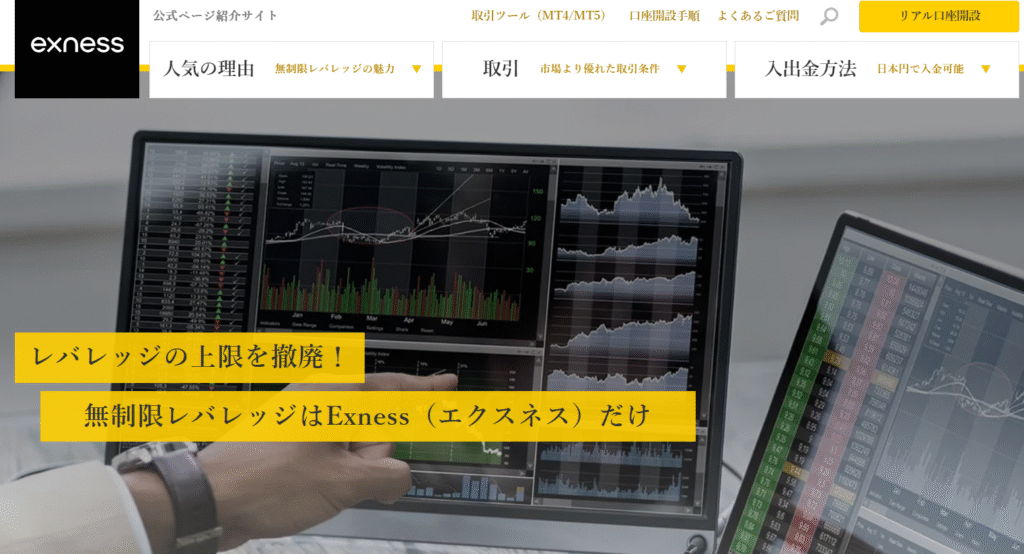
Exnessis a popular broker among swing traders due to its flexible leverage and high cost-performance ratio
The greatest weapon in swing trading isStop-out (loss cut) level: 0%This is the design. Because forced liquidation does not occur until the effective margin reaches zero, it has outstanding resilience to unrealized losses over several days to several weeks compared to the other two companies
Furthermore,a wide range of assets, including major currency pairs and gold, are eligible for swap-free trading, making it less likely for swap costs to accumulate even with long-term holdings.
However, swap-free tradingmay be terminated if large positions are frequently held overnight(the criteria are not publicly disclosed). Those planning long-term, large-scale trading should check the conditions with support in advance.
| Maximum leverage | Unlimited (with conditions such as effective margin of $999 or less) |
| Stop-loss level | 0% (all account types) |
| Margin Call | 60% (Standard) / 30% (Pro Zero, etc.) |
| Swap-free | Yes (major currencies, gold, cryptocurrencies, etc. Automatically applied upon account opening) |
| Main account types | Standard (no commission) / Zero-Raw Spread (commission applies) |
| Supported Platforms | MT4/MT5/Exness Terminal/Exness Trade (app) |
| Zero Cut System | can be |
ExnessFor a detailed review of , please see " ExnessReviews and Testimonials Summary "
Get great deals with cashback!
TitanFX | Secure swing trading with stable execution capabilities
TitanFX is a broker that boasts stable execution capabilities and low spreads, making it possible to trade with confidence even in swing trading
The maximum leverageincreased from 500x to 1,000x in May 2026, and 2,000x will be available for micro accounts if certain conditions are met (conditions include an effective margin of less than $1,000, 10 or more trades, and 5 or more lots).
The Zero Blade account, in particular, offers extremely narrow spreads of 0.0 pips or less on major currency pairs, keeping costs down even when holding positions for extended periods (a separate fee of $3.50 per lot, one way, applies)
Known for its low slippage during economic indicator announcements, this platformthose who prioritize order execution stability, even for positions held over the weekend. Note that swap-free options are not offered, so be sure to check the official swap rate table each time.
| Maximum leverage | 1,000x leverage (2,000x leverage with conditions for micro accounts) |
| Stop-loss level | 20% |
| Margin Call | Warning email sent in 90% of cases |
| Swap-free | None (3-day swap for FX and metals is Wednesday) |
| Main account types | Zero Standard (from 1.0 pips, no commission) / Zero Blade (from 0.0 pips, $3.50 one way) |
| Supported Platforms | MT4/MT5/Titan FX Social/WebTrader |
| Zero Cut System | can be |
A detailed review of TitanFX can be found in " TitanFX Reviews and User Feedback Summary "
Get great deals with cashback!
ThreeTrader| Medium- to long-term trading with some of the lowest trading costs in the industry
ThreeTrader'sindustry-leading low trading costsare a major advantage for swing traders.
The Raw Zero account features a commission of approximately $2.50 per lot, starting from 0.0 pips, while the Pure Spread account offers commission-free trading starting from 0.5 pips, allowing you to choose your cost structure
The maximum leverage is 1,000 times,When the effective margin exceeds $5,000, the leverage for major currency pairs is automatically reduced to 500xThis can happen. Those who invest heavily in their swings will be more affected, so it's important to be aware of this beforehand
Although it's a relatively new broker, it uses an ECN environment with NY4 servers,those who prioritize low trading costs. MT5 will be available from September 2024.
| Maximum leverage | 1,000x leverage (500x leverage for major currencies with effective margin of $5,000 or more) |
| Stop-loss level | 20% |
| Margin Call | 80% |
| Swap-free | None (3-day swap is Thursday morning) |
| Main account types | Raw Zero (0.0 pips and up, approx. $2.50/lot) / Pure Spread (0.5 pips and up, no commission) |
| Supported Platforms | MT4/MT5/WebTrader/Copy Trading |
| Zero Cut System | can be |
ThreeTraderA detailed review of can be found in " ThreeTraderReviews and User Feedback Summary "
Get great deals with cashback!
"Leverage restrictions during weekends and economic indicator releases" are easily overlooked in swing trading
Swing trading isCarry over positions into the weekendThat is the premise. What is often overlooked here is that many overseas FX brokers have a policy in placeLeverage reduction rules before and after weekends and important economic indicatorsis
When leverage decreases,the required margin increases, and the margin maintenance ratio decreases. If you have set your lot size to the maximum, you should be careful because you will approach a stop-loss even if the market is not moving.
| Contractor | Weekend leverage restrictions | subject |
|---|---|---|
| TitanFX | The odds are up to 100 times from approximately 120 minutes before closing on Friday until 15 minutes after opening on Monday (and up to 200 times before and after closing from Monday to Thursday). | New positions in precious metals, crude oil, and stock index CFDs (FX currency pairs are excluded) |
| ThreeTrader | On weekends and public holidays, starting 30 minutes before closing,gold/silver/platinum and stock indices will be traded at 100x leverage, and crude oil at 20x leverage. | The above-mentioned instruments (major and minor currency pairs and cryptocurrencies remain unchanged) |
| Exness | Temporary restrictions apply before the weekend closure and immediately after the Monday reopening | Varies by stock (check official trading conditions) |
As shown in the table,the impact is limited if you only trade major currency pairs in FX, but if you swing trade gold, crude oil, or stock indices, the weekend restrictions will come into play.
The solution is simple:ensure you have sufficient margin maintenance ratio by Friday (i.e., reduce your lot size).the calculation table belowas a guide and check your position size before the week ends.
Additionally, knowing the day of the week when three days' worth of swap points are credited (Wednesday for most brokers, Thursday morning forThreeTrader) will make it easier to forecast your holding costs
5 Advantages of Swing Trading with Overseas Forex Markets
By engaging in swing trading with overseas forex brokers, you can take advantage of features not available with domestic accounts
In particular, the high leverage, zero-cut system, and low-cost environment make it very compatible with the swing
Even those who are too busy during the day to monitor the market can efficiently manage their funds and more easily aim for long-term profits
Here are five key benefits of practicing swing trading in overseas forex trading
| 5 Benefits | point |
|---|---|
| 1. You can make large trades with a small amount of capital | High leverage and good capital efficiency |
| 2. The stop-loss level is low, making it easier to maintain positions | Strong against unrealized losses and good at waiting for trends |
| 3. You can prepare for unexpected losses without margin calls | With zero-cut loans, you don't have to worry about debt |
| 4. You don't need to constantly monitor the market | It's easy to continue trading even when you're busy |
| 5. Easier to keep transaction costs (spread) down | Fewer transactions mean lower costs |
Let's take a closer look at the advantages of each
1. You can make large trades with a small amount of capital
With overseas forex trading, you can use high leverage, ranging from up to 1,000 times to unlimited, depending on the broker
This allows you to trade in large lots even with a small initial investment
Swing trading involves holding positions for several days to several weeks, and its appeal lies in the ability to dramatically increase capital efficiency by leveraging the power of leverage
However, the danger isn't in using high leverage itself, but in"using excessively large lot sizes." The correct way to use high leverage is to understand that it allows you to hold the same lot size with less margin, meaning you can use surplus funds as a buffer for your margin maintenance ratio.
2. The stop-loss level is low, making it easier to maintain positions
In swing trading, it's common to hold positions for several days to several weeks while incurring unrealized losses
If the stop-loss order is triggered too early, the position will be forcibly closed before the market recovers, and the loss will be finalized
Many overseas forex brokers set their stop-loss levels lower than domestic brokers, which is an advantage as it makes it easier to withstand unrealized losses(the level varies depending on the broker and account type, so be sure to check before opening an account).
On the other hand, domestic FX brokers generally trigger stop-loss orders when the margin maintenance ratio is around 100%, which means they have less resilience to unrealized losses
For example, even if your position's unrealized losses temporarily increase, with overseas forex trading, you may have ample time to wait for a rebound. This kind of system is very compatible with a style that rides long-term trends
3. You can prepare for unexpected losses without margin calls
Most overseas forex brokers employ a zero-cut system
This system ensures that you will not be asked to make additional deposits even if your account balance goes negative
Even if you incur significant losses due to sudden market fluctuations or economic indicator announcements, your losses will be limited to the amount of your margin deposit, so you can rest assured
Swing trading involves holding positions for several days, which exposes you to the risk of unexpected events such as gaps in the market that occur over the weekend
However,having a zero-cut featuregives you peace of mind knowing that you can trade without incurring losses exceeding your deposit.
4. You don't need to constantly monitor the market
This is common both domestically and internationally, and is not a characteristic unique to overseas forex trading
The fact that you don't have to constantly monitor the market is an inherent advantage of the swing trading method itself
In swing trading, while there may be some ups and downs while you hold a position, there is no need to get overly excited or discouraged by small daily price fluctuations
In particular, by utilizing the order reservation function (limit orders, stop orders, OCO orders, etc.), you can automatically take profits or cut losses, eliminating the need to constantly monitor the market
This can be considered a significant advantage for busy office workers, parents, and others who want to conduct transactions efficiently within their limited time
5. Easier to keep transaction costs (spread) down
In swing trading, the number of trades is small, so the impact of costs from spreads is inherently smaller
This point, too, is a characteristic of the swing trading method itself, not just limited to overseas forex trading
However, many overseas forex brokers offer account types with narrow spreads, which can sometimes make trading more advantageous
Therefore, it can be said that it is well-suited to swing trading, where the profit margin per position tends to be large
Furthermore,by using a cashback site in conjunction with this, a portion of the spread will be refunded, further reducing the effective trading cost.
Five disadvantages of swing trading in overseas forex markets

While swing trading offers many advantages, there are also disadvantages that you should be aware of
There are several points to be aware of, especially due to the unique mechanisms and environment of overseas forex trading
To consistently make profits from trading, it's crucial to consider not only the positive aspects but also the risks. Understanding these risks beforehand will allow you to manage your investments wisely while developing strategies to mitigate them
| 5 disadvantages | point |
|---|---|
| 1. Transaction costs are higher compared to domestic companies | Pay attention to fees and spreads |
| 2. Increasing the lot size too much increases the risk of stop-loss | High leverage trading may result in forced liquidation |
| 3. Swap points tend to be unfavorable | Profits are reduced by negative swaps |
| 4. It will take time to reach the target profit | It is difficult to make short-term profits |
| 5. You need to be able to withstand unrealized losses over a long period of time | If you have a weak mentality, you're more likely to cut your losses midway |
These disadvantages can be easily avoided by being aware of them beforehand. Let's explain each of them in detail
1. Transaction costs are higher compared to domestic companies
Overseas forex trading often features wider spreads, and some accounts (such as ECN accounts) also incur trading fees
This "wide spread" is the main reason why trading costs are higher than with domestic brokers
The spread is an invisible cost incurred when placing and closing an order, and it becomes a significant burden, especially as the position size increases
Although swing trading involves fewer trades, the positions opened per trade are often large, so the impact of these costs can sometimes be surprisingly significant
Note that "transaction costs" here refer to spreads and fees, and are different from swap points while holding a position (swap points will be explained later)
To create a favorable trading environment, it's important to choose an account type and broker with the narrowest possible spreads
2. Increasing the lot size too much increases the risk of stop-loss
One of the attractions of overseas forex trading is that you can use high leverage, allowing you to take on large positions with a small amount of capital
However, increasing the lot size more than necessary can cause even small price movements to lower the margin maintenance ratio, potentially leading to a stop-loss
Since swing trading is based on long-term holding, periods of unrealized losses tend to be long, and setting excessive lot sizes is dangerous
For example, if the margin maintenance ratio falls below the stop-loss level due to a price movement against you, your position will be automatically closed
If you don't thoroughly manage risk, such as cutting losses and adjusting lot sizes, even a good trade will become meaningless. Specific guidelines for margin maintenance ratios will be explained with numbers later in the section "Maintain a minimum margin maintenance ratio of 250%."
3. Swap points tend to be unfavorable
In swing trading, positions are held for several days to several weeks, so swap points (adjustments for interest rate differences that occur while a position is held) affect profits and losses
In overseas forex trading, swap rates are sometimes set less favorably compared to domestic forex trading, which can gradually become a cost over long-term holding periods
In particular, positions selling high-interest rate currencies can result in large negative swaps, which can directly lead to unexpected losses, so caution is advised
For swing trading with a long-term holding strategy,choosing a broker that offers swap-free (no swap fees) stocksis an effective measure. Swap conditions vary greatly depending on the broker, stock, and trading direction, so be sure to check them before entering a trade.
4. It will take time to reach the target profit
Swing trading is a style that aims to capture trends over the medium to long term, so it is usually difficult to make large profits in the short term
Especially in situations where the market is consolidating, the holding period for positions tends to be longer, and it can be difficult to reach profit-taking targets
For those who want to accumulate profits every day, like with day trading or scalping, swing trading might feel frustrating
Furthermore, holding a position for an extended period means your capital is tied up for a longer time, potentially leading to missed opportunities and mental stress
5. You need to be able to withstand unrealized losses over a long period of time
In swing trading, it's not uncommon for the price to move in the opposite direction immediately after you enter a trade
Therefore,it is common to incur unrealized losses while holding a position for several days to several weeks, and you need the mental fortitude to withstand this.
If you get scared and cut your losses midway through, you might miss out on the trend you were originally aiming for, resulting in a wasted opportunity
To overcome this disadvantage, setting stop-loss rules in advance and trading with smaller lot sizes are effective. Swing traders need the ability to continue trading without being swayed by emotions
The most powerful FX swing trading method ① | Trend following

To consistently aim for profits in swing trading, the concept of "trend following," which involves riding the market trend rather than going against it, is extremely important
Especially with overseas forex trading, you can choose highly volatile currency pairs and markets with large price movements, making it easier to profit from price swings by riding the trend
This section will explain , step by step with actual chart images , everything from the basic concepts of trend following to useful indicators, how to choose the right timeframe, and entry and exit points
This is a classic strategy that is easy for beginners to adopt and has great versatility, so be sure to understand it thoroughly
What is trend following?
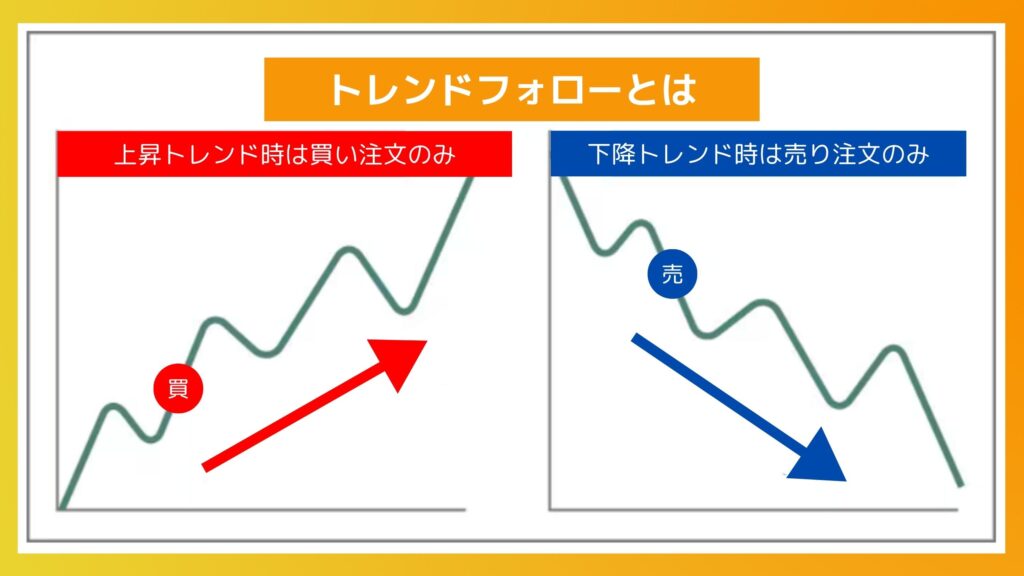
Trend following isa trading strategy that involves buying and selling in line with the market trend.
The strategy involves buying (going long) during an uptrend and selling (going short) during a downtrend. Unlike counter-trend trading, this strategy allows you to profit from larger price movements by riding the bigger trend
The advantage of this method isthat you can hold a position for a long time and increase your profits as long as the market moves in the direction of your entry.
This approach is very well-suited to swing trading, which aims to capture medium-term trends spanning several days to several weeks
For example, trend following is effective when the market takes a clear direction due to economic indicators or geopolitical risks. It's more successful to ride the trend midway through than to try to pinpoint the top or bottom
Configure the indicators you want to use
In swing trading, it's important to use moving averages to simply grasp the direction of the market
First,let's set up two SMAs (Simple Moving Averages): a 20-day line and a 75-day line.
To improve the visibility of the chart, color coding is recommended
- 20SMA (short term) = blue
- 75SMA (medium term/long term) = red
- Auxiliary trend line = orange
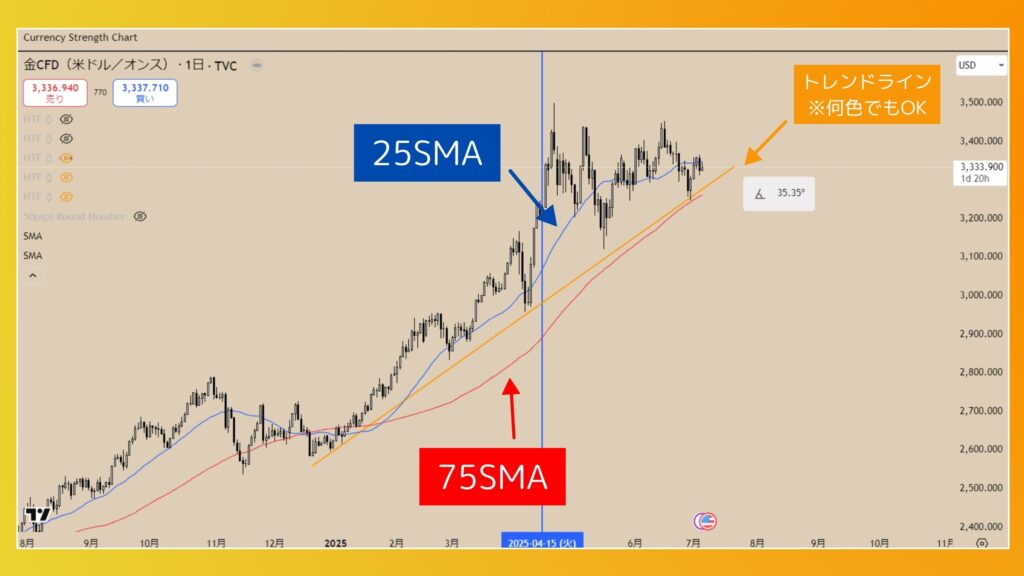
First, display the 75-period Simple Moving Average (SMA) (red) on the daily chart anddetermine the trend based on whether the slope is clearly visible.
In terms of the image, an upward slope indicates an uptrend, while a downward slope indicates a downtrend
Next, apply the same settings (20-period SMA and 75-period SMA) to the 1-hour timeframe. Maintaining consistent market analysis across these two timeframes is crucial for a swing trading strategy
Simply select "SMA (Simple Moving Average)" as the indicator type and set the period to 20 and 75
Finally, add auxiliary trend lines to potential rebound points for visual clarity. Avoid adding unnecessary indicators and hone your decision-making skills with easy-to-read charts
Analyzing trends from multiple timeframes
In swing trading, the basic approach is to determine the trend using two timeframes: the daily chart and the hourly chart
First,let's use the 75-period Simple Moving Average (SMA) (red) that we drew earlier on the daily chart to check the overall trend of the market by looking at the slope of the line.
At this point, by drawing an orange trend line and connecting past lows and highs, you can visually grasp the direction of the price
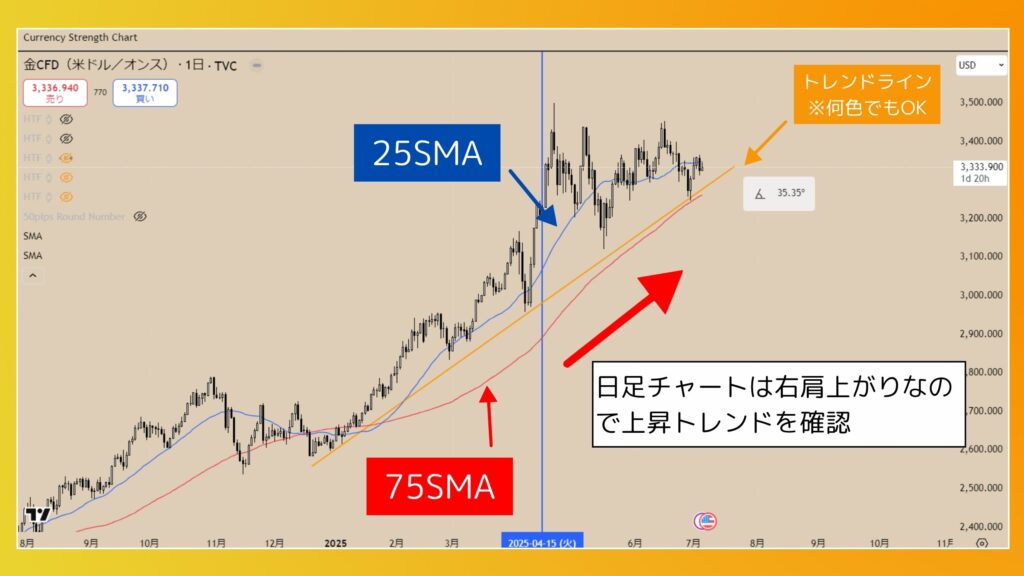
If both the trend line and the moving average are sloping upwards, it indicates a clear uptrend
Next, we'll analyze the short-term trend using the 75-period Simple Moving Average (SMA) on the 1-hour chart in a similar manner .
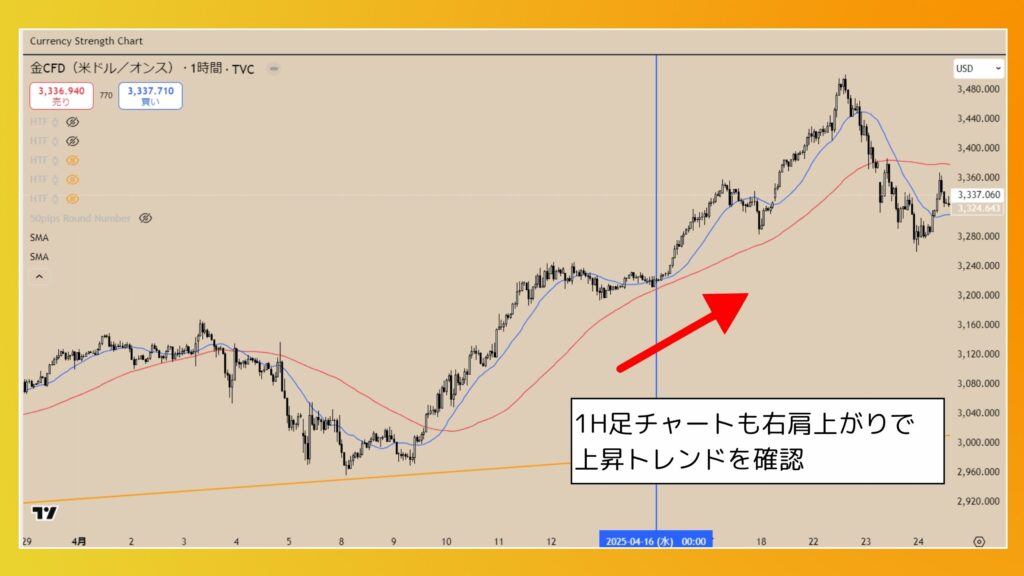
If we can confirm an upward trend here as well, it means that the direction of the daily chart and the hourly chart are aligned
Furthermore,be sure to check for any recent economic indicators or event announcements.If there is any major news on the horizon, you should be cautious, as it could disrupt the market's momentum.
The most important point before entering a trade is that the trend aligns across multiple timeframes
Use technical analysis to determine entry timing
In markets where a clear trend is present,entering trades on pullbacks or retracements is an effective strategy.
In particular, use the "golden cross" and "dead cross" of moving averages to determine entry timing
First,let's look at the SMA20 (blue) and SMA75 (red) displayed on the 1-hour chart.If the market is in an uptrend, a buy signal will be generated immediately after the SMA20 crosses above the SMA75.
However, it is safer to aim for the second pullback after the crossover (i.e. , the point where it bounces back at the 20-period Simple Moving Average) rather than the first rebound after the crossover
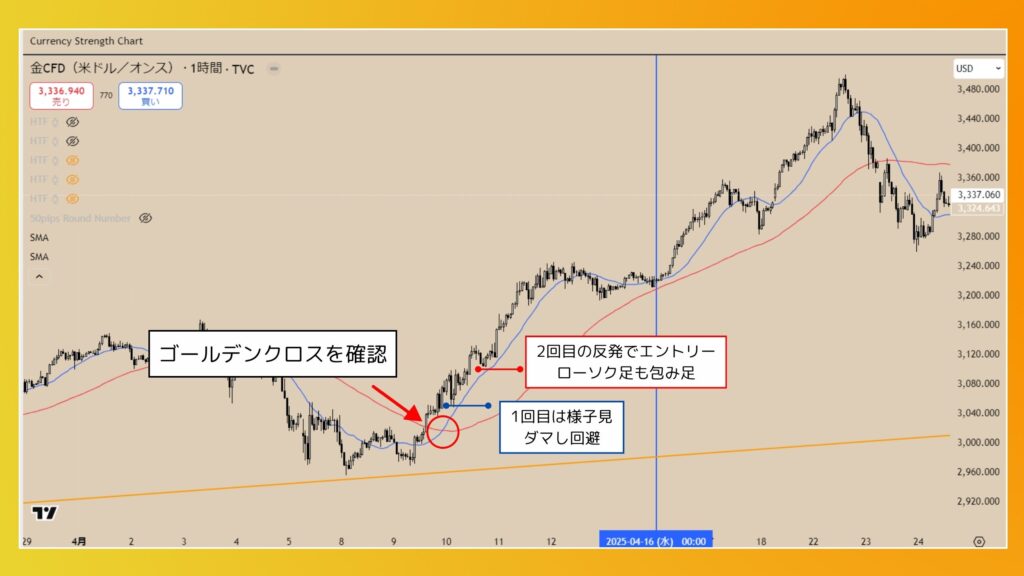
The ideal entry point is when the candlestick approaches the 20-period Simple Moving Average (20SMA) and a rebound is confirmed. Checking whether the price has rebounded at the same 20SMA several times in the past will increase reliability
Furthermore, rushing into an entry carries the risk of being misled, soconsider factors such as the angle of the moving average and the momentum of the market before making a decision.In situations where fundamentals are highly influential, it is also important to consider refraining from entering a trade.
A highly reliable entry point is when all three factors align: "market environment analysis + a rebound from the moving average + candlestick movement."
Set a stop-loss level in advance
In swing trading, it is extremely important to decide on your stop-loss level in advance
If you don't set a stop-loss order, you risk being unable to make a decision while holding unrealized losses, which could lead to further losses
In this method, the basic strategy is to enter a buy position on the second rebound after the 20-period Simple Moving Average (SMA) and 75-period Simple Moving Average (SMA) form a golden cross on the 1-hour chart
In this case,the stop-loss line is set below the second rebound line.
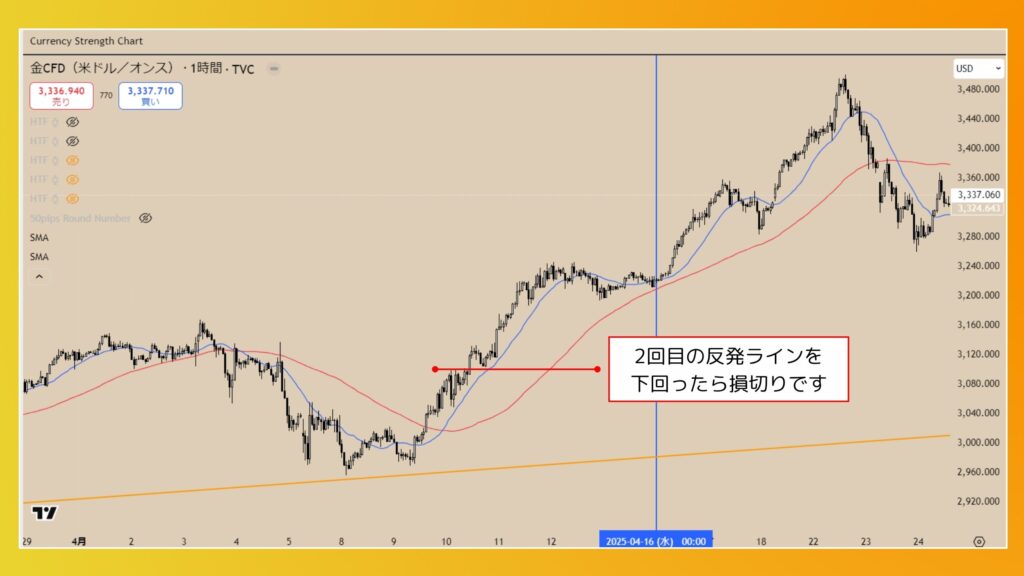
This is because, since the entry is based on the assumption of an uptrend, if the price falls below the most recent support level, it is considered that the assumption has been invalidated
Relying on the expectation that "it might go up eventually" prevents you from making rational judgments
By clearly defining your stop-loss line, you can trade without being swayed by emotions
Set a profit target
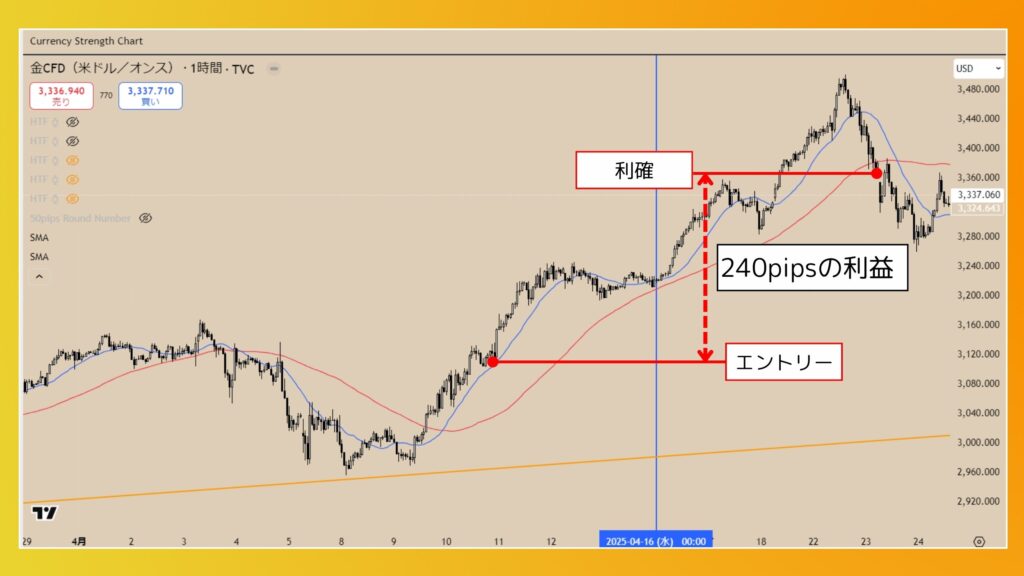
In swing trading, clearly defining profit-taking rules allows for calm decision-making that is not influenced by emotions
For this trade, taking into account the strong momentum of the trend, I adopted the rule of "take profits when the body of the candlestick falls below the 75-period Simple Moving Average (SMA)" as my profit-taking target
This is a clear signal indicating the end of an uptrend, and it is also easy to recognize visually
Another profit-taking target is直to take profits when there are signs of a rebound at the recent high. This is because highs tend to be noticed by many traders and are often points where reversals occur.
Setting a simple, visually clear target for taking profits allows for more decisive trading
The order will be an OCO order
Once you've decided on your stop-loss and take-profit points, you should generally use OCO orders
OCO orders are a convenient order type that allows you to set both profit targets and stop-loss orders at the same time
If you set it up in advance, the trade will be automatically closed when either price is reached. This is an effective way to limit risk, especially for people who cannot monitor charts during the day
However,if you've defined profit-taking as "when the candlestick body breaks below the 75-period Simple Moving Average (75SMA)," as in this case, an OCO order alone won't suffice.
In such cases,it is recommended to utilize the alert function of your charting tool.Platforms such as MT4 and TradingView allow you to set up alarm notifications when the price crosses with an SMA or reaches a certain price level.
By setting up an alert to sound when the candlestick falls below the 75-period Simple Moving Average (SMA), you can ensure you don't miss the opportunity to take profits
Even if it's difficult to decide when totake profits, it's essential to always set a stop-loss order.To prevent losses from escalating, always implement at least basic risk management.
If you want to set alerts or perform chart analysis on your smartphone, please also refer to " Comparison of Overseas Forex Brokers Compatible with MT4 " and " Ranking of Overseas Forex Brokers Compatible with MT5 "
The Ultimate FX Swing Trading Method ② | Ichimoku Cloud
Next, Ichimoku Kinko Hyo is listed as an optimal method for swing trading
The Ichimoku Kinko Hyo is a technical indicator originating in Japan, devised by Japanese market researcher Goichi Hosoda (pen name: Ichimoku Sanjin). The name Ichimoku Sanjin reflects his desire to be "a person like a sage who can see the whole picture at a glance."
The Ichimoku Cloud is characterized by its ability to visually determine the strength of a trend and turning points by combining five lines with candlestick charts.
Especially in swing trading, using powerful signals such as the "three positive lines" and "three negative lines" makes it easier to ride the major trends. This chapter will provide a clear explanation of everything from the basics to the practical applications of the Ichimoku Cloud
Basic signals to be aware of in Ichimoku Kinko Hyo
The Ichimoku Cloud is an excellent technical indicator that allows you to visually grasp market trends and turning points. In particular, it is useful in swing trading for developing medium- to long-term position strategies while reading the major trends
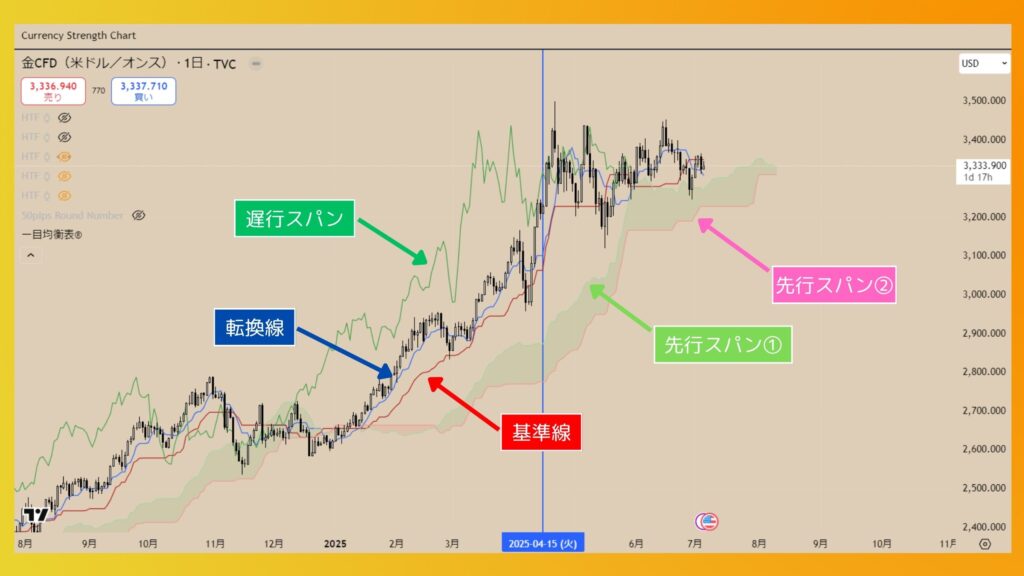
Among them, the following three basic signals are particularly important
| Signal content | meaning |
|---|---|
| Crossing of the conversion line and the base line | A golden cross is a buy signal, and a dead cross is a sell signal |
| Lagging span and candlestick crossover | Buy when the lagging span crosses above the candlestick, sell when it crosses below |
| The relationship between candlestick charts and the cloud's position | Above the cloud, the market is rising; below, it's falling; and within the cloud, the market is unstable |
These basic signals areuseful individually, but their reliability increases when multiple signals occur simultaneously.
For example, if you can make a decision based on "the crossover of the conversion line and the base line" + "the crossover of the lagging span" + "the position where the price breaks through the Ichimoku Cloud," your trading strategy will be much more robust
Let's start by correctly understanding these basic signs. You can then utilize even more powerful signals in the next steps: "Three-Line Turnaround" and "Three-Line Reversal."
Enter the market based on the strong upward signal, "Three Positive Reversals"
The strongest buy signal in the Ichimoku Cloud is the "Three Positive Reversals" pattern
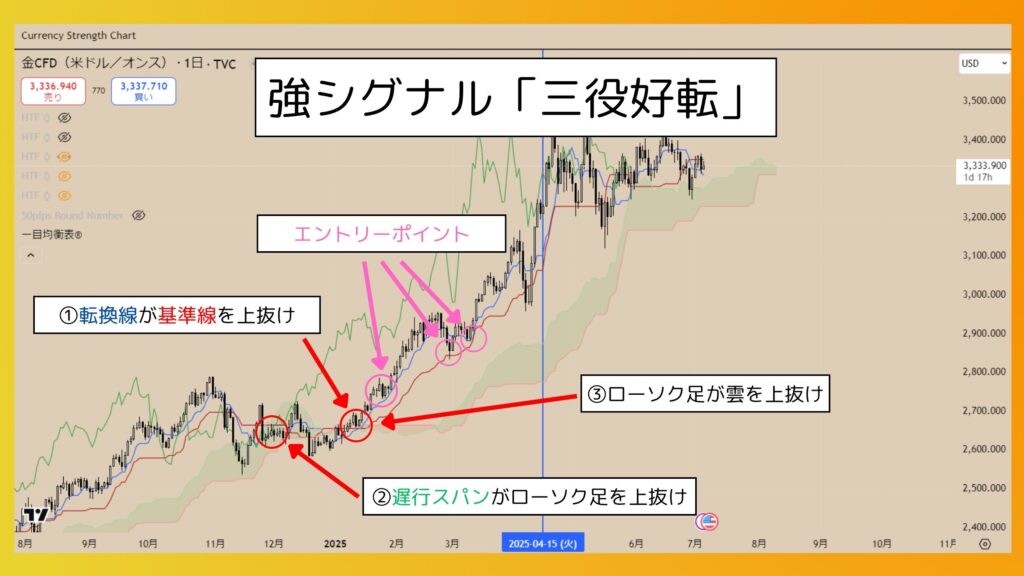
This is a state where all three elements are showing an upward trend, and it is a highly reliable signal indicating a trend reversal or the start of a full-fledged bull market. The three conditions for a three-line positive reversal are as follows:
- The conversion line crosses above the base line (golden cross)
- The lagging span has crossed above the candlestick
- The candlestick has broken above the cloud and is trading above it
If all three of these occur simultaneously or in quick succession, the likelihood of an upward trend increases
In particular, if the lagging span clearly crosses above the candlestick, followed by a golden cross between the conversion line and the base line, and finally the candlestick breaks above the cloud, this is considered the complete form of a three-line positive reversal, providing strong grounds for a buy entry
The ideal entry point is immediately after the three conditions are met, or when there is a pullback after the price breaks above the Ichimoku Cloud. In swing trading, riding these strong medium-term signals leads to improved win rates and profit margins
Enter the market based on the strong downward signal, "Three-Line Reversal."
The "Three-Line Reversal" is one of the strongest sell signals in the Ichimoku Cloud
When the conditions for a "three-line positive reversal" during an uptrend are met, the opposite conditions are present, suggesting the start of a full-fledged downtrend
The following three conditions must be met for a Sanyaku Gyakusen to occur
- The conversion line has crossed below the base line (death cross)
- The lagging span has crossed below the candlestick
- The candlestick has broken below the cloud and is trading below it
If these three conditions appear simultaneously or in quick succession, it can be concluded that the market has entered a clear downward trend
In particular, a "three-line reversal" is completed when the lagging span clearly breaks below the candlestick, the conversion line makes a death cross with the base line, and finally the candlestick breaks below the cloud
Since there may be a pullback immediately after breaking out of the cloud, one strategy is to enter the market on the subsequent decline after the rebound. In swing trading, by not missing these clear bearish signals and taking advantage of them, it is possible to aim for profits even in a declining market
Enhance timing by using it in conjunction with MACD
The "three positive lines" and "three negative lines" in the Ichimoku Cloud are highly reliable signals indicating a strong trend
However, since it takes time for the signal to be completed, there is a disadvantage in that the entry timing is slightly delayed
Therefore, to help you detect earlier signs, it is recommended to use MACD (Moving Average Convergence Divergence) in conjunction with other indicators. MACD makes it easy to visually grasp the momentum of the market and reacts to even small signs of trend reversals
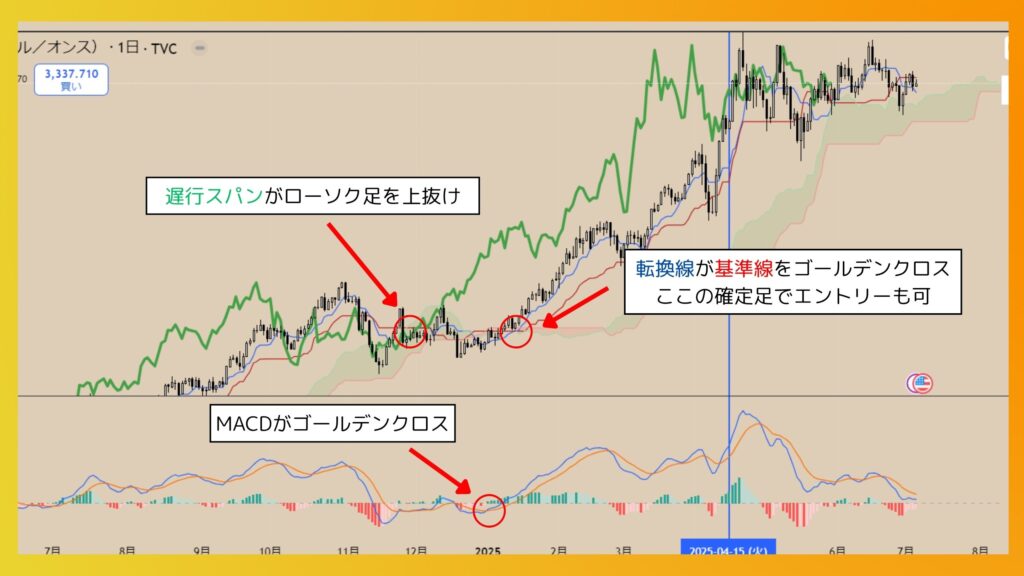
For example,if the lagging span crosses above the candlestick, or if the MACD makes a golden cross before the conversion line and base line cross, theseare very effective signals to prepare for an entry.
Furthermore,entering a buy position when all three positive indicators have been completed is also a solid option.By being aware of this pattern, you can reduce the risk of jumping in hastily and make calmer decisions.
MACD is also useful for determining profit-taking timing while a trend is continuing. For example, if a "divergence" occurs where the price is rising but the MACD is falling, it suggests the end of the trend, and it is a sign that you should consider taking profits early
MACD is a powerful indicator for swing trading, serving both as a way to "detect market trends" and "assist in taking profits."
Profit-taking targets are determined based on the Ichimoku Cloud
In swing trading, deciding where to take profits is a crucial decision
While the MACD-based profit-taking strategy mentioned earlier is also effective, in an entry strategy based on the Ichimoku Cloud's three-line bullish signal, as in this case,effective to set "the moment the candlestick enters the cloud" as one of the profit-taking targets.
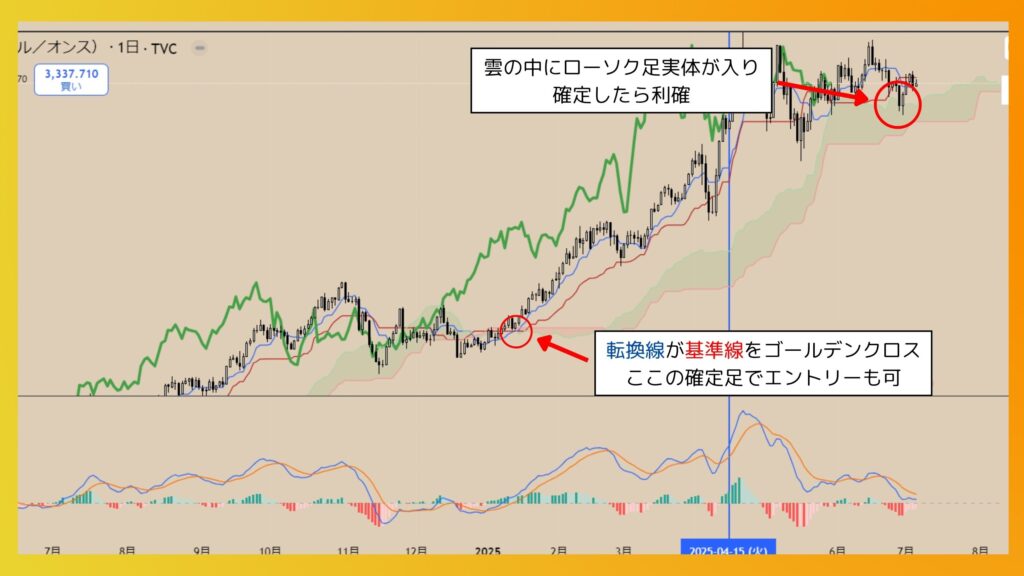
Clouds act like walls in the market, serving as support and resistance levels
Therefore, when a candlestick touches or enters the Ichimoku Cloud, it can be interpreted as a sign that the trend that had been continuing up to that point is beginning to weaken
Especially when entering a trade based on a three-line positive reversal, the upward momentum tends to slow down as the price approaches the Ichimoku Cloud, making it a very clear point to visually identify as a profit-taking target
Furthermore, paying attention to the thickness and slope of the clouds will further improve the accuracy of your judgment. Thin clouds may allow the price to break through, but thick clouds are more likely to cause a rebound, often making it an ideal time to take profits
Having clear, visual profit-taking rules like these is crucial for consistently maintaining a stable swing trading strategy, as it helps avoid being swayed by emotions
5 tips to increase your winning rate in FX swing trading
Swing trading is a trading style that aims to capture trend waves over a period of several days to several weeks
While this tends to result in larger profit margins in a single trade, it also makes it difficult to identify trends and manage risk, requiring a certain level of skill and ingenuity to consistently win
Here are five practical tips to improve your swing trading success rate. All of them are easy to incorporate into your daily trading, so try to make these simple steps a habit
| 5 tips | Content | Explanation |
|---|---|---|
| ① Choose a major currency pair | USD/JPY and EUR/USD, etc | With many participants, the chart tends to be more stable |
| ② Check the fundamentals | Check interest rates, employment statistics, etc | This makes it easier to predict long-term market trends |
| ③ Adjust position size and hold | Use split entries and profit-taking | It's easier to increase profits while keeping risks low |
| ④ Maintain a margin maintenance ratio of 250% or higher | Maintain a moderate position | This makes it easier to withstand sudden price fluctuations |
| ⑤ Analyze the background of the trend | Identify the factors through news reports, etc | It also becomes easier to predict the end of a trend |
1. Choose mainly major currency pairs
To achieve consistent results with swing trading, the basic principle is to choose "major currency pairs" as your trading targets
Major currency pairs refer to currency pairs with high global trading volume, such as USD/JPY, EUR/USD, and GBP/USD
These are suitable because they have high liquidity and their price fluctuations tend to follow a consistent rhythm. When many traders use the same charts and technical indicators as a reference for buying and selling, technical analysis becomes more effective
For example, the USD/JPY pair is the most familiar to Japanese traders, and there is a wealth of information available about it.
Because technical patterns and the impact of news are easy to read, this currency pair is recommended for beginners in swing trading
Conversely, emerging market currencies such as the Turkish lira and South African rand tend to have low liquidity and unstable prices, making them difficult to analyze and less profitable to trade
2. Check the fundamentals beforehand
The second tip is that, in addition to charts, "fundamental analysis" is also an essential element
Fundamentals refer to all economic and political factors that influence exchange rates, including economic indicators, policy interest rates, statements from key figures, and geopolitical risks
While these factors have a limited impact on short-term trading, they significantly influence charts in swing trading, which involves holding positions for several days to several weeks
For example, if the United States decides to raise interest rates, the dollar tends to be bought, and the dollar-yen exchange rate tends to rise
Furthermore,since trends may reverse or strengthen around the time economic indicators such as employment statistics, GDP, and inflation rates are released, it is important to check the release dates of key indicators in advance on the economic calendar.
Entering a trade based solely on technical analysis can lead to unexpected losses if you're trading against the major fundamental trends. Having both perspectives allows for more accurate decision-making
3. Hold the position while adjusting the position size
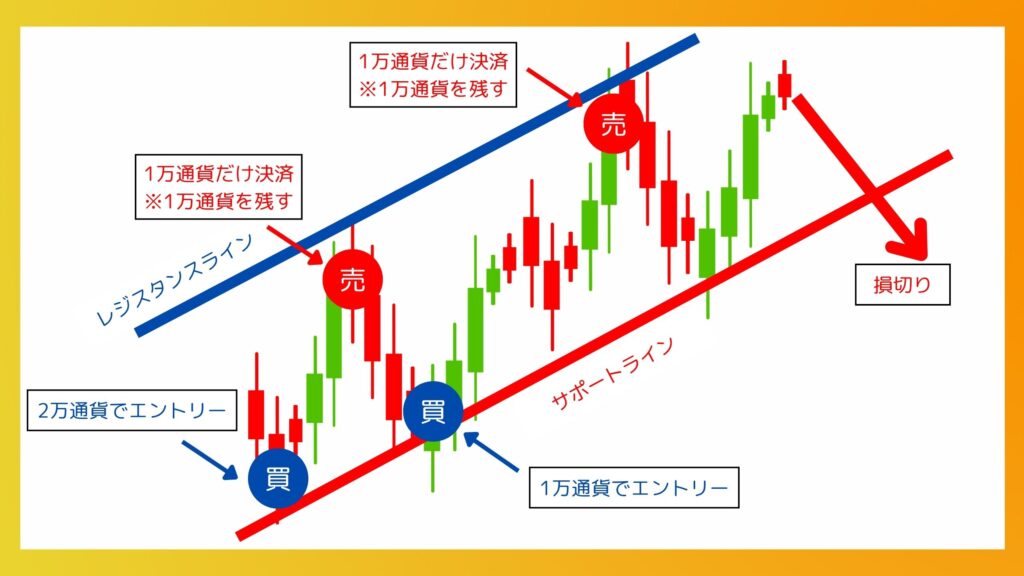
In swing trading, instead of entering and closing all trades at once, you can reduce risk and increase profits by dividing your trades into smaller segments
Specifically, effective strategies include starting with a small lot size and gradually increasing your position once the trend is confirmed, or conversely, partially taking profits and letting the rest run
For example, if you enter a trade of 20,000 units during an uptrend, you can take profits on 10,000 units once the price has risen to a certain point, and keep the remaining 10,000 units. If the trend continues, you can add more units again, allowing for flexible position management
This way, you can maximize profits if the trend continues as expected, and minimize losses if it moves against you
4. Maintain a margin maintenance ratio of at least 250%
Swing trading involves a longer period from entry to exit, which often leads to temporary unrealized losses
To avoid forced liquidation in such situations,maintaining a margin maintenance ratio of 250% or higheris the minimum standard that should be adhered to.
The margin maintenance ratio indicates the ratio of effective margin (balance + unrealized profit/loss) to required margin. If the maintenance ratio falls too low, the position will be subject to a stop-loss order
However, a more practical approach in swing trading is:Check by "how many pips of adverse movement you can withstand."Here's the method. The table below shows a guideline assuming a margin of approximately $625.00, an exchange rate of approximately $0.94 per dollar, a leverage of 1,000 times, and a stop-loss level of 20%
| Lot size (currency volume) | Profit/Loss per 1 pip | Margin maintenance ratio at the time of entry | Guideline for the amount of retrograde motion that can be tolerated | Suitability for the swing |
|---|---|---|---|---|
| 0.1 lot (10,000 units of currency) | Approximately $0.63 | Approximately 6,600% | Approximately 990 pips | ◎ Can be held comfortably |
| 0.3 lots (30,000 units of currency) | Approximately $1.88 | Approximately 2,200% | Approximately 330 pips | ◎ A level where we can wait for a pullback on the daily chart |
| 0.5 lots (50,000 units of currency) | Approximately $3.13 | Approximately 1,300% | Approximately 190 pips | ○ Somewhat cautious operation is necessary |
| 1 lot (100,000 units of currency) | Approximately $6.25 | Approximately 660% | Approximately 97 pips | △ A few days of fluctuations could put it in danger zone |
| 2 lots (200,000 units of currency) | Approximately $12.50 | Approximately 330% | Approximately 47 pips | × Insufficient resistance even with a maintenance rate exceeding 250% |
The bottom section is what we should pay attention to.Even with 2 lots, the maintenance margin at the time of entry is approximately 330%, which meets the "250% or more" standard, but the adverse movement that can be withstoodis only 47 pips.
In swing trading, where you wait for pullbacks on the daily chart,setting your lot size to withstand a reversal of at least 200-300 pipswill help you avoid the risk of being forced to close your position due to price movements within your expectations.
The higher your margin ratio, the more leeway you have to withstand market fluctuations, reducing unnecessary anxiety and stress. Creating a stable trading environment with safe lot size settings will lead to consistent profits
5. Analyze the background behind the emergence of trends
The final and most important tipto understand the background behind why a trend is occurring.
Simply buying because the chart is rising isn't enough;exploring the reasons and factors behind that movement makes it easier to determine the strength and duration of the trend.
For example, let's say the US dollar is trending downwards, and the reason behind this is "expectations of interest rate cuts due to a slowdown in the US economy." In this case, it is expected that the same trend will continue until a policy change is made at the next FOMC (Federal Open Market Committee) meeting
Thus,important to look not only at the results of news and economic indicators, but also at how the market reacts to them and how it incorporates them into its calculations.
By developing a deep understanding of the underlying context, you can achieve not just one-off trades, but consistently ride the wave of success. This, in turn, leads to a more stable win rate
Reasons why you might not be successful in FX swing trading and how to fix them

Swing trading is a trading strategy that involves holding positions for several days to several weeks while anticipating the trends in the foreign exchange market
While both technical and fundamental analysis are required, many people say they "can't win as much as they'd like" or "find it difficult."
This section explains the main reasons why you might feel you're not winning at swing trading, and provides specific solutions. Compare these points to your own trading style and identify areas for improvement
- Are we following the wrong trend?
- Are the stop-loss levels and timing appropriate?
- Are you making full use of technical analysis?
Are we following the wrong trend?
The most important thing in swing trading is "riding the trend."
Nevertheless, there are still countless cases of people taking short positions during an uptrend or long positions during a downtrend
The foreign exchange market has both "trend markets" and "range markets," butthe basic principle of swing trading is to target trend markets.
In particular, if you can capture the early stages of a trend reversal, the chances of making a large profit increase significantly. Conversely, swing trading is unsuitable in range-bound markets because the trend is not clear
To determine the direction of a trend, make it a habit to use technical indicators such as moving averages , Ichimoku Kinko Hyo , and MACD to assess market trends
Are the stop-loss levels and timing appropriate?
To minimize losses in swing trading, it is essential to clearly define your "stop-loss line" in advance
However, many peoplemake the mistake of letting their emotions get the better of them when it comes to cutting their losses, or they continue trading without setting any stop-loss orders at all, resulting in significant losses.
When setting your stop-loss level, take into account market volatility and chart patterns, and set it within a price range that limits a single loss to approximately 2-3% of your account balance
Stop-loss orders that are too short are easily shaken out by noise, while those that are too long reduce capital efficiency
Furthermore, by utilizing "stop-loss orders" that automatically cut losses, you can manage losses systematically without being swayed by emotions. Additionally,that allow you to set profit targets and stop-losses simultaneously"OCO orders", you can achieve even more balanced risk management.
Are you making full use of technical analysis?
In swing trading,identifying entry points through technical analysis is extremely important.
However,you're just "entering based on a vague feeling" or "simply referring to what influencers are saying," your chances of winning won't increase.
First, narrow down the technical indicators you use to just one or two, and make sure you can use them thoroughly
Typical analytical tools includewhich were introduced in the previous section,the moving average,Ichimoku Kinko Hyo, and MACD,as well as RSI and Bollinger Bands.
Furthermore, it is important to conduct transactions in a cycle of "plan → analyze → execute → review."
By reviewing and correcting discrepancies between your analysis and the results, you can achieve continuous growth and stable profits
Frequently Asked Questions about Swing Trading

Many people are interested in swing trading, but have questions such as, "What timeframe should I look at?", "Can I really make money?", and "Can beginners do it?". Here, we will explain by answering these frequently asked questions
What timeframe should I use for swing trading?
This article explains how to identify trends using the daily chart and enter trades using the 1-hour chart
This combination of timeframes is easy for even beginners in swing trading to implement and is used by many traders. It's characterized by its ability to improve entry accuracy by confirming the overall trend and direction on the daily chart and identifying opportunities for buying on dips or selling on rallies on the hourly chart
While using a daily chart plus a 4-hour chart is sometimes considered the standard approach,using a 1-hour chart allows you to react to more subtle changes. To find the timeframe that suits you best, it's important to experiment and test different options.
How should I determine the right time to close a swing trade?
In swing trading, where you take profits and cut losses significantly impacts your results.The basic principle is to decide on your profit target and stop-loss line before entering a trade.
This article also provides a detailed explanation of trading methods using the Ichimoku Cloud and moving averages , so please check it out
For example, it's important to have clear decision-making criteria using technical indicators" , such as "take profits when the candlestick enters the Ichimoku Cloud" or "cut losses when the candlestick clearly breaks below the moving average.
The key to achieving consistent results in swing trading is to follow predetermined exit rules rather than making decisions based on emotions
Are there any currency pairs you would recommend for swing trading?
In swing trading, the key is to choose currency pairs with straightforward price movements and high liquidity
This article focuses on USD/JPY, EUR/USD, and GBP/USD . These pairs have high trading volumes and are well-suited for swing trading because technical analysis is effective
The USD/JPY pair, in particular, is a representative currency pair that is easy for Japanese traders to handle, even beginners , as there is plenty of information available about it
Conversely, emerging market currencies such as the Turkish lira and South African rand have wide spreads and are prone to wild fluctuations due to sudden news, making them less suitable for swing trading
Can beginners do swing trading?
Swing trading is a method that even beginners can try. However, it's essential to first grasp the basics and not aim for huge profits right away.
Unlike day trading, you don't need to constantly monitor charts all day,making it ideal for people who are busy with work or school.
However, since you will be able to withstand unrealized losses for a longer period,important to thoroughly manage your funds and adhere to stop-loss rules. Be careful, as delaying stop-losses carries the risk of a sudden decrease in your capital.
Which is more likely to generate profits: swing trading or day trading?
Which approach is more suitable depends largely on the trader's personality and lifestyle
Swing trading is characterized by its large profit margins per trade, allowing traders to aim for significant profits with fewer trades. It is suitable for busy people or those who cannot constantly monitor the market, and it also involves relatively less mental stress
On the other hand, day trading involves buying and selling many times in a short period of time, so quick judgment and experience are necessary. The appeal lies in being able to accumulate profits in a single day while glued to the charts, but it also comes with a great deal of stress and effort
If you're unsure,it's a good idea to start with swing trading, and once you're comfortable, try day trading.
How long do you typically hold a swing trading position?
Generally, a few days to a few weeks is a good guideline. Rather than setting a time limit such as "closing the position in X days," the basic idea is to hold the position until the basis for your entry becomes invalid
With the method described in this article, the holding period ends when "the body of the candlestick breaks below the 75-period Simple Moving Average (SMA)" or "the candlestick enters the Ichimoku Cloud." As a result, it can end in 3 days or last for 3 weeks
Furthermore, since the longer you hold a position, the more you will be affected by swap points, be mindful of the holding costs when dealing with currency pairs that have negative swap points
How much capital is needed to start swing trading?
With overseas forex brokers, you can open an account and start trading with as little as a few thousand yen to approximately $62.50, butif you want to manage your investments comfortably with swing trading, approximately $625.00is a good guideline.
The reason is that,calculated above, to withstand price fluctuations of several days to several weeks, you need the capacity to withstand adverse movements of around 200 to 300 pips. The less capital you have, the smaller your lot size will be, and the smaller your profits will be.
If you're starting with a small amount, you can also increase your margin by taking advantage of account opening bonuses and deposit bonuses
Summary | FX swing trading is a method that is easy to replicate, especially for busy people
Swing trading in overseas forexan efficient trading method that allows even those with limited time to aim for profits. Since it doesn't require constantly monitoring the market, it's also suitable for those who want to balance trading with work.
This article explains everything from the basics of swing trading to tips for increasing your win rate and specific trading methods, all illustrated with actual chart images
In particular, technical analysis methods such as "trend following" and "Ichimoku Kinko Hyo" are easy for beginners to replicate and offer the potential for long-term profits
To deal with unrealized losses and indecision about entry points, be sure to manage your margin maintenance ratio and stop-loss settings.Consistency and strict adherence to rules are the shortest path to stable profits.
Furthermore, when you actually start trading, you can lower your effective trading costs by opening an account through the cashback site "Money Charger (Manecha)" and having a portion of the spread refunded