













Using bonuses from overseas forex brokers for hedging (bonus arbitrage) is prohibited by the terms and conditions of almost all brokers and will almost certainly be detected. It willbe detected through MT4/MT5 trading data, information sharing between brokers, and unnatural position patterns, andif discovered, itwill result in profit confiscation, withdrawal refusal, and account freezing.
This article provides a detailed explanation of the bonus hedging strategy, why it's prohibited, how it gets detected, and common violation patterns. By the time you finish reading, you'll not only be able to decide whether or not to use it, but you'll also have a clearer understanding of the criteria for choosing a safe trading strategy for yourself
Conclusion | Key points of bonus hedging
- Using bonuses for hedging is a violation of the terms of service: It's prohibited by almost all brokers for trading across multiple accounts or different brokers. "It's not illegal, but penalties are certain."
- Almost certainly detected: It can be detected through transaction data, information sharing between brokers, and KYC information, and profits may be confiscated retroactively.
- Hedging within the same account is permitted by some brokers: Many brokers recognize it as a legitimate hedging strategy (provided you use your own funds and check the terms and conditions).
You don't need to rely on any tricks; you can receive cash back with every trade by using cashback programs . The latest bonus information is updated monthly in our " Recommended Account Opening Bonus Ranking " and " Recommended Broker Ranking for Deposit Bonuses ."
*This article was created and updated by the MoneyCharger editorial team in accordance with their content creation policy . Information regarding the permissibility and prohibition of hedging was confirmed on each company's official website (terms of service and FAQ), and also based on publicly available information from government agencies such as the Financial Services Agency and the Consumer Affairs Agency . Terms and conditions may change, so please be sure to check the latest terms and conditions of each company before trading.
Is it okay if you don't get caught? What is hedging with overseas forex bonuses?

In overseas forex trading, "hedging," which utilizes account opening bonuses and deposit bonuses, is attracting attention from some traders. This method aims to limit risk while profiting from bonuses by simultaneously holding buy and sell positions, buthedging involving bonuses is prohibited in most cases.
This section will explain the basic mechanism of hedging, including what it is in the first place and how it is used in conjunction with bonuses
Hedging is a trading strategy that involves simultaneously holding both buy and sell positions
In forex trading, hedginga technique where you simultaneously hold both a "buy" and a "sell" position in the same currency pair. For example, if you enter a buy position in USD/JPY, it's a "buy position," and if you enter a sell position, it's a "sell position."
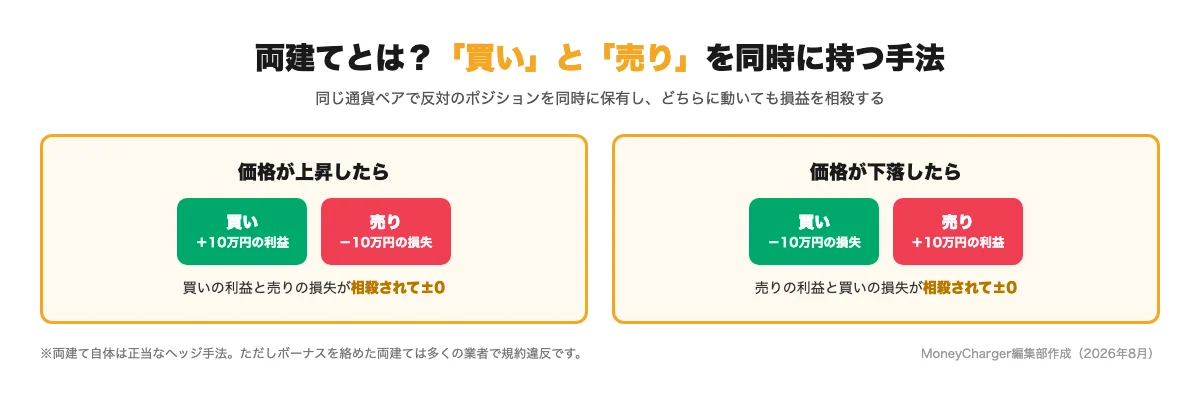
When you use a hedging strategy, you will incur both profits and losses regardless of which way the price moves. If the price rises, buying will result in profits and selling will result in losses; if the price falls, the opposite will happen. In other words, hedgingfix risk in range-bound markets where the direction is unclear or during sharp rises and falls, and it is a legitimate strategy in itself.
On the other hand, when the market shows a clear direction, you need to be careful because mistiming your settlement can lead to both profits and losses increasing unilaterally
How to specifically use the bonus hedging strategy
Bonus hedging is a trading strategy that uses "bonus credits" provided by FX brokers to extract profits while minimizing the risk to one's own capital. It is typically executed in the following steps
- I opened an account with company A and received a bonus
- Company A holds a long position as a bonus
- I also opened an account with Company B and received a bonus
- Company B holds a short position as a bonus
- Market movements can result in losses for one party and profits for the other
- Losses are handled through zero-cut or bonus forfeiture, and only profits are withdrawn
Thus, in theory, a "one-sided structure" is possible where losses are covered by bonuses while only profits are reappointed. However,hedging using bonuses across multiple accounts or different brokersis explicitly prohibited in the terms and conditions of many overseas forex brokers. If discovered, it can result in serious penalties such as profit forfeiture, withdrawal refusal, and account freezing.
For general rules and techniques regarding hedging, please also see " Is Hedging a Surefire Winning Strategy in Overseas Forex Trading? Explanation of Mechanisms and Prohibited Practices ."
The mechanism by which bonus hedging generates profits
The reason why profits are made through bonus hedging is that losses are shifted onto the broker's funds (=bonus), allowing the trader to reap the profits without bearing any risk themselves. For example, if you buy with company A (bonus only) and sell with company B (bonus only), and the market falls, company A's bonus disappears (your own funds remain intact), while company B retains its profits
noted that the ability to trade using only bonus fundsbonuses with a cushioning function. However, this function is originally intended to support "continuing to trade while enduring losses," and is not intended to be used as a means to shift losses onto others.
Bonuses are a system designed to support new users' trading. Methods that allow one to profit without risk are considered clear abuse, and many brokers prohibit "hedging between different brokers by the same person" and "intentional profit/loss separation through multiple accounts."
Is hedging with bonuses essentially arbitrage? An explanation of the boundaries of illegality and terms of service violations

Using bonuses to hedge positions might appear to outsiders as a form of "risk-free arbitrage." However, unlike genuine arbitrage that exploits market inefficiencies, it almost always involves abusing the bonus system of the FX broker itself
Is a bonus hedging strategy equivalent to bonus arbitrage?
Bonus hedging is also called "bonus arbitrage" because it eliminates risk through a structure where "losses are covered by bonuses and profits are withdrawn ." However, it is fundamentally different from true arbitrage, which utilizes price differences between markets, and is a tactic that uses the broker's system (i.e., bonuses).
| FX brokers | Funding type | position | result |
|---|---|---|---|
| Company A | Bonus only | Buy | Loss → Bonus disappears (personal funds remain unscathed) |
| Company B | Bonus only | Sell | Profits → Withdrawable (Profits with no risk) |
While it may seem efficient because it allows you to take profits without risking any of your own funds, this is an unintended use of the service provider andis almost always explicitly prohibited as a violation of their terms and conditions. On the surface, it may appear to be arbitrage, but in reality, it is considered an abuse of bonuses.
For more information on arbitrage in general, please see " Is Arbitrage Profitable? Explanation of Methods and Prohibited Practices ."
It's not illegal, but it could violate the terms of service
From a legal standpoint, the act of hedging with bonuses in overseas forex trading is not itself an illegal act that is punishable. However, the issue iswhether or not it violates the "terms of service" of each forex broker. Many brokers explicitly state the following as prohibited actions:
- Hedging across multiple accounts by the same person
- Intentional position manipulation between different companies
- Trading aimed at avoiding losses by utilizing bonuses and zero-cut features
| Violation details | Anticipated penalties |
|---|---|
| Hedging in violation of the terms of service | Trading restrictions, bonus revocation |
| Intentional bonus arbitrage | Account frozen, withdrawal refused, all profits confiscated |
Even if it's a legal gray area, if it constitutes a "breach of contract" from the business's perspective, penalties will definitely be imposed
Reasons why overseas forex brokers prohibit hedging using bonuses

There are three main reasons why brokers strictly crack down on bonus hedging:
Because there is a method that allows you to make a profit risk-free using only bonuses
What brokers are most concerned about is the creation of a structure where they can "take profits with no risk." When a user sets up hedging strategies with multiple accounts without using their own funds, losses on one account are handled through zero-cut or bonus elimination, and only the profits from the other account are withdrawn.If the user loses, the broker bears the loss; if the user wins, the broker takes the profits—it's a situation where the broker loses unilaterally.
Taking advantage of promotions can undermine the credibility of the bonus system itself, so many brokers explicitly state that "hedging solely with bonuses" is prohibited
Because the broker does not incur any spread or commission revenue
FX brokers' revenue sources are spreads and commissions. However, in zero-sum trades like bonus hedging, funds flow out while the actual trading volume is small. Positions opened with bonuses do not directly contribute to spread revenue, resulting in a structure where "only operating costs remain" for the broker. Because there is a risk of repeated trades that do not generate profits and unilaterally cause losses, regulations have become stricter
This makes it possible to artificially determine profits and losses by using other brokers and multiple accounts
By using multiple FX brokers and multiple accounts to implement hedging strategies, it becomes possible to control profits and losses by "concentrating losses on broker A and profits on broker B." The broker that is burdened with the losses receives no return whatsoever, only having to compensate for the losses, and is left with an unnatural settlement history
If such practices become widespread, it could ultimately lead to the abolition or restriction of the bonus system itself . The company is particularly sensitive to fraudulent activities involving the use of cross-accounts between brokers and has implemented countermeasures such as detection systems and strengthened regulations.
| reason | Risks for businesses |
|---|---|
| Profit secured with bonuses only | This creates a structure where businesses are the only ones who suffer losses |
| No spread or fees are charged | Only the cost burden remains, and it cannot be made profitable |
| Intentional separation of profit and loss | Unnatural transaction histories and losses are concentrated among the brokers |
Is account freezing just a matter of time? Hedging with bonuses is almost certainly going to be discovered

The idea that "it's okay if I only do it a few times" or "it should look natural if it's a small amount" is dangerous. Modern overseas forex brokerssystems in place to detect fraud with high accuracy by using a combination of automated trading monitoring and manual review. There are mainly three ways in which fraud can be detected:
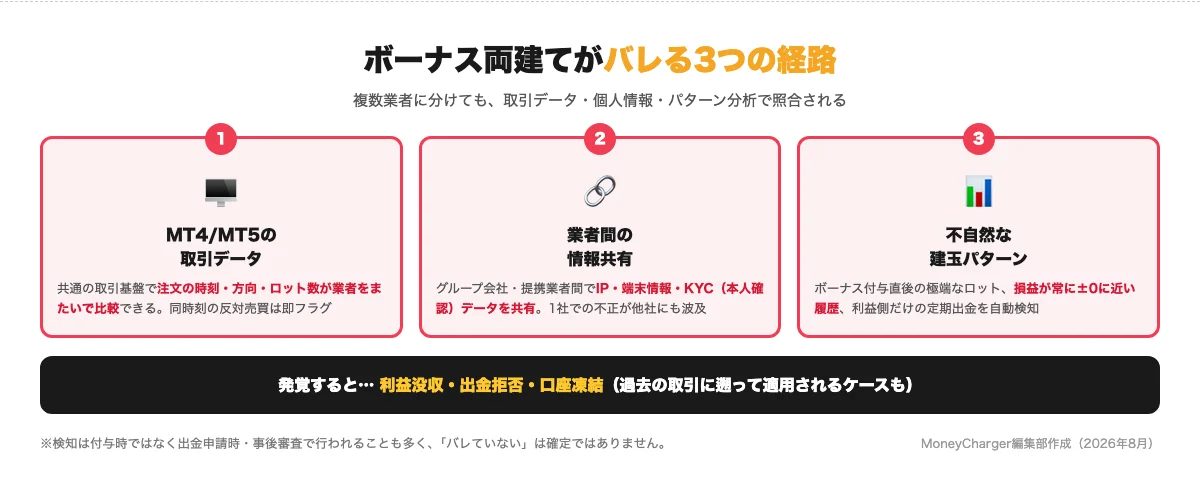
The trading platform is the same, such as MT4 or MT5
Many overseas forex brokers use MT4/MT5 and often utilize common trading engines and server providers,it possible to compare order timing, direction, and volume across different brokers. The following patterns, in particular, should be viewed with caution.
- Multiple dealers simultaneously engage in offsetting trades of the same lot size
- Log in to multiple MT4/MT5 accounts consecutively from the same device
- The settlement timings are almost identical, and the transaction history intentionally separates profits and losses
This kind of history will surface in the broker's backend as a signal of "arbitrage motives" or "abuse of the system." Even if you use multiple brokers, it's only a matter of time before the system detects it
Information sharing among overseas forex brokers
One often overlooked aspect is the information sharing system between vendors. Between different brands within the same group, or between vendors using the same system provider, data such as IP addresses, terminal information, transaction patterns, and Know Your Customer (KYC) information may be shared
Once something is deemed fraudulent, there's a risk of a chain reaction of consequences, such as withdrawal refusal at broker A and account opening refusal at broker B. This verification mechanism is also the reason why you might not receive the second account opening bonus
Unnatural position opening patterns
The broker's detection system can identify "mechanical and unnatural trading patterns" with high accuracy. The following types of transactions are particularly risky:
- Immediately after bonus is awarded, a single position is opened with an extremely large lot size
- Holding the opposite position in a separate account at the same time
- The profit/loss is consistently close to ±0, with settlements occurring every few minutes
- Losses are always cut off, and only profits are withdrawn periodically
Once suspicion arises, the internal review department will begin a thorough re-examination of your entire transaction history, and there is a high possibility that you will be excluded from future transactions and bonus eligibility
Violations of the terms and conditions will result in penalties such as account suspension
Here is a table summarizing the penalties that can be imposed if bonus hedging is discovered
| Types of violations | Main penalties |
|---|---|
| Bonus arbitrage using multiple accounts or different brokers | Profits will be forfeited, withdrawals will be refused, and the account will be frozen (including all past transactions) |
| Unnatural position patterns (e.g., opposite positions at the same time) | Bonus forfeiture, forced liquidation of all positions, permanent account suspension |
| Multiple account usage on the same IP address and device | All accounts frozen, withdrawals impossible, blacklisted |
| Accumulation of terms of service violation history | Re-examination of the entire transaction history and retroactive application of penalties |
| Re-registration after account suspension history | Refusal to verify identity, refusal to open accounts across all affiliated brands |
It is especially important to note that profit confiscation and withdrawal refusal can occur retroactively . If you continue trading thinking, "I made a profit this time, so it's okay," you could end up losing everything, as several months' worth of trading history could be suddenly canceled. For more details, please also see " Reasons for Withdrawal Refusal in Overseas Forex Trading and How to Deal with Them ."
Just like using separate accounts within the same broker, using bonus hedging between different brokers is also a violation of the terms and conditions
The idea that "Company A and Company B are different companies, so we can hedge without getting caught" is no longer valid. Many brokers prohibit "trading that intentionally separates profits and losses" and clearly state this in their terms of service
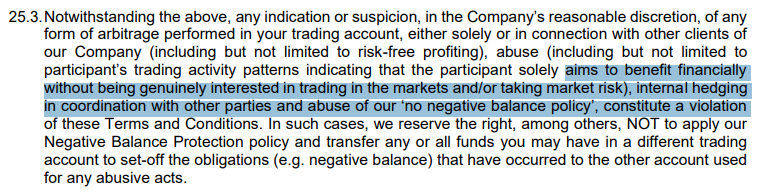
Even if it's a different company, a structure that allocates bonuses to the losing side and only extracts profits is a clear violation. In recent years, ittechnically possible to link trading histories across multiple brokersand there has been an increase in cases where "it seemed OK according to the terms and conditions, but penalties were imposed." In reality, you should consider bonus hedging to be dangerous regardless of which broker you use.
Common violation patterns and risks of bonus hedging

Here, we'll outline common violation patterns and the risks involved. By understanding real-world problems such as "losing all your money instead of making it" or "having your account frozen due to overlooking the terms and conditions," you can make informed decisions to avoid making the same mistakes
The risk of losing profits due to a stop-loss before withdrawal
The bonus hedging strategy is designed to "absorb losses with bonuses and withdraw only profits," but market fluctuations can disrupt this assumption. For example, even if company A is stopped out and company B makes a profit,withdrawals may not be possible if company B's withdrawal conditions (such as trading lot size) are not met.
In this case, only the loss is confirmed, and the bonus disappears without any profit being realized, resulting in a double loss. As explained in " How to Use Overseas FX Bonuses and Tips to Prevent Them from Expiring," it is essential to check the bonus withdrawal conditions and expiration conditions in advance
Multiple accounts were discovered, and all accounts were frozen
Using multiple accounts with the idea that "it won't be discovered if I use a different name" or "it's okay if I use a family member's name" is subject to severe penalties. Brokers identify individuals by matching IP addresses, device identification information, submitted documents, and login history,making it relatively easy to detect multiple accounts or accounts using borrowed names belonging to the same person. If discovered, all accounts involved will be frozen, and past profits will be confiscated. You may also be refused access to accounts with related brokers.
| Violation patterns | Specific risks |
|---|---|
| Transactions and applications without checking withdrawal conditions | Even if you make a profit, you can't withdraw it, and the profit and bonus disappear |
| The profit and loss balance of both accounts was miscalculated, resulting in a stop-loss | Only the losses on one side have been confirmed, and the withdrawal conditions for the profits have not been met |
| Hedging using family members' names or multiple accounts | All accounts frozen, profits confiscated, blacklisted |
The bonus hedging strategy carries far more risks than potential profits, and in reality, it's safe to say it's a method that "almost certainly fails." Don't be fooled by short-term gains; the best option is to avoid it from the start
[Overseas Forex] Frequently Asked Questions about Hedging with Bonuses

This section answers frequently asked questions from readers regarding bonus hedging in a Q&A format. Please review this information to avoid situations where you unknowingly violate the rules
Q. What is bonus arbitrage?
This is a common term for a trading method where bonus credits are used to take opposing positions across multiple brokers and accounts, shifting losses onto the bonus and withdrawing only the profits. Unlike genuine arbitrage (a trading strategy that takes advantage of price differences between markets), this is considered an abuse of the broker's bonus system and is prohibited in the terms and conditions of almost all overseas forex brokers
Q. Is it okay to use a hedging strategy if I don't use my bonus?
Using only your own funds and hedging within the same account is generally accepted as a legitimate hedging strategy by many overseas forex brokers. However, trading that is considered an abuse of the zero-cut system or involves separate accounts or bonuses may be a violation. Checking the terms of service beforehand is essential
Q. Which brokers allow hedging within the same account?
Hedging within the same account is generally permitted by most brokers. The following is a breakdown of whether major brokers allow it (as of August 2026; please check each company's official terms and conditions)
| Company name | Within the same account | Multiple accounts / Interbank transactions |
|---|---|---|
| XMTrading | OK | ✕ Prohibited (including organized hedging) |
| Exness | 〇 OK (Full hedging requires 0% margin) | △ There is no ban on naming specific individuals, but the purpose of abusing the zero-cut bonus is prohibited |
| Titan FX | OK | △ Attempting to achieve zero payouts, etc., are not eligible for zero payout compensation |
| AXIORY | 〇 OK (cTrader does not require margin offsetting) | - Not officially listed (inquire before use) |
It's important to note that even if a broker allows hedging,it can violate their terms and conditions if it involves other accounts or bonuses. We recommend checking each company's terms of service and contacting their support before trading.
Q. Will I get away with it if I only do it once?
Even a single suspicious transaction can trigger a flag. Transaction history, IP address, and trading environment are all recorded, and those who "got away with it" are simply lucky not to have received a penalty. It's common for brokers to take action retroactively
Q. What are the specific penalties for violating the terms of service?
While there are differences between brokers, common consequences include profit confiscation, withdrawal refusal, and account freezing. Manipulating profits and losses across different brokers or multiple accounts can result in the freezing of the entire account, a thorough review of all transaction history, and even blacklisting. Not only will you gain nothing in the end, even if you make a profit, but you will also lose credibility
Summary: It's best not to use bonus hedging. The way to make money is through legitimate methods and cashback
While using bonus arbitrage in overseas forex trading may seem like a "risk-free trick," in reality, it's considered a violation of the terms and conditions by many brokers andcarries heavy penalties such as profit forfeiture, withdrawal refusal, and account freezing.
| What is hedging? | A trading strategy that involves simultaneously holding both buy and sell positions |
| The purpose of hedging with bonuses | A system that absorbs losses with bonuses and generates risk-free profits in the opposite account |
| Treatment under the terms and conditions | Many companies have banned it, citing "abuse of the system." |
| How it gets exposed | Commonality between MT4/MT5, information sharing between brokers, unnatural position patterns |
| Main risks | Profit confiscation, withdrawal refusal, account freezing, all accounts suspended |
| conclusion | The risks and penalties are significant, so we do not recommend using bonus hedging |
Even if you achieve temporary success, brokers often retroactively cancel profits and freeze accounts, making this a method with a very high probability of ultimately resulting in losses.Aiming for long-term profits through legitimate trading methods that adhere to the terms and conditions is ultimately the most sound strategy.
If you want to recoup some of your trading costs, a cashback site is the legitimate solution, rather than using any loopholes. These sites offer a cashback system where a portion of the spread is returned to you in cash with every trade, with zero risk of violating terms and conditions . They can also be used in conjunction with bonuses. For the latest bonus information, please check our " Recommended Account Opening Bonus Ranking " and " Recommended Deposit Bonus Broker Ranking ."
\ Zero risk of violating terms and conditions - Cash back with every transaction /